Clear Sky Science · en
Diffusion-based restoration of corroded bronzeware images under a minimal-intervention framework: spatial-compliance indices and over-restoration risk diagnostics
Why Old Bronze Photos Still Matter Today
Photographs of ancient bronze vessels do more than show beautiful objects; they quietly record how each piece has aged underground and in museum storage. Corrosion spots, flaking surfaces, and multicolored patina are not just blemishes to be cleaned away on a screen. They are physical clues about history. This study asks how modern artificial intelligence (AI) tools for image repair can be used to tidy up damaged bronzeware photos without accidentally rewriting those clues and creating a misleading picture of the past.
Fixing Pictures Without Erasing the Past
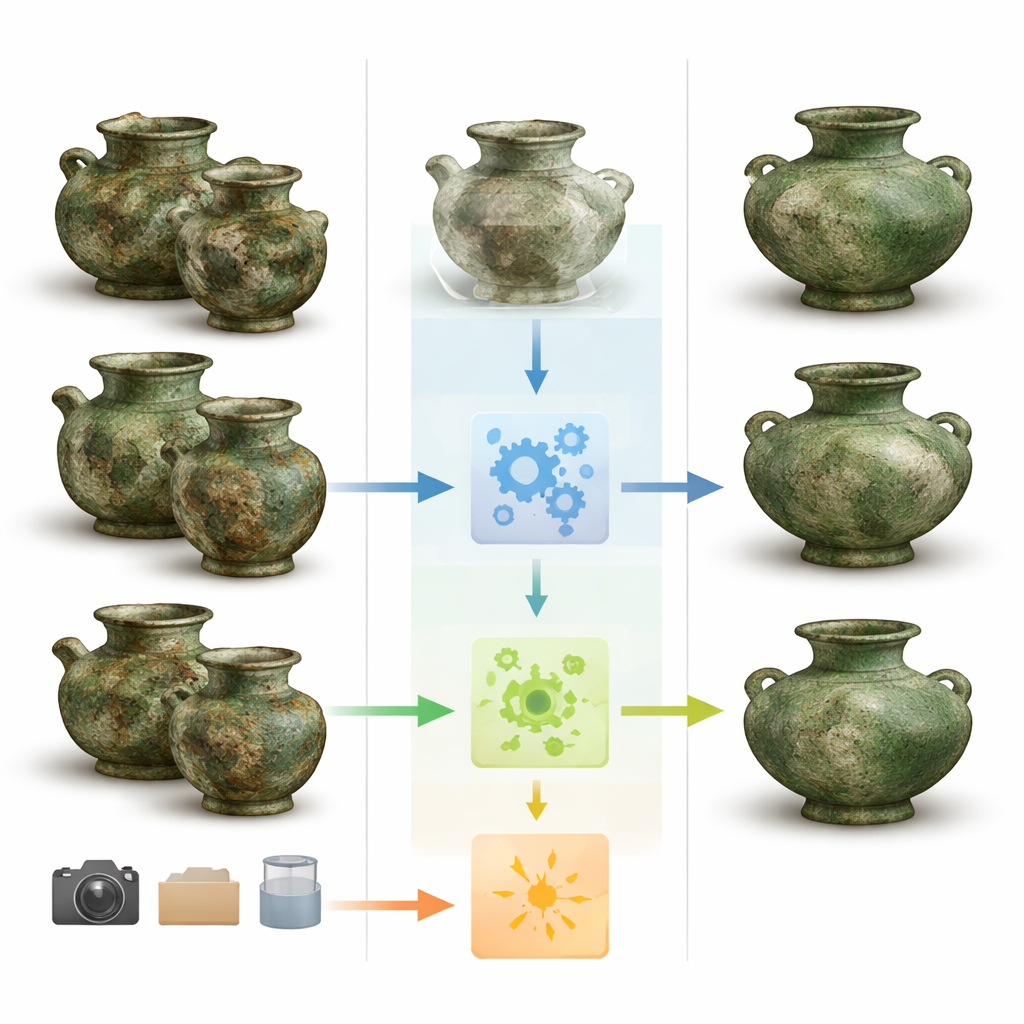
Museums and archaeologists rely on archival photos of bronzeware for research, cataloging, and sharing collections. Many of these images are damaged: parts are missing, scratched, or covered by later stains. In everyday image editing, software is free to "beautify" such flaws. But for cultural heritage, corrosion crusts and patchy patina are evidence, not noise. The authors frame digital restoration as a "minimal intervention" problem: change only what must be changed to make the photo readable, and leave authentic surface traces alone. This makes restoration not just a question of visual appeal, but of honesty and trustworthiness.
Three AI Tools Put to the Test
The study compares three leading AI approaches that can fill in missing parts of images. LaMa represents a fast, conventional neural network that completes holes in pictures in a single pass. Stable Diffusion Inpainting and ControlNet Inpainting are newer "diffusion" models that gradually refine images and are known for producing rich, realistic details. All three were asked to repair photos of excavated bronzeware from the ancient Gumei Kingdom, using exactly the same inputs and carefully prepared damage masks that mark where content is truly missing.
A Clever Way to Measure Helpful Versus Harmful Changes
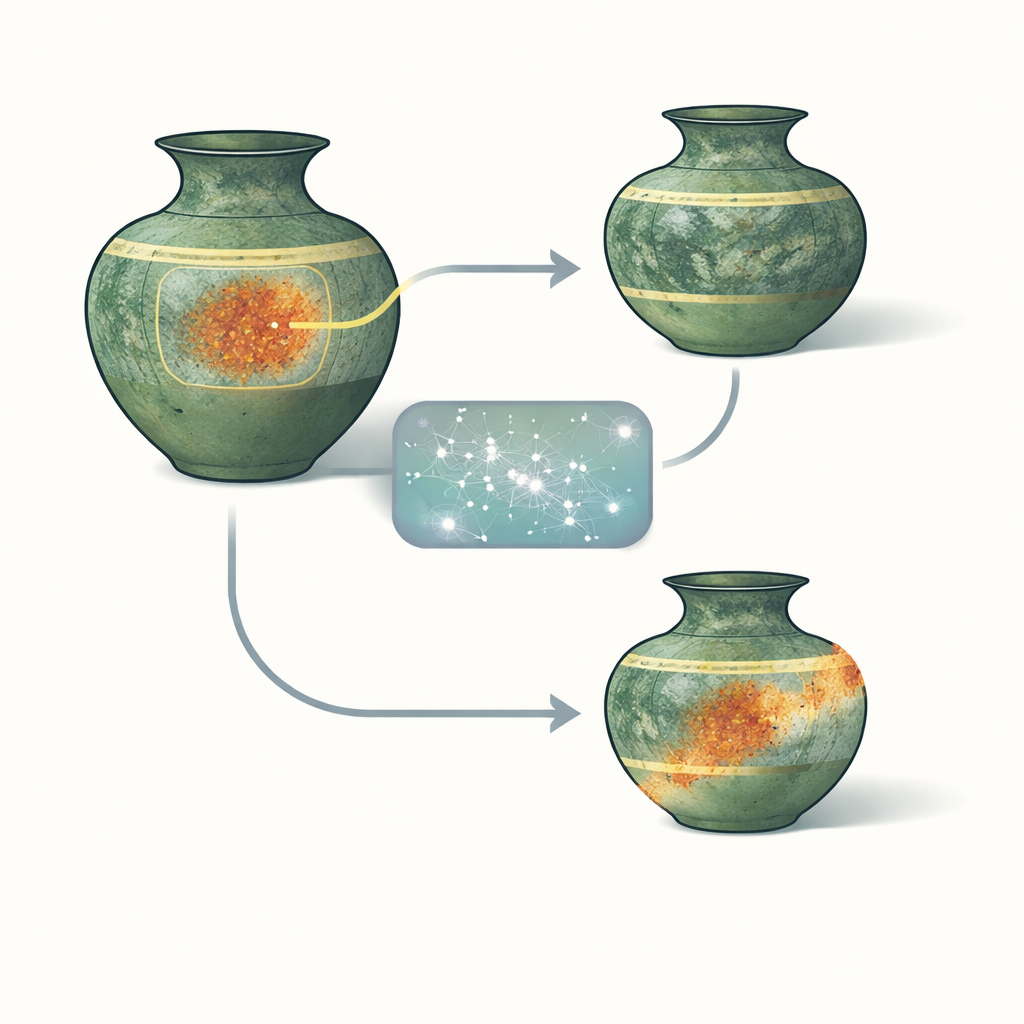
Evaluating restoration is tricky because there is rarely a perfect "after" photo of a damaged artifact. The authors therefore designed two complementary tests. First, for relatively intact images, they artificially blanked out regions and asked each method to reconstruct them. Here, they could compare the results to the original and compute standard image-quality scores. Second, for genuinely damaged archival photos, where no ground truth exists, they shifted focus from "How good does it look?" to "Where did the algorithm actually change the image?" They divided each photo into three zones: the masked damage that should be altered, a narrow tolerance band just outside this area where some transition is acceptable, and the untouched rest of the surface where changes are risky.
Finding and Mapping Over-Restoration Risk
For the real damage cases, the team measured how often each method made strong changes inside the mask, in the boundary band, and farther away on supposedly intact surfaces. They visualized these changes as heatmaps, showing where new pixels appeared or colors shifted. They then invited three experts in conservation and archaeology to judge, blind to the method, which results felt most authentic and whether the level of intervention was acceptable. All three AI systems could plausibly reconstruct missing patterns and shapes, and diffusion models often produced more visually impressive textures. But they were also more likely to subtly smooth or repaint corrosion and patina outside the damaged region, raising the danger of an attractive but misleading "false reality."
What the Study Teaches Conservators and Technologists
The authors found that LaMa, despite being simpler, repaired missing areas about as effectively as the diffusion models while causing far fewer unwanted changes beyond the mask. Stable Diffusion and ControlNet delivered sharper, more coherent fills but showed higher rates of spillover into original surface regions, especially in corrosion-rich areas that matter most as evidence. Experts judged most outputs from all methods as useful draft material for discussion and teaching, but not suitable as final, stand-alone surrogates for the real artifacts. The study concludes that powerful generative tools must be paired with strict, transparent checks on where they intervene. By turning the conservation ideal of "minimal intervention" into measurable spatial indices and visual risk maps, the authors offer museums and researchers a practical way to harness AI restoration while still safeguarding authenticity.
Citation: Sui, Q., Shou, W. & Yang, H. Diffusion-based restoration of corroded bronzeware images under a minimal-intervention framework: spatial-compliance indices and over-restoration risk diagnostics. npj Herit. Sci. 14, 259 (2026). https://doi.org/10.1038/s40494-026-02539-y
Keywords: digital restoration, cultural heritage imaging, bronze artifacts, image inpainting, minimal intervention