Clear Sky Science · en
A CityGML ADE for modeling ancient chinese timber architecture in 3D with semantic information
Why old wooden temples need new digital tools
Across China, centuries‑old wooden halls and temples still stand, their layered roofs and intricate brackets surviving earthquakes, wars, and weather. Yet these masterpieces are fragile, and preserving them now depends on more than carpentry alone. This study presents a new way to describe such buildings in three dimensions so that computers can understand not just what they look like, but what each part is and how it all fits together, laying the groundwork for smarter conservation and research.
Turning ancient craft into digital building blocks
Traditional Chinese timber architecture follows an orderly logic: a raised base, a timber frame of columns and beams, enclosing walls and doors, and a complex roof. Special wooden brackets called dougong and mortise–tenon joints allow buildings to flex during earthquakes while carrying heavy tiled roofs. The authors argue that to truly safeguard this heritage, digital models must capture this hierarchy and vocabulary, not just the outer form. Existing 3D models and even many heritage‑oriented building information models often record shapes very precisely but blur or ignore the traditional categories that craftspeople use, making it hard to ask questions such as which elements belong to the roof layer or how a specific bracket set relates to nearby columns.
Adding meaning to 3D city models
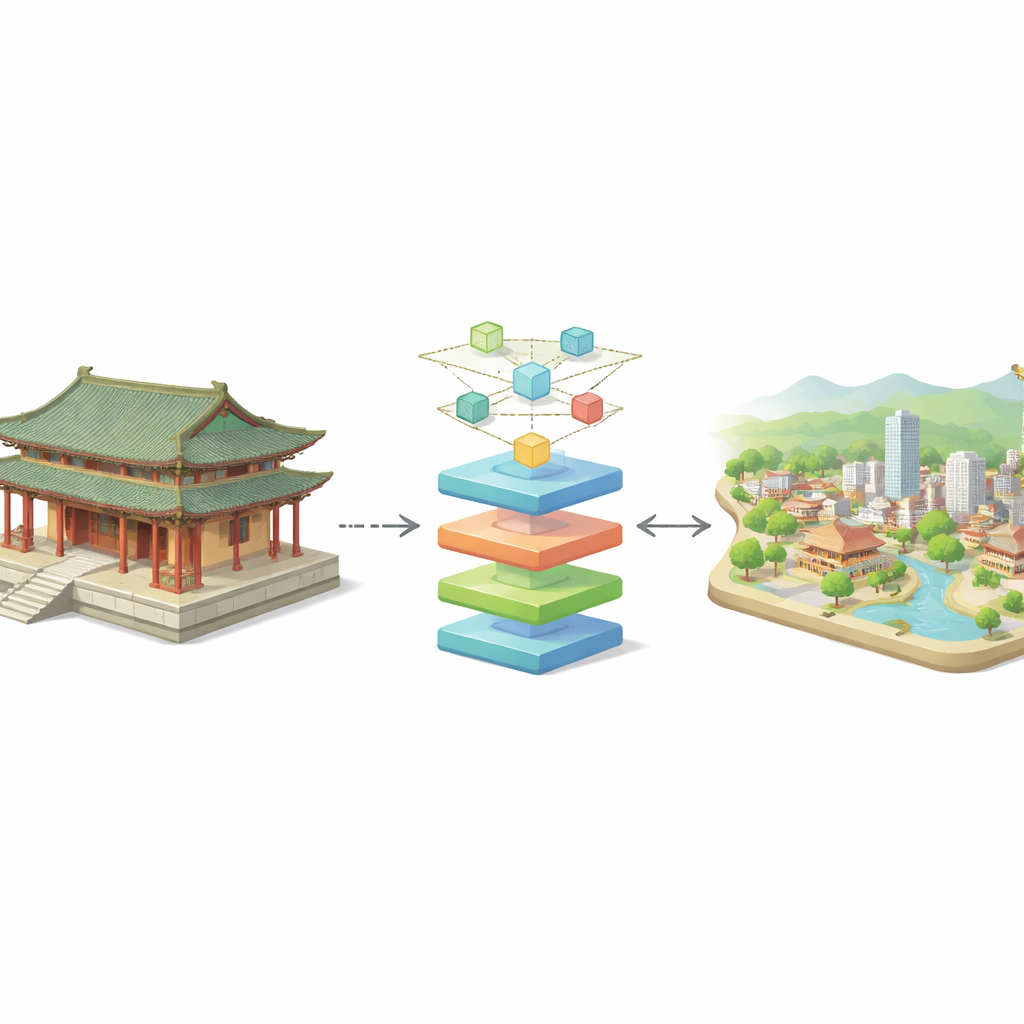
To bridge this gap, the researchers extend CityGML, an international standard used to describe 3D cities, by creating a specialized add‑on called the Chinese Timber Architecture Application Domain Extension (CTAADE). This extension introduces four main layers—foundation, timber frame, vertical enclosure, and roof—and 17 key component types, including bases, columns, beams, rafters, tiles, walls, windows, and dougong. Each digital object can carry information such as historical period, style, protection level, and dimensions, and is linked to geometric surfaces in space. By nesting these components in a clear hierarchy, CTAADE lets computers “know” that a particular beam belongs to a given hall, sits in the timber frame layer, and connects to a specific set of columns and roof parts.
From design files to semantically rich heritage models
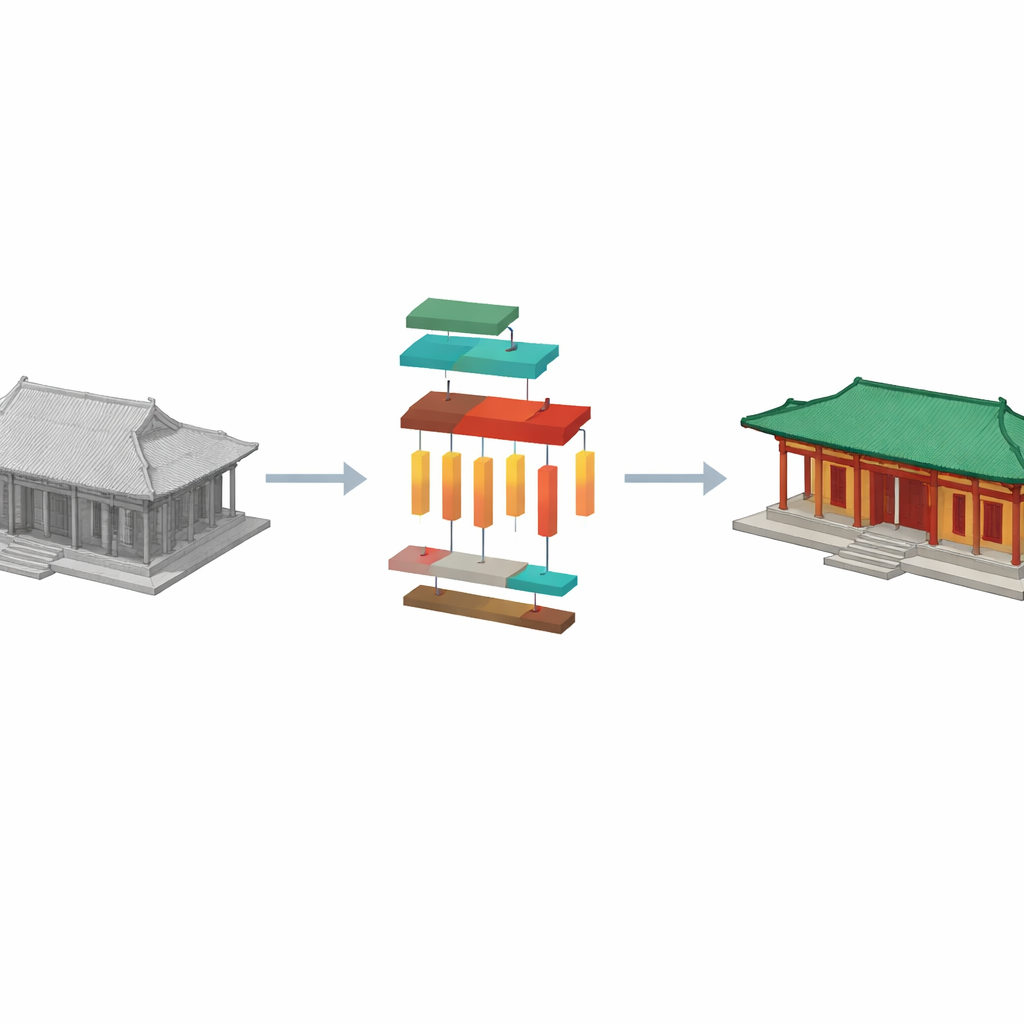
Building on this framework, the team devised a pipeline to convert existing heritage building information models into CTAADE‑compliant city models. Starting from a detailed 3D model created in commercial design software, they automatically extract the shapes and basic attributes of every object. Since the original model only labels elements in very broad categories, experts then classify each piece—such as distinguishing bases, doors, beams, or individual bracket sets—using a mapping table aligned with the 17 CTAADE component types. Custom scripts finally encode all this geometry and meaning into CityGML files, so the result can be read by standard geographic information systems and visualization tools.
Putting the method to the test in a major temple hall
To demonstrate what their approach can do, the authors applied CTAADE to the Hall of Great Compassion at Chongshan Temple in Taiyuan, Shanxi Province, a large Ming‑dynasty wooden hall with layered eaves and richly articulated timberwork. They transformed its heritage building information model into a CTAADE‑based 3D city model containing 4,704 semantic components and over half a million triangular surfaces. Using specialized viewers, they confirmed that the file followed the CityGML rules and that the geometric primitives were almost entirely valid. More importantly, the software could display a tree of components, highlight individual elements such as a single bracket set or roof layer, and show their attributes and relationships, enabling rich queries that were impossible with a bare mesh.
What this means for protecting historic buildings
In everyday terms, this work gives conservators, planners, and researchers a shared, computer‑readable language for talking about complex wooden temples. Instead of treating a hall as a solid shell, CTAADE breaks it into meaningful parts that can be searched, analyzed, and linked to other data such as structural simulations or weather exposure. While the current model focuses on one main building type and still relies on human expertise to classify components, it can be expanded to other structures and paired with artificial intelligence to speed up recognition. Ultimately, this semantic 3D approach could support digital twins of heritage sites, helping society plan repairs, assess risks, and keep the knowledge embedded in ancient carpentry alive for future generations.
Citation: Zhang, J., Hou, M., Chen, J. et al. A CityGML ADE for modeling ancient chinese timber architecture in 3D with semantic information. npj Herit. Sci. 14, 271 (2026). https://doi.org/10.1038/s40494-026-02535-2
Keywords: ancient Chinese timber architecture, 3D semantic modeling, CityGML ADE, cultural heritage preservation, HBIM integration