Clear Sky Science · en
Technical art history of Tibetan ceramics from Jinchuan and Dêgê workshops in Sichuan Province, China
Clay Stories from the Roof of the World
High in the mountains of Sichuan, on the eastern edge of the Tibetan Plateau, two small pottery workshops are quietly shaping more than cooking pots and incense burners—they are shaping how future generations will understand Tibetan life. This study follows these workshops in detail, showing how local clay, hand tools, and firing fires are tied to family memory, religion, and economic survival. For readers, it opens a window onto how ordinary household objects can carry science, history, and culture all at once, and how those traditions can either fade away or adapt and thrive in a fast-changing world.
Two Villages, Two Paths
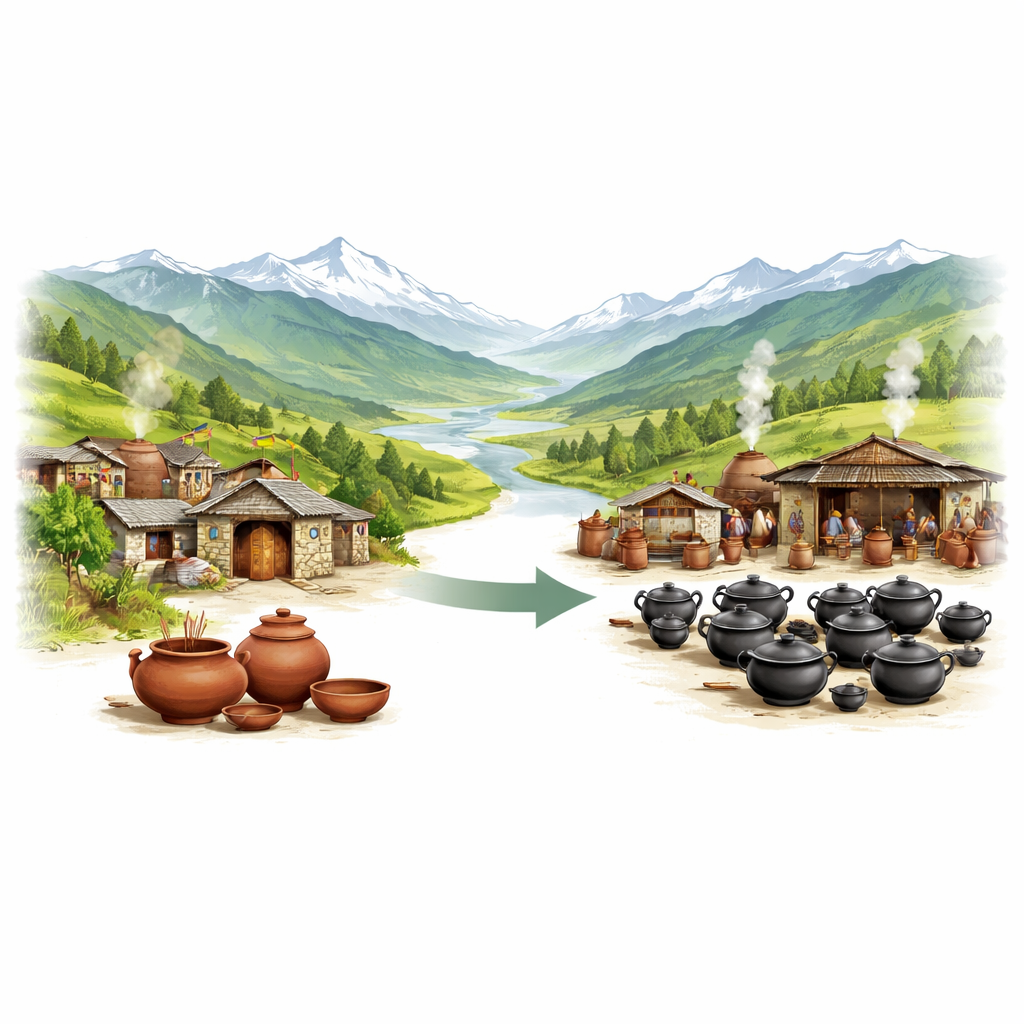
The research focuses on two Tibetan communities in northern Sichuan Province, China: Jinchuan and Dêgê. Both lie in a rugged frontier region that has long linked China with Tibet, India, and Central Asia through caravan routes carrying tea, salt, wool, and sacred texts. In each village, pottery has been made for generations without written manuals, with skills passed down orally and by example. Yet their trajectories could not be more different. In Jinchuan, a single elderly potter continues a shrinking family craft with no apprentice in sight. In Dêgê, an organized workshop supported by a Tibetan cultural association trains dozens of young people and experiments with new products while insisting on traditional materials and methods.
Everyday Objects with Deep Roots
In Jinchuan, the lone potter makes a narrow range of red, low‑fired wares just for his local Gyarong Tibetan neighbors. Small hand‑held drinking vessels for alcohol, larger storage containers, and incense burners used on rooftop shrines are shaped in two‑part clay molds and finished with simple carved lines and small inlaid porcelain chips from broken teacups. Fired quickly in an open hillside kiln, the vessels remain relatively soft and porous—good enough for holding drink or burning juniper, but not for cooking. Villagers later rub pig fat into their surfaces to add shine and seal them with a thin rice gruel before use. These pieces are valued less as luxury items than as familiar companions in daily and religious life, recognized by their forms, reddish color, and modest decorations.
Black Pots That Love the Fire
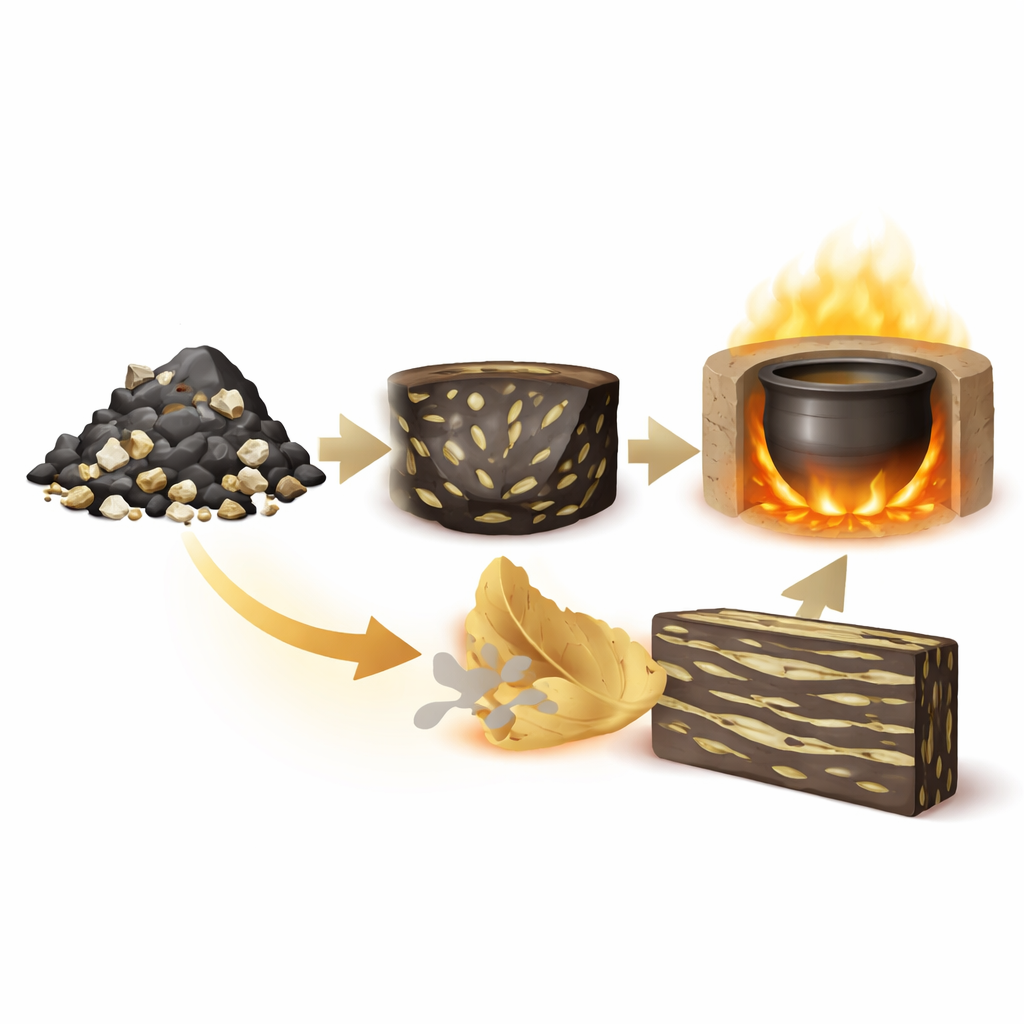
In Dêgê, potters work collectively in a long wooden shed, building vessels by hand on simple turntables. Their hallmark is a rich grey‑to‑black sheen, achieved without glaze. The secret lies in mixing a carbon‑rich black clay from a nearby mountain with large amounts of a soft "golden" stone rich in talc. After grinding both to fine powders and combining them roughly half‑and‑half, potters form cooking pots, braziers, teapots, and new items such as apple juicers, whistles, and flower bowls. The pieces dry indoors, then go through a two‑stage firing: first above a wood fire to drive off moisture, then buried in a shallow pit under wood and sawdust for a hot, oxygen‑poor firing. This treatment darkens the clay, creates a subtle glassy binding among the talc grains, and leaves the walls strong yet tolerant of sudden heating and cooling—ideal for long stews, hot tea, and keeping food warm over coals.
Reading Clay with Modern Tools
To see how these choices of clay, stone, and fire shape performance, the researcher examined thin slices of pots with microscopes, scanned fragments in 3D using micro‑CT, and used light‑based instruments to identify minerals. Jinchuan ceramics proved to be low‑temperature red earthenware with small natural rock fragments and modest porosity: fine for holding liquids and incense, but mechanically weak. Dêgê ceramics showed something else: thick bands of talc grains, many stretched and aligned, and long, connected pores formed as those layers separated slightly during firing. Together, these features help spread heat and absorb stress, making the black vessels highly resistant to cracking on open fires. The study links what villagers feel in their hands—light weight, smoothness, quick heating, and durability—to measurable features inside the clay body.
Tradition at a Crossroads
By pairing scientific analysis with interviews and workshop observation, the paper shows how broader social forces steer these crafts. Jinchuan’s potter has chosen to keep making only the familiar red vessels for his neighbors, even as cheap factory goods and better‑paying jobs lure younger people away; when he stops, the tradition will likely vanish. In Dêgê, by contrast, a local Tibetan non‑governmental group has invested in training, marketing, and recognition as intangible cultural heritage. That support encourages careful innovation: new forms for outside buyers, but always the same black clay, "gold stone," hand building, and firing style that define local identity. For non‑specialists, the key message is that everyday pottery is far from simple. It is a finely tuned technology, shaped by geology, craft knowledge, religion, and economics—and whether it survives depends as much on social support as on the clay itself.
Citation: Reedy, C.L. Technical art history of Tibetan ceramics from Jinchuan and Dêgê workshops in Sichuan Province, China. npj Herit. Sci. 14, 254 (2026). https://doi.org/10.1038/s40494-026-02523-6
Keywords: Tibetan pottery, traditional ceramics, heritage conservation, Sichuan Tibet, craft innovation