Clear Sky Science · en
Digital analysis and research on the structural characteristics of Yuan–Ming–Qing meiping forms
Why Vase Shapes Matter
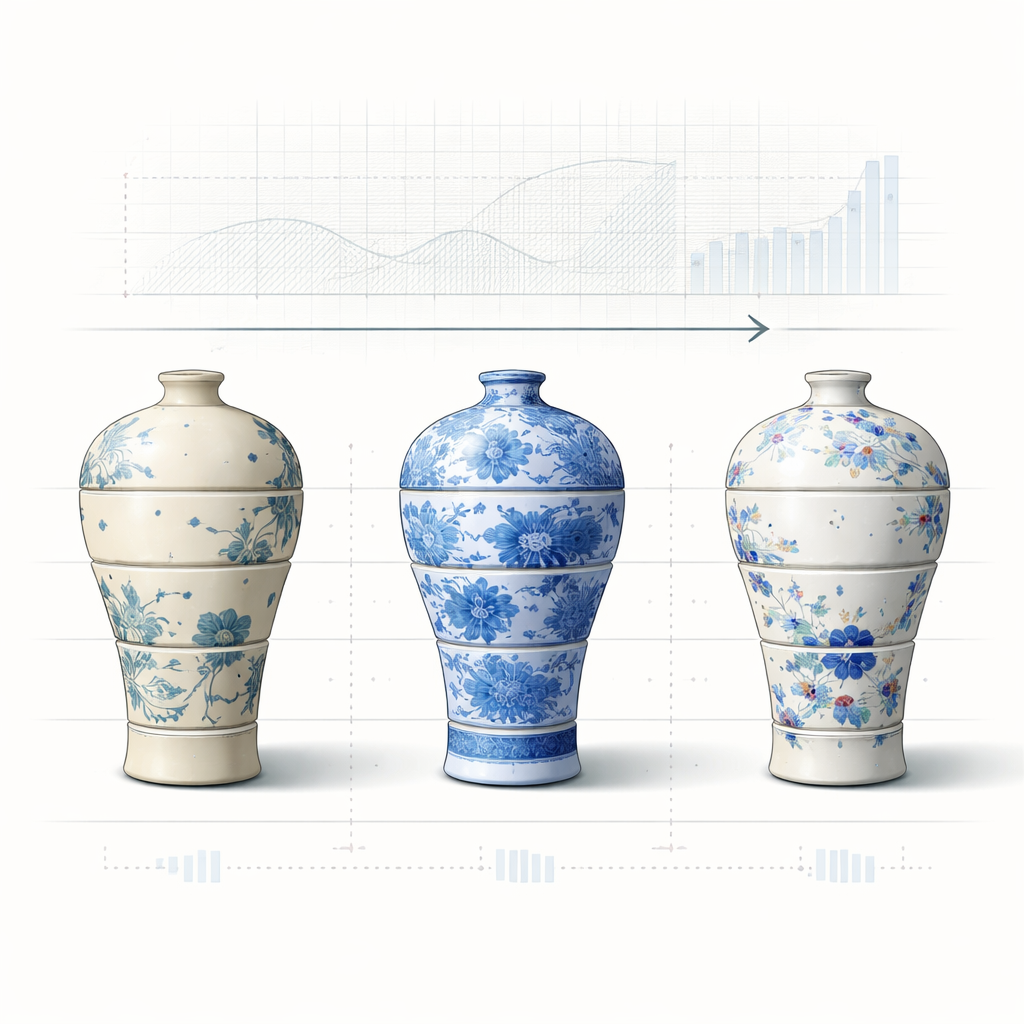
Across China’s imperial centuries, the gently swelling profile of the meiping, or plum vase, carried wine, flowers, and status. Subtle shifts in its curve—from a fuller shoulder to a slimmer foot—encode changes in technology, taste, and power. Yet for generations, scholars have judged these differences mostly by eye, using terms like “stout” or “elegant.” This study turns those impressions into numbers, showing how digital tools can read history from the outline of a single ceramic vessel.
Turning Museum Photos into Measurements
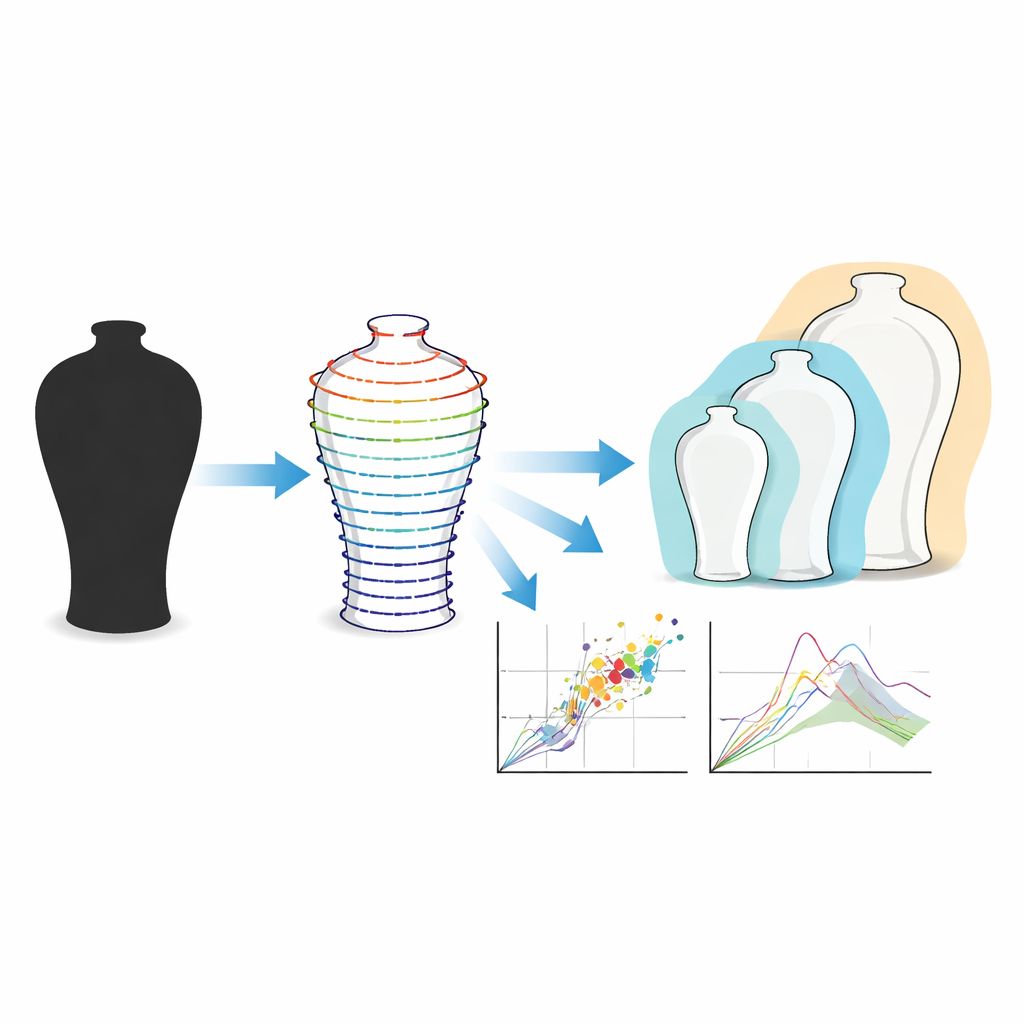
The authors focused on meiping vases made in Jingdezhen, China’s most important porcelain center, during the Yuan, Ming, and Qing dynasties. They assembled 58 representative examples from museum collections and excavation reports, then fed their photographs into a carefully tested image-processing pipeline. Because catalog photos are taken from different angles and distances, the team first corrected perspective distortions and restored the true scale. They then sharpened the edges and extracted a clean side silhouette for each vase. Assuming the vases are symmetrical around a vertical axis, these outlines could be spun into simple three-dimensional models and, most importantly, sliced into many thin horizontal sections from foot to rim.
Dissecting the Curve of a Vase
To compare shapes fairly, the researchers ignored absolute size and tracked proportions instead. They divided each vase’s height into 50 equal layers and measured the width at each level, then expressed that width as a fraction of total height. This produced a “shape fingerprint” for every meiping: a smooth curve showing how wide the vessel is at each relative height. By stacking these curves for all vases from the same dynasty, they could see where shapes clustered tightly and where they spread out. Statistical tools then distilled this high-dimensional information into a few principal patterns, capturing differences in how shoulders swell, bellies bulge, and feet contract.
What Changed from Yuan to Ming to Qing
When the team plotted median curves together with bands showing typical variation, distinct dynastic personalities emerged. Yuan meiping tend to have relatively full shoulders and more restrained bellies, with variation kept within a narrow corridor—evidence of consistent workshop practice or functional demands. Ming vases, by contrast, show greater diversity: the point of maximum width shifts downward into the belly, which becomes more prominent, and the spread of shapes in this region widens. This pattern fits a period of growing market demand and more pluralistic tastes. In the Qing dynasty, the overall outline narrows and regularizes: necks are slimmer and longer, feet tighten sharply, and the curves for different pieces hug each other closely, suggesting stronger stylistic control under imperial patronage even as fine-grained details still vary.
From Shape Statistics to Dating Tools
Beyond describing trends, the authors tested whether their numerical fingerprints could help assign vases to dynasties. They engineered a set of compact descriptors—such as average width in the neck, shoulder, belly, and foot; where the widest point occurs; and how sharply the profile bends—and used these in a classification model. Under rigorous cross-validation, the system correctly identified the dynasty of about 86% of specimens, with especially strong performance for Yuan and Qing pieces. In an independent test, a meiping from an archaeological report—excluded from model building—was digitized and compared against the dynastic “confidence bands.” Its profile fit squarely within the Ming range and matched the excavators’ dating based on stratigraphy.
Why This Digital Approach Matters
In plain terms, this work shows that the feel of a vessel—bulky or slender, high-shouldered or low-bellied—can be translated into reproducible curves and ranges rather than left to subjective judgment. By building “shape confidence intervals” for different periods, the study provides a quantitative reference against which new finds, fragments, or reconstructions can be checked. It does not claim to explain history on its own, but it offers a sturdy numerical layer that archaeologists, art historians, and designers can combine with evidence about kilns, trade, and court taste. In doing so, it opens a path toward reading social and technological change directly from the quiet curves of porcelain.
Citation: Chen, C., Luo, H., Du, M. et al. Digital analysis and research on the structural characteristics of Yuan–Ming–Qing meiping forms. npj Herit. Sci. 14, 288 (2026). https://doi.org/10.1038/s40494-026-02508-5
Keywords: Chinese ceramics, meiping vases, digital morphometrics, Jingdezhen porcelain, artifact dating