Clear Sky Science · en
FEA structural stability assessment of the ancient Serapeum tunnels beneath Pompey’s Pillar using SSI modelling
Hidden Tunnels Beneath a Famous Column
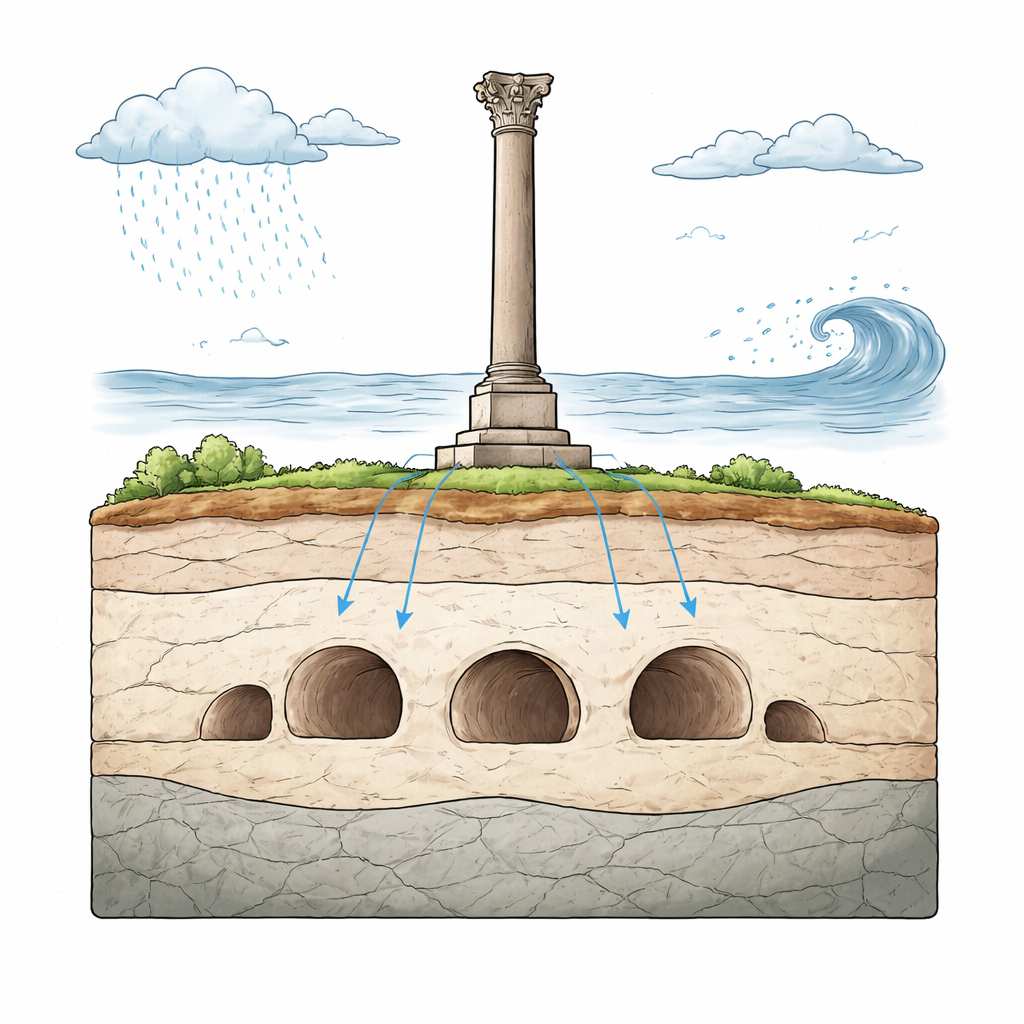
In the heart of Alexandria, a single towering granite column known as Pompey’s Pillar rises above the ruins of an ancient temple. Few visitors realize that a delicate network of Greek tunnels and a daughter library lies directly beneath it, carved into a soft, easily damaged rock. This study uses advanced computer simulations and rock tests to ask a simple but urgent question: how long can this underground world safely hold up the massive monument above, especially as climate change brings more intense rain and rising seas?
An Ancient Monument in a Fragile Setting
The research focuses on the Serapeum tunnels and related underground spaces that run under Pompey’s Pillar, a 285-ton granite column cut from hard Aswan stone. The tunnels are excavated in a soft, porous limestone-like rock called calcarenite, which is much weaker than the column itself. Over centuries, wind, salt, moisture, and chemical reactions have slowly eaten away at this rock. Today, stronger storms, flash floods, and higher groundwater linked to climate change are accelerating this decay. That combination—an enormous stone pillar resting on aging, weakened tunnels—makes this site a prime testing ground for modern tools that can assess risk without damaging the archaeology.
Reading the Ground Without Touching It
Because drilling and heavy testing at such a heritage site must be limited, the author assembled a picture of the subsurface from existing maps, earlier surveys, and rock samples taken from the area. Laboratory tests measured how strong and deformable both the soft calcarenitic rock and the hard granite are, including how easily they crack when compressed or sheared. These measurements fed into a two-dimensional computer model created with specialized geotechnical software. In this virtual cross-section, the pillar, its foundation, the tunnels, and a thick block of surrounding ground were recreated so that gravity, the pillar’s weight, and even simple earthquake forces could be applied and their effects tracked in detail.
Following Stress, Strain, and Tiny Movements
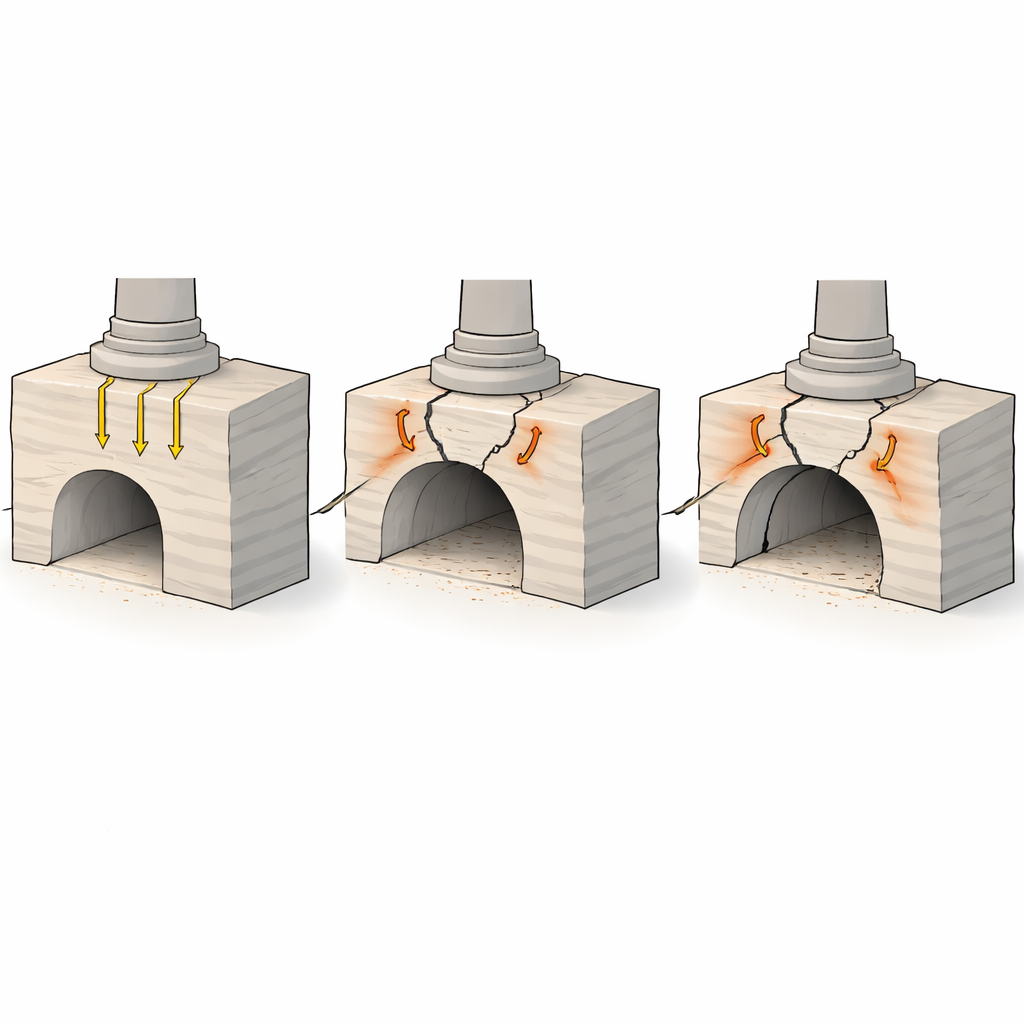
The simulation shows where forces concentrate around the tunnels as the ground carries the column’s load. The highest crush-like forces appear at the sharp corners of the tunnel roofs directly under the pillar—precisely where the rock is already the weakest and most weathered. Here, the rock is working at roughly two-thirds of the strength measured in the lab, and the model reveals small zones where the material has already yielded and behaves more like plastic than elastic. Yet, deeper between the tunnels, the rock is squeezed from all sides, creating a strong “clamping” effect that actually helps hold the system together. Surprisingly, the total downward movement of the pillar predicted by the model is less than a millimeter—far below the levels that would usually worry engineers.
Stable for Now, But with a Narrow Safety Margin
To judge overall stability, the study calculates a factor of safety—a ratio comparing the rock’s current strength to the strength at which collapse would begin. The value of about 1.55 suggests that, under today’s static loads, the tunnels are just above the commonly accepted line for safety. However, this cushion is thin for a monument of such cultural value, especially because the soft rock continues to weaken due to moisture, salt, and temperature changes. The same hot spots identified in the model—the tunnel crowns and corners—are exactly where further loss of strength or shaking from an earthquake could push the system toward failure.
From Simulation to Protection Plans
The study concludes that the Serapeum tunnels beneath Pompey’s Pillar are not on the brink of sudden collapse, but they live in a delicate balance. Long-term weathering and climate-driven flooding are slowly eroding the natural support, shrinking the safety margin over time. The author argues that conservation should focus on keeping water out, closely monitoring the stressed tunnel zones, and planning gentle, reversible reinforcement where needed. By turning complex rock tests and computer models into practical thresholds for action, this work offers a roadmap for protecting not only this iconic Alexandrian landmark, but also other underground heritage sites hidden beneath historic monuments around the world.
Citation: Hemeda, S. FEA structural stability assessment of the ancient Serapeum tunnels beneath Pompey’s Pillar using SSI modelling. npj Herit. Sci. 14, 294 (2026). https://doi.org/10.1038/s40494-026-02506-7
Keywords: Pompey’s Pillar, underground heritage, tunnel stability, climate change impacts, geotechnical modeling