Clear Sky Science · en
The manufacture of the Baskerville typographic punches: the versatile chaîne opératoire of an 18th-century printing workshop
How the Metal Behind Famous Letters Tells a Story
Every printed page you read rests on a hidden world of tools and techniques. Long before digital fonts, each letter on the page began life as a tiny metal rod, painstakingly shaped by hand. This article explores the surviving tools of one of history’s most influential printers, John Baskerville, and shows how scientists and craftspeople today are working together to uncover how these miniature objects were made, used and adapted over time.
The Man Who Changed the Look of Books
John Baskerville, active in 18th-century Birmingham, helped transform how books looked and felt. A self-taught experimenter, he designed the crisp, elegant typeface that still bears his name, improved presses, inks and paper, and became printer to the University of Cambridge. To create his books, he relied on thousands of small iron or steel punches, each carrying one letter, number or symbol in reverse on its tip. These punches were struck into softer copper to form moulds, which in turn were used to cast the individual pieces of type that built up every page. Although Baskerville’s books became famous, the punches themselves—his core working tools—remained poorly understood.
A Forgotten Collection and a New Way to Study It
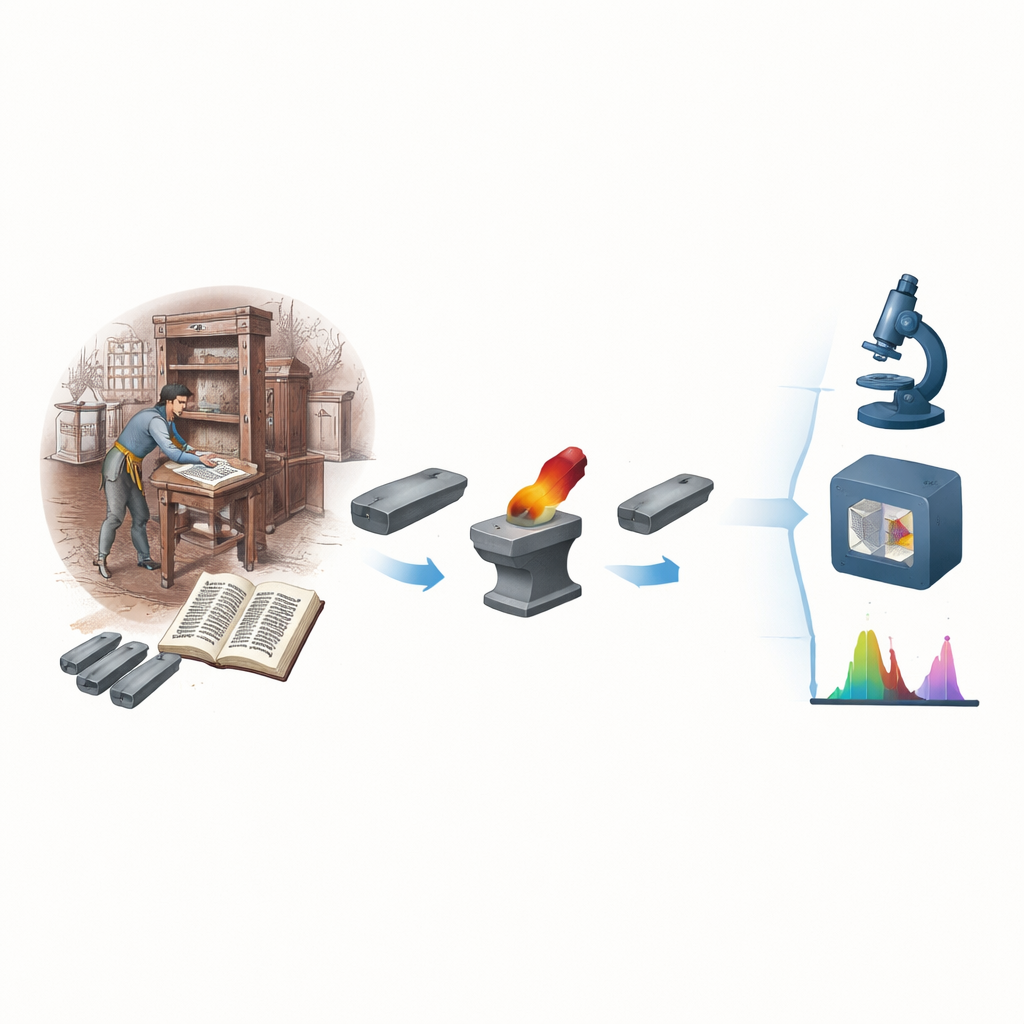
An unusually complete set of Baskerville’s punches—over 3,200 pieces—survives today at Cambridge University Library, stored alongside some of the books they helped print. The authors treat this collection as a kind of time capsule of workshop practice. Rather than relying only on old manuals, they apply an approach borrowed from archaeology called the chaîne opératoire, or “operational chain.” This means reconstructing, step by step, every action involved in making a punch: choosing metal, shaping it at the forge, carving the letter, polishing, heat-treating and finally protecting it for storage and repeated use. By combining historical texts, hands-on craft experiments and a suite of non-destructive scientific tests, they work backwards from each finished punch to the decisions that created it.
Reading the Tool Marks in Metal
The team selected a representative sample of punches and examined them at many scales. Simple measurements revealed how long bars of iron were cut into standard lengths depending on letter size. Under magnification, surfaces recorded tiny “witness marks” of tools: hammer blows from forging, pressure from clamps, fine parallel lines from files and broader, more irregular cuts from engraving tools. X-ray and micro–CT scanning exposed internal cracks and confirmed that Baskerville’s workshop forged its punches from solid metal rather than welding different pieces together. Infrared spectroscopy showed that many punches had been coated with substances such as beeswax or oily fats, probably to ward off rust during storage. Together, these clues allowed the researchers to reconstruct several distinct forging routes, chosen according to the size and shape of the letter to be cut.
A Versatile Workshop and Its Technological Tradition
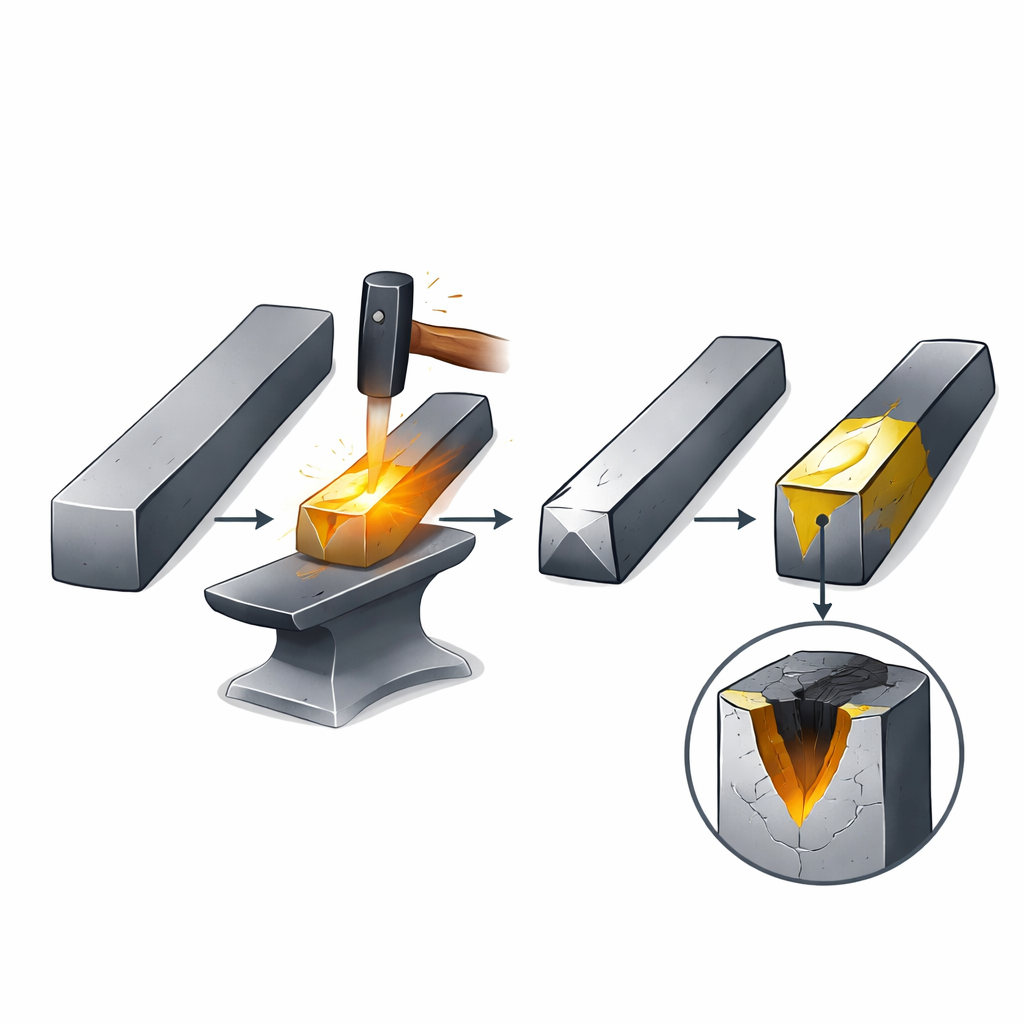
One key finding is how flexible and skilled the Birmingham workshop was. For large letters, smiths expanded the metal at the tip of the bar to create a broader working surface and extra strength. Medium and small letters followed other shaping paths, but always with careful chamfering of corners to prevent cracks. When carving the letter itself, Baskerville’s team relied on filing wherever possible, switching to engraving only in very tight spaces or tiny point sizes. As letters became smaller, engraving took over more of the work, but even then filing remained central—unlike later, 19th- and 20th-century punches in the same collection, which show heavier reliance on engraving and use machine-made metal bars instead of hand-forged blanks. Patterns in polishing also varied with letter size: small punches were usually polished in straight strokes, larger ones with circular motions that helped keep wide faces flat. Across all these stages, the researchers see consistent workshop habits—a technological tradition—but also many small deviations where craftsmen adapted to how a particular piece of metal behaved.
From Punch-Making to Punch-Cutting
Comparing Baskerville’s tools to later additions in the collection reveals a broader shift in printing technology. In the 18th century, much of the work happened at the forge: planning a punch meant planning how to heat and hammer the bar so the right amount of metal was in the right place before any letter was carved. The authors argue that this full sequence deserves the name “punch-making,” not just “punch-cutting.” With the rise of industrial steelmaking and rolled bars in the 19th century, workshops could skip the forging stage and start from factory-made stock, turning the craft into something closer to pure carving. This change reflects not only new materials, but also new workshop organisation and divisions of labour.
Why This Matters for the Story of Printing
By treating Baskerville’s punches as archaeological artifacts rather than mere typographic curiosities, the study recovers a rich picture of skill, improvisation and technological choice hidden behind familiar printed pages. The researchers show that what looked like uniform, finely finished letters actually emerged from a remarkably varied set of paths through the workshop, guided by both explicit rules and tacit, bodily knowledge. Their methods and findings open the door to similar studies of other historic type-makers, promising a more material, craft-centred history of printing at the very moment when traditional punch-making has almost vanished as a living trade.
Citation: Montes-Landa, J., Box, M., Archer-Parré, C. et al. The manufacture of the Baskerville typographic punches: the versatile chaîne opératoire of an 18th-century printing workshop. npj Herit. Sci. 14, 246 (2026). https://doi.org/10.1038/s40494-026-02504-9
Keywords: history of printing, typography, craft technology, heritage science, John Baskerville