Clear Sky Science · en
Developing efficient cleaning agents for textile relics affected by mold stains
Why old fabrics grow mold — and why it matters
From silk robes of Chinese empresses to embroidered festival jackets, historic textiles are fragile witnesses to the past. Yet in the dim, humid corners of storerooms and tombs, mold quietly eats away at these fabrics, leaving dark stains and weakening threads. Conservators have long struggled to remove such mold without scrubbing away the very history they hope to preserve. This study explores a new, carefully tuned cleaning recipe that can lift mold stains from precious textiles while keeping their fibers strong and their age-worn character intact. 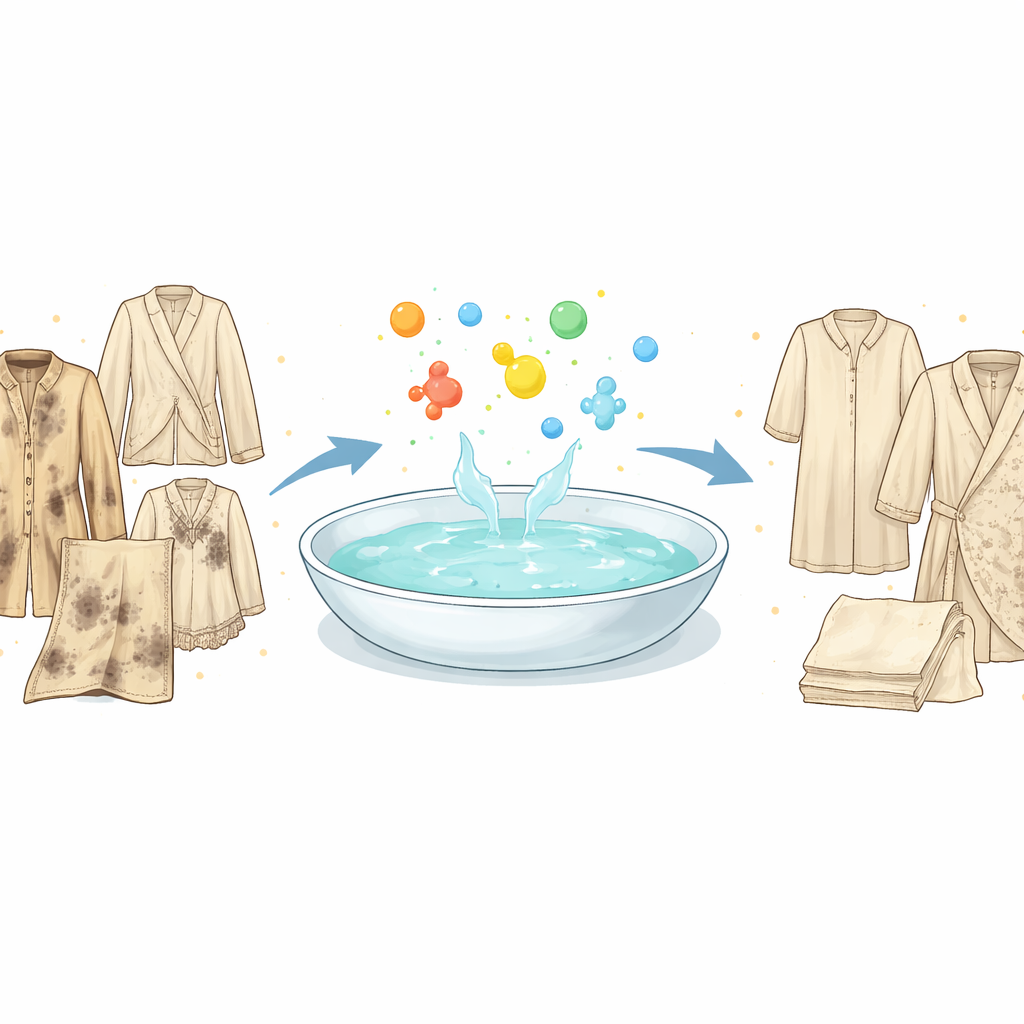
The hidden life of mold on precious cloth
Textile relics are usually made from natural fibers such as cotton, linen, silk, and wool. These are rich in carbohydrates and proteins, which make excellent food for molds. In warm, humid, dusty spaces with poor air circulation, molds quickly colonize fabric surfaces. As they grow, they form webs of filaments and secrete acids, sticky slime, and colored pigments that soak into the fibers. Green, black, or whitish patches spread over the cloth, obscure fine patterns, and quietly weaken the material. Once this damage has occurred, it cannot be fully reversed, so safely removing mold as early and completely as possible is a central task in textile conservation.
Building a safe stand-in for irreplaceable artifacts
Because actual museum treasures cannot be used for trial-and-error cleaning, the researchers first created realistic stand-ins. They selected four typical fabrics—cotton, linen, silk, and wool—and artificially aged them using controlled chemical treatments to mimic the brittleness of old textiles. These samples were then deliberately infected with three mold strains often found on Chinese textile relics: a green Trichoderma, a pale Aspergillus, and a black Rhizopus. Over several days, the molds spread over the fibers, forming dense mats and colored deposits. The team documented each step with color measurements, mechanical strength tests, microscopes, and electron microscopes, building a detailed baseline to compare different cleaning methods.
Designing a three-part cleaning recipe
Instead of relying on a single soap-like ingredient, the study tested a family of "ternary" cleaning systems built from three parts: a surfactant to loosen and lift dirt, an enzyme to break down biological glue, and an antimicrobial agent to stop any surviving mold. Various natural and synthetic surfactants were compared, including tea saponin, a plant extract, a lab-made compound called C₈E₉ suited to plant-based fibers, and a biosurfactant called rhamnolipid. Enzymes such as alkaline protease and cellulase were added to target protein- and cellulose-based residues, while mild preservatives like zinc salts and potassium sorbate were included to discourage regrowth. All mixtures were used in gentle ultrasonic baths at near-neutral pH, conditions chosen to be kind to weakened historical fibers.
What worked best on which mold and fabric
Photography and color measurements showed that surfactants alone could strip away visible surface fuzz but often left behind sticky films and pigments. Adding enzymes made a striking difference: stains faded further, and color values moved much closer to those of the aged but clean fabric, especially when alkaline protease was used on protein-rich deposits. The best surfactant depended on both the mold and the fiber. Rhamnolipid excelled at cleaning black Rhizopus stains on all fabrics, while C₈E₉ was particularly effective on cotton and linen covered with the green or pale molds. Cellulase further improved cleaning on plant-based fibers, whereas lipase contributed little. Microscopy confirmed that with the optimized mixes, mold filaments, slime, and pigment halos were largely gone and the original weave became visible again.
Keeping strength while lifting stains
One of the greatest fears in conservation is that cleaning might sacrifice strength for brightness. Mechanical tests here showed the opposite: even short mold attacks slightly weakened the textiles, but after washing with the new formulations, breaking strength did not drop further and sometimes increased a little. The authors attribute this not to "repair" of fibers but to the removal of lingering moisture and corrosive mold by-products, and to the neutral, low-stress washing conditions. Scanning electron micrographs revealed clean, well-defined fiber surfaces with no new cracks or pitting. In other words, the recipes were strong against mold, yet gentle on aged cloth. 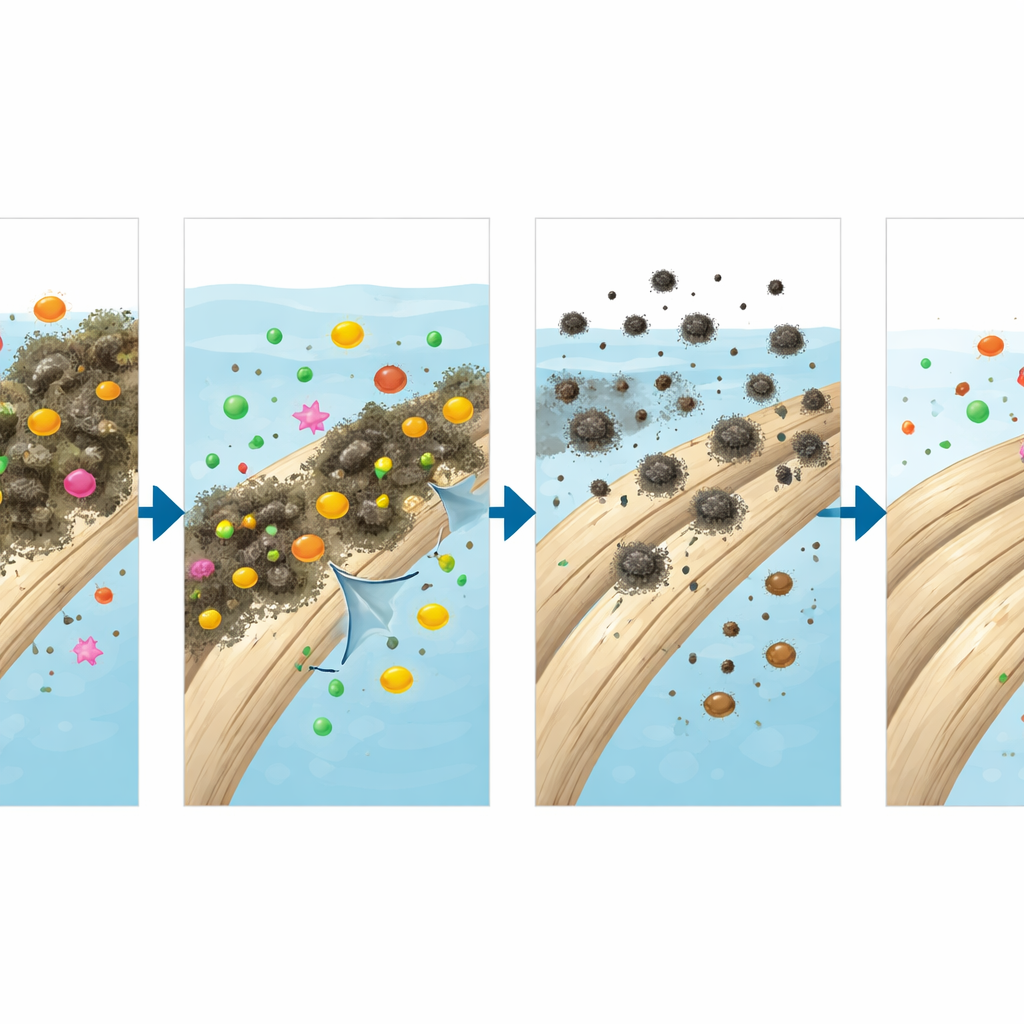
From the lab bench to a Qing dynasty embroidery
To test real-world usefulness, the researchers applied their best-performing mixture—built around C₈E₉, alkaline protease, and potassium sorbate—to a natural-colored silk Miao embroidery from the Qing dynasty bearing yellow-brown mold stains. After ultrasonic treatment and careful rinsing, the stains were greatly reduced, the design appeared clearer, and no new damage was seen, though the piece still retained its natural patina and frayed edges. This outcome reflects a guiding principle in conservation: clean enough to remove active harm, but not so much as to erase the passage of time.
A new toolkit for saving mold-stained textiles
In plain terms, this study shows that there is no one-size-fits-all "magic soap" for moldy textiles. Instead, the safest and most effective approach is a tailored three-part system in which each component plays a distinct role: surfactants detach mold and dirt, enzymes break down the sticky biological glue that anchors stains, and antimicrobials keep surviving spores from starting the cycle again. By matching these ingredients to both the kind of mold and the type of fabric, conservators can remove even stubborn green and black stains while preserving the strength and character of irreplaceable cloth. This work offers a science-based roadmap for museums and archives facing the age-old problem of mold on treasured textiles.
Citation: Wei, Y., Cao, X., Su, Z. et al. Developing efficient cleaning agents for textile relics affected by mold stains. npj Herit. Sci. 14, 226 (2026). https://doi.org/10.1038/s40494-026-02502-x
Keywords: textile conservation, mold stains, heritage preservation, enzyme-based cleaning, historic fabrics