Clear Sky Science · en
A residual mamba point cloud classification framework for 3D Terracotta Warrior fragments
Why broken statues still matter
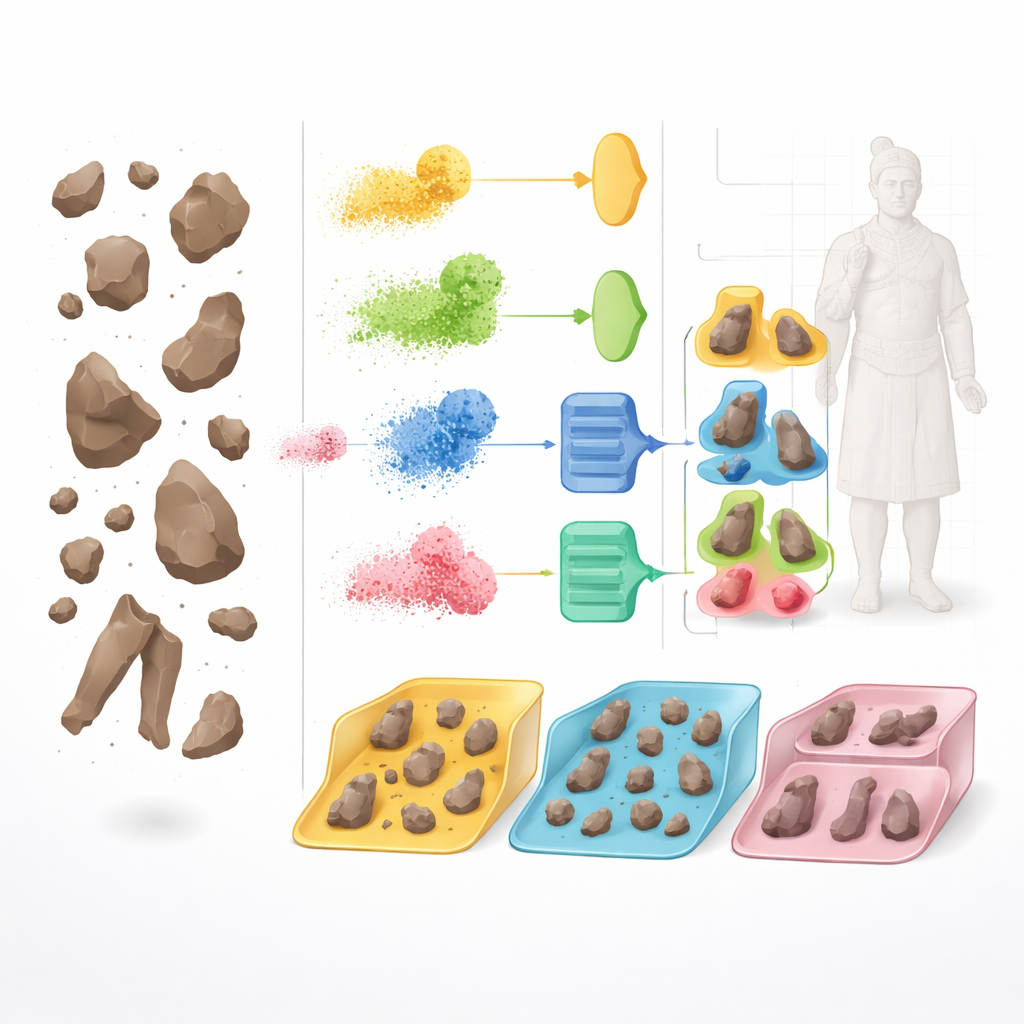
The Terracotta Warriors are among the world’s most iconic archaeological discoveries, yet many of these life‑size clay soldiers now survive only as scattered fragments. Piecing them back together is like tackling a three‑dimensional jigsaw puzzle with thousands of missing and misleading pieces. This study introduces a new artificial‑intelligence method that looks directly at detailed 3D scans of fragments to sort them by body part, aiming to speed up digital restoration and help conservators understand how the original statues were built.
From scattered shards to digital dots
Modern scanners can capture the shape of each fragment as a “point cloud” – millions of tiny dots in space that trace every bump, curve, and break edge on the clay surface. These raw 3D point clouds preserve far more detail than photographs, but they are also harder for computers to interpret. Earlier approaches tried to simplify the data, either by slicing it into 2D images or packing it into 3D grids. Both shortcuts made the calculations easier, yet they blurred away some of the fine surface structure that matters most when you are trying to tell an arm shard from a leg shard.
Teaching computers to read fine detail
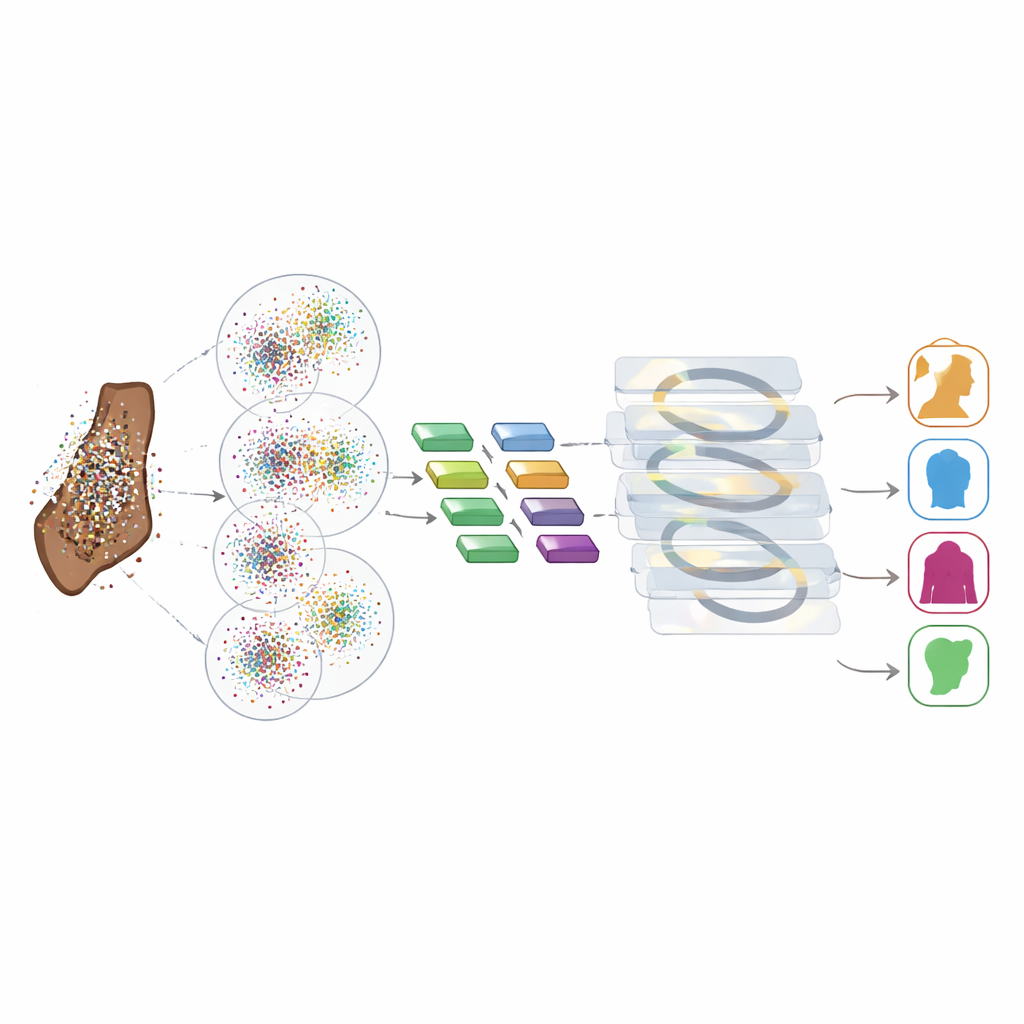
The researchers designed a new system called PointRM that works directly on the original 3D dots without flattening or coarsening them. First, the method breaks a fragment’s point cloud into many small neighborhoods using sampling and nearest‑neighbor searches. Within each neighborhood, it combines the exact spatial coordinates of the dots with learned “feature” values that summarize local shape. A specialized module then fuses these pieces of geometric and appearance information, highlighting subtle curves and ridges that mark, for example, the edge of a sleeve or the bend of a knee.
Letting the model see the big picture
Once these local groups are built, PointRM must still decide which features matter most overall. To do this, it scores each local patch by importance and then reorders them into two mirrored sequences: one running from high‑importance to low, and the other in reverse. These ordered sequences feed into a “residual Mamba” module, a new kind of sequence‑processing network that can trace long‑range relationships across many patches with relatively light computation. By scanning these patches in both forward and backward directions, the model learns how far‑apart regions of the same fragment relate to one another – a key step for recognizing incomplete and irregular pieces.
Putting the method to the test
The team evaluated PointRM on several standard 3D benchmarks, including collections of everyday objects and shapes with labeled parts. Across these tests, the new method matched or exceeded the accuracy of leading systems based on more traditional neural networks and Transformer models, while using fewer operations. The authors then turned to their main goal: classifying real Terracotta Warrior fragments into four categories – arms, bodies, heads, and legs – from carefully cleaned and downsampled scans. Out of nearly twelve thousand fragments, PointRM correctly identified over 96 percent, edging out prior specialized methods and remaining stable even when the input data were made noisier or sparser.
What this means for ancient soldiers
For non‑specialists, the key takeaway is that this work gives archaeologists and conservators a powerful new “sorting engine” for 3D fragments. Instead of relying solely on painstaking manual inspection, teams can now use PointRM to quickly group large numbers of pieces by likely body part, filter out misleading fragments, and prepare more focused sets for detailed matching and reconstruction. Although the method has technical limitations – such as difficulty with extremely sparse scans – it marks an important step toward fully digital restoration pipelines that respect the fragile originals while revealing more about how the Terracotta Warriors were made and how they once stood together in the emperor’s vast underground army.
Citation: Li, Y., Zhou, M., Zhou, P. et al. A residual mamba point cloud classification framework for 3D Terracotta Warrior fragments. npj Herit. Sci. 14, 243 (2026). https://doi.org/10.1038/s40494-026-02496-6
Keywords: Terracotta Warriors, 3D point clouds, cultural heritage, fragment classification, deep learning