Clear Sky Science · en
Characterization and provenance analysis of jade-and-stone from the Daxi Culture, Three Gorges, China
Tracing Ancient Stories in Stone
Long before written records, people along China’s Yangtze River told stories about power, belief, and identity using stone and jade. This article follows 120 small but precious objects from the Neolithic Daxi Culture—rings, pendants, beads, and tiny carvings—to ask a big question: where did these materials come from, and what do they reveal about an early society taking shape in the famous Three Gorges region?
People, River, and a World of Ornaments
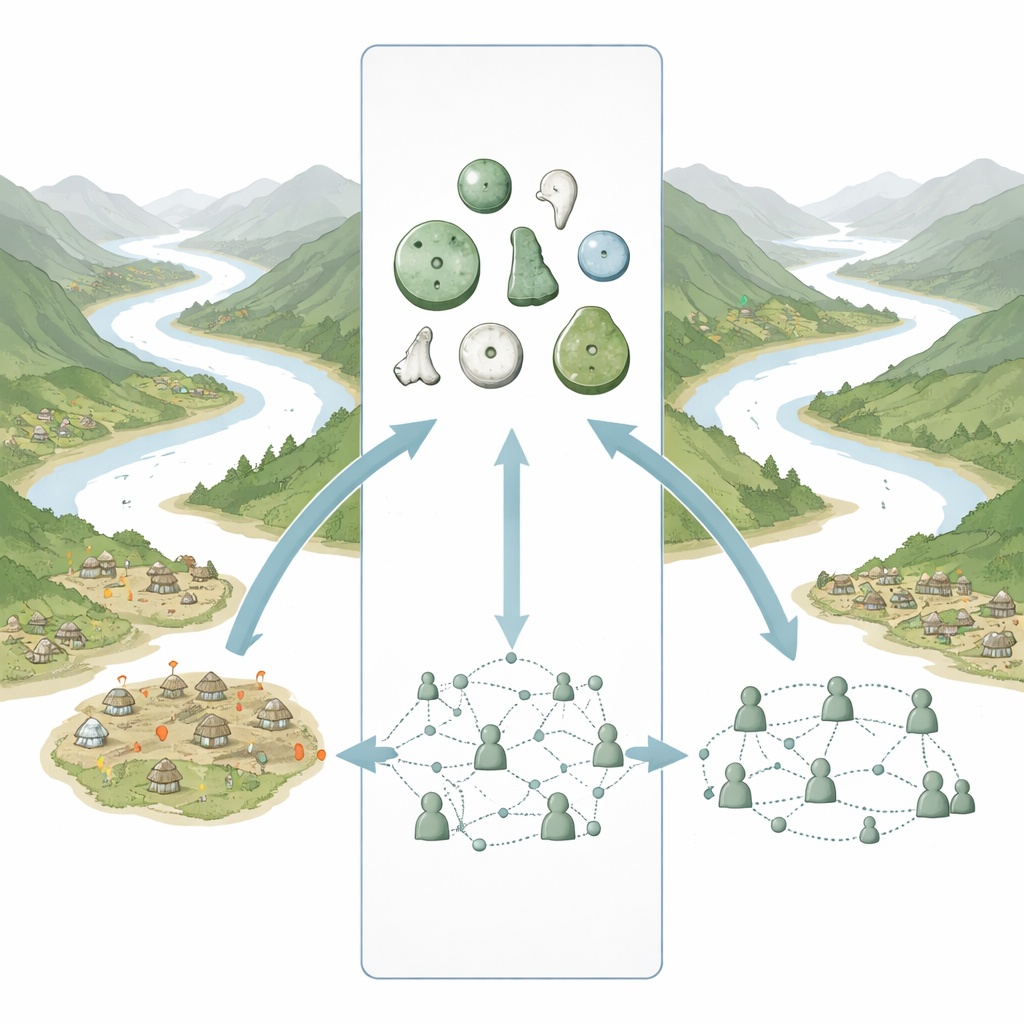
The Daxi Culture flourished about 6,300 to 5,050 years ago along the middle reaches of the Yangtze. Two key sites—Daxi and Dashuitian, now submerged or altered by modern development—have yielded dozens of finely worked stone ornaments. Many were found close to the heads and necks of the dead, often arranged as rings, beads, and pendants. Women and children in particular were frequently buried with such pieces, hinting that these objects signaled family ties, social rank, or special roles such as craftwork or ritual practice. Over time, the range of forms expanded dramatically: from simple rings and ear plugs to large curved pendants, discs, animal figures, and even human faces carved from dark, glossy stone.
How Scientists Read the Hidden Makeup of Stone
To uncover what these artifacts are made of and where their raw materials originated, the researchers used a battery of non-destructive techniques more commonly seen in physics or geology labs than in museums. Infrared and Raman spectroscopy probed how the stones absorb and scatter light, revealing the specific vibrations of their internal atoms. X-ray methods and electron microscopes mapped elements and crystal structures, while laser ablation mass spectrometry sampled microscopic spots to determine trace elements. Together, these methods allowed the team to classify each artifact’s mineral type—marble, nephrite, serpentine, quartzite, malachite, turquoise, black talc, jet, shell, mica, and slate—without cutting or grinding the precious pieces.
Local Stone, Distant Treasures
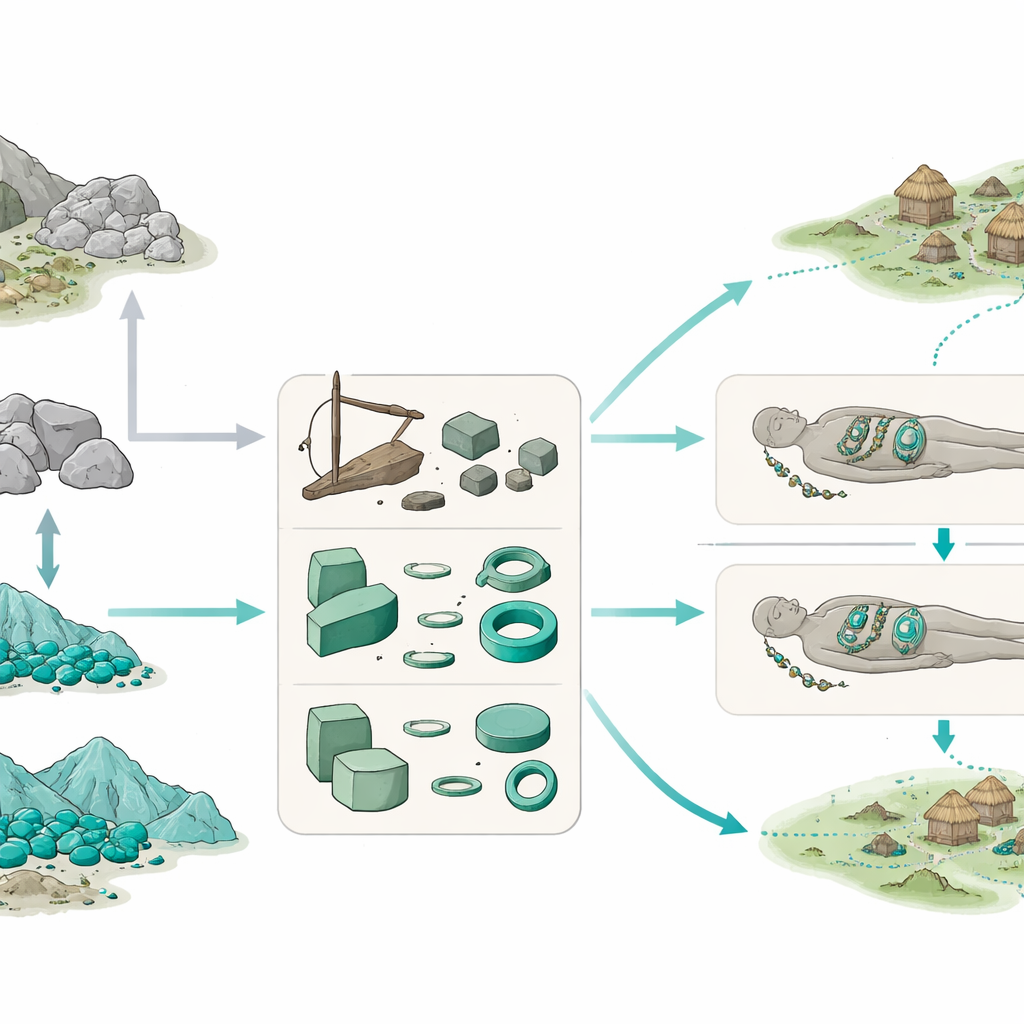
The analysis showed a clear pattern: most of the materials, especially the abundant gray-white marble used for small rings, likely came from nearby rock formations in the Three Gorges area. Archaeological layers at Daxi even contain debris, drill cores, and half-finished ornaments, strong evidence that stone-working workshops operated on site. In contrast, some materials stand out as strangers. A lone jet pendant, made from fossilized wood normally found in northern China, almost certainly arrived through long-distance exchange. Most striking is turquoise: by comparing its chemical “fingerprint” with samples from known deposits, the authors tie Daxi turquoise to a rich mineral belt spanning Hubei, Henan, and Shaanxi hundreds of kilometers away. This means the Daxi people were already plugged into wide-ranging trade routes, moving bright blue-green stones from distant mines to local graves.
Two Neighboring Sites, Two Distinct Styles
Although Daxi and Dashuitian belong to the same culture and time span, their ornament sets tell slightly different stories. At Daxi, the toolkit leans heavily on local marble and simple shapes: small rings and beads that repeat familiar forms. Dashuitian, by contrast, features more exotic materials and bold designs—nephrite, turquoise, and especially black talc carved into birds, animals, and expressive human faces. The workmanship there is more intricate, with serrated edges, stepped carving, and tiny incised patterns that may have served as early symbols or records. These contrasts hint at regional identities within the broader Daxi world: one site relying on nearby stone and understated designs, the other embracing imported colors and more narrative imagery.
What These Stones Reveal About an Early Civilization
By treating each artifact as both a piece of jewelry and a geological sample, the study reconstructs how Neolithic craftspeople combined local resources with far-traveled materials to build social meaning. The results show that Daxi communities were not isolated villagers but active participants in a wider network that moved turquoise and perhaps other valuables across great distances. Over several centuries, their ornaments evolved from plain shapes to lifelike figures, mirroring growing social complexity and richer ritual life. For a modern reader, these tiny objects of stone and jade offer a rare, tangible glimpse of how early societies along the Yangtze used beauty, rarity, and craftsmanship to mark status, remember the dead, and knit themselves into the emerging fabric of Chinese civilization.
Citation: Bai, J., Fang, T., Zhao, W. et al. Characterization and provenance analysis of jade-and-stone from the Daxi Culture, Three Gorges, China. npj Herit. Sci. 14, 296 (2026). https://doi.org/10.1038/s40494-026-02488-6
Keywords: Daxi Culture, Neolithic jade, turquoise trade, Three Gorges archaeology, ancient ornaments