Clear Sky Science · en
Ancient echoes as clues to the structural relationship between grotto soundscapes and auditory perception
Why Echoing Caves Matter Today
Imagine stepping into a stone cave where even the rustle of your sleeve blooms into a lingering echo. The Xiang Tang Shan (XTS) Buddhist grottoes in northern China are just such places, famous for sound as much as for sculpture. This study asks a deceptively simple question with wide implications for heritage and religion: how do these carved cave-temples actually sound, and how do their acoustics shape what worshippers feel and hear? By treating echoes and reverberation as clues, the researchers show that sound is not a background detail but a core part of how these sacred spaces work.
Listening to a Mountain of Carved Rooms
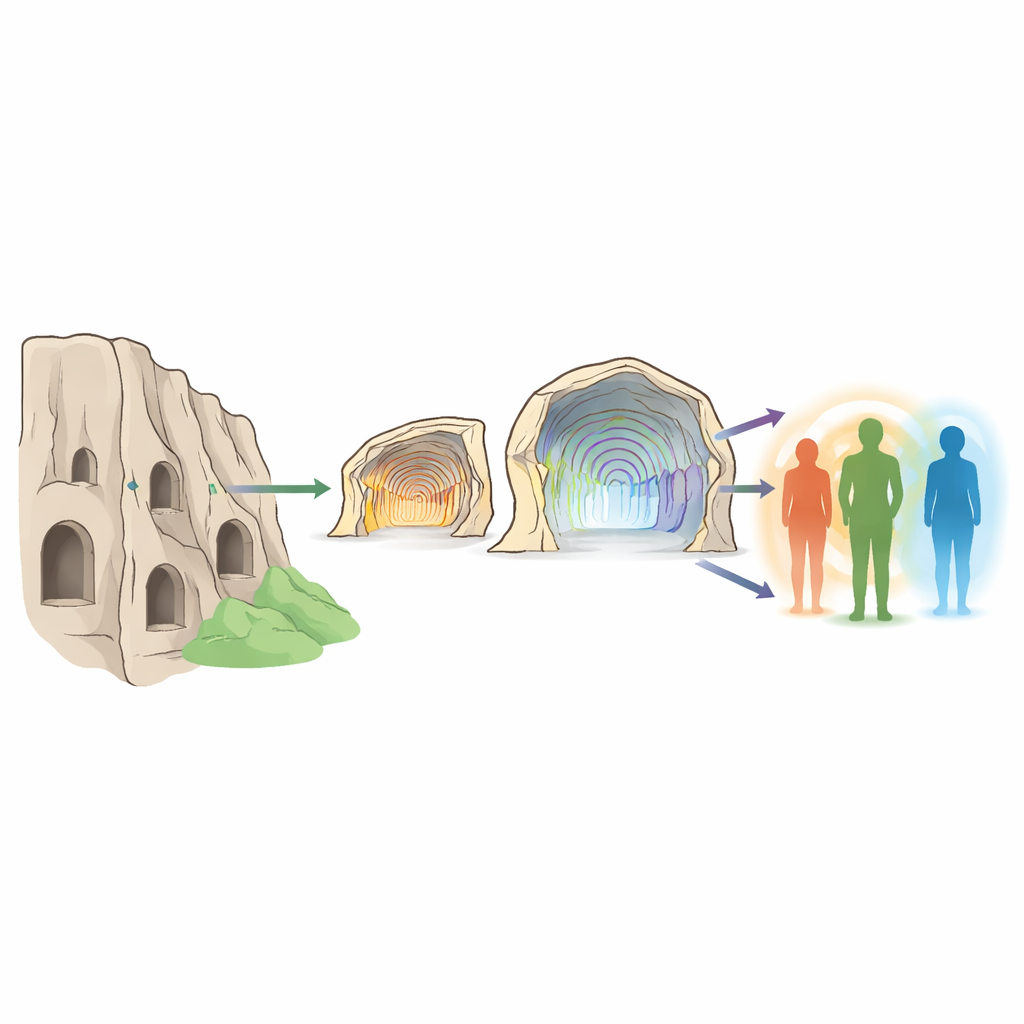
The team focused on six representative caves in the XTS complex, which dates back to the sixth century. These grottoes range from intimate cell-like chambers to a towering hall known as the Giant Buddha Grotto. To compare them fairly, the researchers first classified the spaces by size, using a large dataset from another famous Buddhist site, the Mogao Grottoes at Dunhuang. This allowed them to sort XTS caves into small, medium, and large volume groups in a way that could later be applied to other cave temples. They then documented each grotto’s shape and layout, distinguishing simple hall-like rooms from more complex “central pillar” caves with a large column encircled by a walkway.
Capturing Echoes Without Harming the Art
Because the grottoes are fragile heritage sites, the team could not bring in powerful loudspeakers. Instead, they used balloon pops as brief, sharp sound bursts, measuring how the echoes decayed with sensitive microphones placed throughout each cave. From these recordings they calculated standard acoustic indicators: how long the sound lingers (reverberation), how quickly early reflections arrive, and how clearly speech and music would be heard. To understand how people actually experience these spaces, they also ran listening tests with 53 volunteers. A short Buddhist text was recorded in a sound-absorbing room, played back inside each grotto, re-recorded, and then replayed in a laboratory. Listeners rated each version on scales such as clarity, loudness, intimacy, sense of mystery, emptiness, and how enveloped they felt by sound.
How Size Turns Stone into Sound
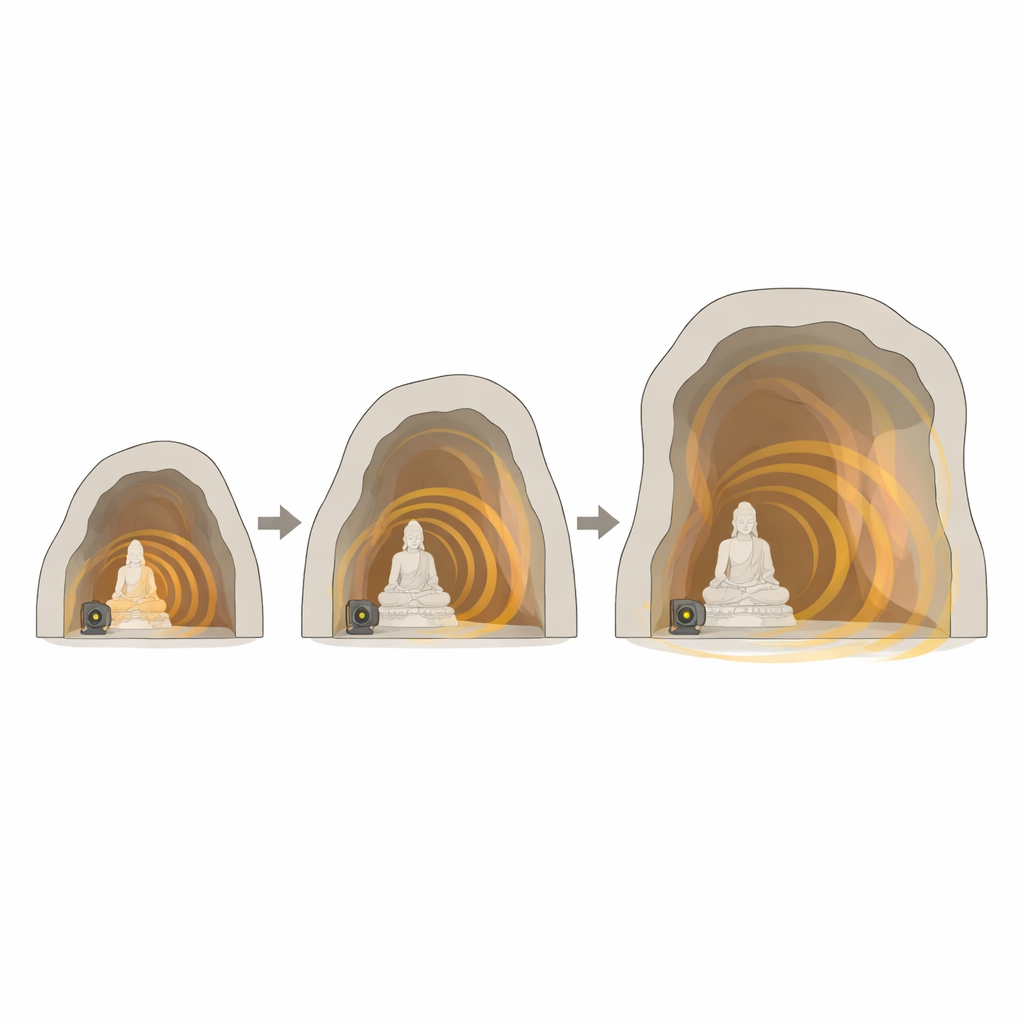
The measurements revealed a simple but powerful pattern: bigger caves sound bigger. The large Giant Buddha Grotto had very long reverberation times, especially at low tones, with sound hanging on for several seconds. This produced a full, resonant field well suited to chanting and music but blurred rapid speech. Small caves, by contrast, had short reverberation and high clarity, making words and musical details easier to pick out but offering less of an overwhelming spatial effect. Medium-size caves fell between these extremes and, tellingly, often gave listeners more mixed or less decisive impressions. Additional analysis of how different tones were emphasized showed that even within the same size category, caves can lean toward a darker, bass-heavy sound or a brighter, high-pitched one, hinting at more subtle “sound fingerprints.”
What Listeners Feel Inside Sacred Stone
The volunteers’ experiences closely matched the physical measurements. In the giant cave, people consistently reported a strong sense of vastness, mystery, and emptiness, but low clarity, intimacy, and immersion; the sound seemed grand yet distant. Small caves produced the opposite: listeners felt sounds were close, clear, and surrounding, but less awe-inspiring or mysterious. Medium caves again sat in the middle, with less uniform opinions. Statistical tests showed that nearly all perceptual dimensions differed clearly between large, medium, and small groups, and were quite consistent within each group. When the researchers compared these patterns with other religious spaces—natural caves, majestic cathedrals, and underground tombs—they found that XTS grottoes sit in a moderate middle zone: more resonant than tombs, less extreme than the echo-heavy cathedrals, with a relatively narrow, stable range of acoustic behavior.
From Echoes to Living Religious Experience
Put simply, the study shows that the way these caves are carved strongly shapes how they sound, and that people hear those differences in predictable ways. Large grottoes reliably foster spacious, mysterious experiences, while small ones encourage clear, intimate listening. The authors argue that this stable bond between stone geometry, measurable acoustics, and human perception can serve as a new lens for classifying and understanding cave temples—one that complements traditional focus on images and architecture. In Buddhist traditions where chanting, recitation, and sound play central roles, such soundscapes may have quietly guided how rituals were practiced and felt. Although the study stops short of proving direct historical intentions, it lays out a testable chain: grotto design shapes sound; sound shapes experience; and, over time, recurring experiences may help shape religious practice itself.
Citation: Cao, Y., Zhang, B., Li, S. et al. Ancient echoes as clues to the structural relationship between grotto soundscapes and auditory perception. npj Herit. Sci. 14, 209 (2026). https://doi.org/10.1038/s40494-026-02487-7
Keywords: Buddhist grotto acoustics, soundscape, heritage science, reverberation, religious architecture