Clear Sky Science · en
Decoupling the effects of mass fraction, protein content, and gelatinization temperature in wheat starch-based paste on Xuan paper degradation
Why the Glue in Old Papers Matters
Many of the world’s treasured documents and paintings on paper are held together by a humble wheat paste. Conservators have trusted this traditional glue for centuries, especially in East Asia. Yet the very paste that repairs fragile works can also make them age faster. This study looks closely at how different recipes of wheat paste change the long‑term health of Xuan paper, a high‑quality handmade paper used for calligraphy and painting, and asks which parts of the paste are most to blame for yellowing, darkening, and cracking.
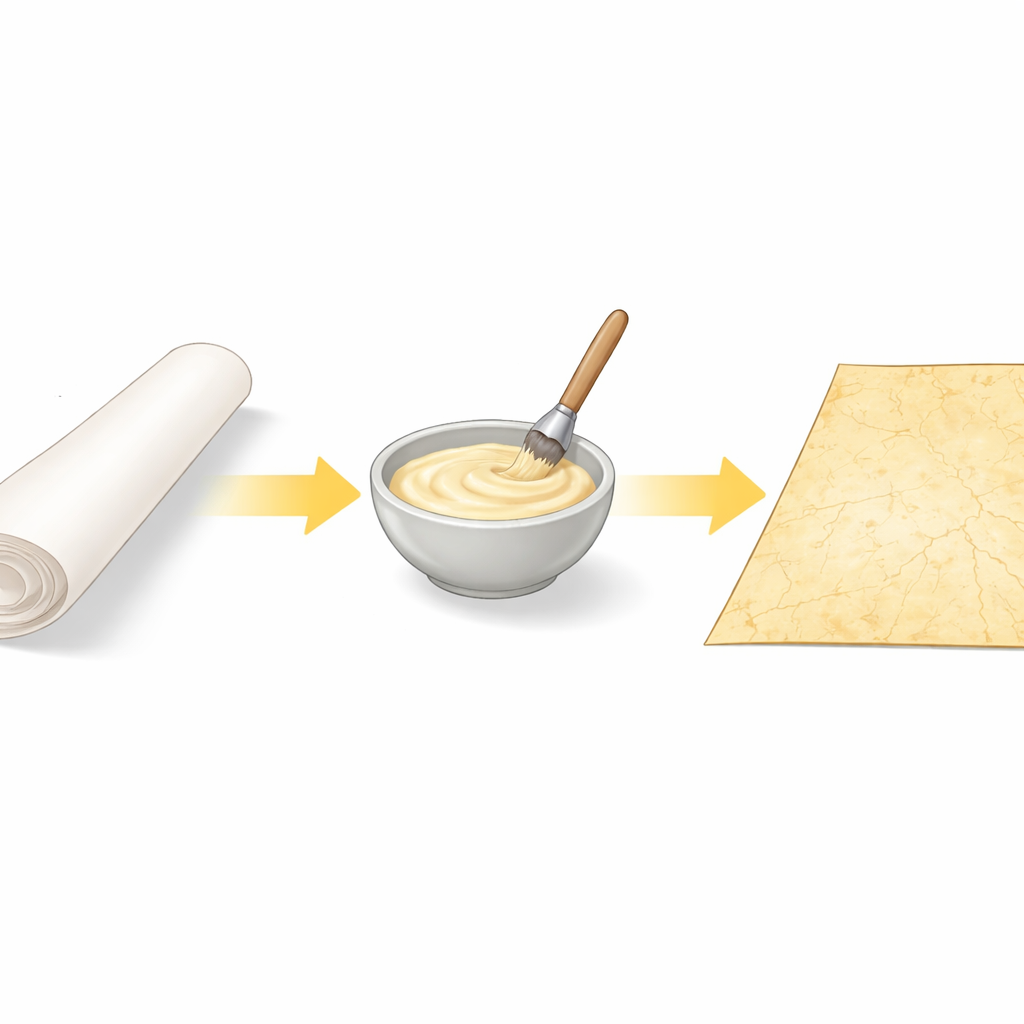
Old Paper, Traditional Paste
Paper conservators value wheat starch paste because it bonds gently with cellulose fibers, can be reversed with moisture, and has a long track record in workshops. But wheat paste is not a single, fixed material. It can be made from purified starch or from ordinary flour that still contains proteins and other components. The paste can be thick or thin, and it is cooked at different temperatures to form a gel. Earlier work showed that these adhesives can lower paper pH and cause it to darken over time, but no one had clearly separated the roles of paste thickness, protein, and cooking temperature. This study set out to untangle those factors in a controlled way.
Designing Fair Tests for Fragile Sheets
The researchers used modern extra‑pure Xuan paper as a stand‑in for historical artworks. They prepared eight wheat pastes that varied in three ways: how concentrated the paste was in water (mass fraction), whether it contained protein (starch only versus flour with protein), and whether it was cooked at a lower or higher temperature. Sheets of Xuan paper were soaked in these pastes, dried, and then placed in a warm, humid chamber to speed up aging for up to 17 days. During and after this period, the team measured changes in color, brightness, acidity, light transmission, and microscopic structure, using tools such as colorimetry, infrared spectroscopy, fluorescence, electron microscopy, X‑ray diffraction, and thermal analysis.
How Paste Recipe Shapes Color and Acidity
By using a factorial experimental design—a statistical way to test several variables at once—the study showed that paste concentration is the main driver of visible change. Thicker pastes made the paper lose more lightness, become more yellow, and show a greater overall color shift. They also made the paper more acidic over time, which is bad news for long‑term stability. Protein from flour played a different but important role: it had the strongest influence on how much the paper’s reflectance at violet light (around 400 nanometers) dropped, a sign of new light‑absorbing “chromophores” that cause browning. Papers coated with concentrated, protein‑rich paste lost the most transparency and brightness.
Proteins That Stiffen and Crack the Film
To see what was happening inside the paste itself, the scientists tracked how wheat proteins changed under heat and moisture. Fluorescence measurements showed that protein molecules shifted their glow to longer wavelengths as they unfolded, meaning their buried building blocks became exposed to water. Infrared data revealed that ordered helical structures in the proteins gave way to more disordered, random shapes. Together, these changes mean the protein network becomes stiffer and less flexible. On the paper surface, this played out as paste films that developed more microcracks—especially when flour, not purified starch, was used. Starch in the paste also tended to recrystallize during aging, making the coating denser and harder, further reducing flexibility and increasing cracking.
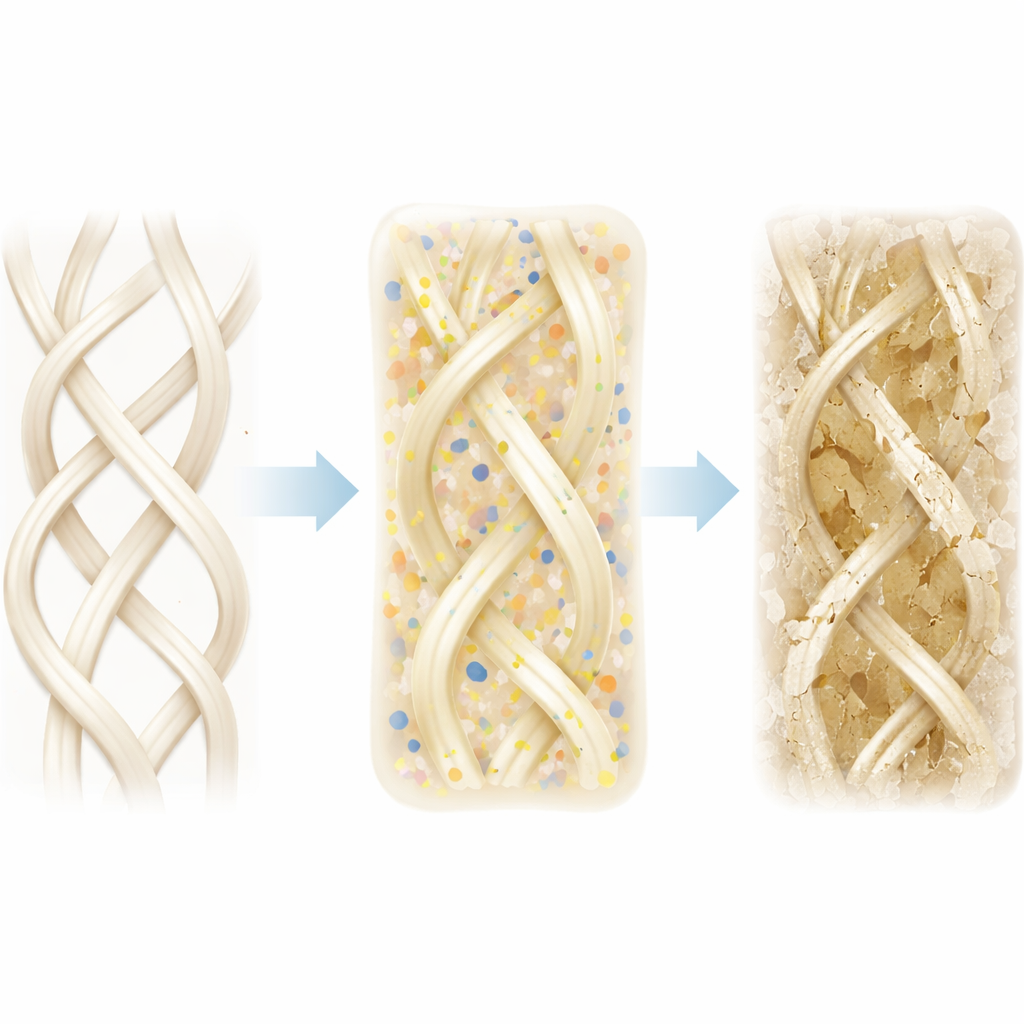
What Happens to Treated Paper as It Ages
After the accelerated aging, untreated Xuan paper and paste‑coated papers looked and behaved quite differently. All samples yellowed to some extent, but those with wheat paste—especially concentrated, protein‑containing formulations—became noticeably darker and less transparent, with much stronger loss of transmitted light at shorter wavelengths. Microscopy showed that bare paper fibers simply loosened slightly, while coated fibers sat under continuous films broken by microcracks. Paste‑treated sheets became more water‑repellent at the surface, and X‑ray and thermal tests indicated that the paste coating had reorganized into more crystalline, heat‑resistant structures than the untreated paper, a sign of starch retrogradation.
Practical Lessons for Protecting Heritage
For conservators and anyone concerned with the survival of paper heritage, this work delivers a clear message in plain terms. The thicker the wheat paste layer, the more it speeds up yellowing and acidification of Xuan paper, and proteins left in flour‑based pastes strongly worsen darkening and loss of clarity. Over time, these pastes can form stiff, crystalline films that crack and change how the paper interacts with moisture. The findings suggest that using lower‑concentration, protein‑free wheat starch pastes—and carefully controlling cooking conditions—can help reduce long‑term damage while preserving the practical benefits of this traditional adhesive.
Citation: Liu, P., Ge, M., Li, X. et al. Decoupling the effects of mass fraction, protein content, and gelatinization temperature in wheat starch-based paste on Xuan paper degradation. npj Herit. Sci. 14, 210 (2026). https://doi.org/10.1038/s40494-026-02483-x
Keywords: paper conservation, wheat starch paste, Xuan paper, cultural heritage, adhesive aging