Clear Sky Science · en
Frequency-domain oversampling for multi-resolution surface reconstruction: towards digital modeling of cultural heritage
Why this matters for history lovers
Many of the world’s most beautiful artifacts—fragile porcelain teapots, carved incense burners, weathered statues—cannot be handled or restored without risk. Museums increasingly turn to digital replicas to study and preserve these treasures. This paper presents a new way to turn scan data into highly accurate 3D models, capturing both delicate patterns and hidden interiors, while keeping the process efficient enough to use on real collections.
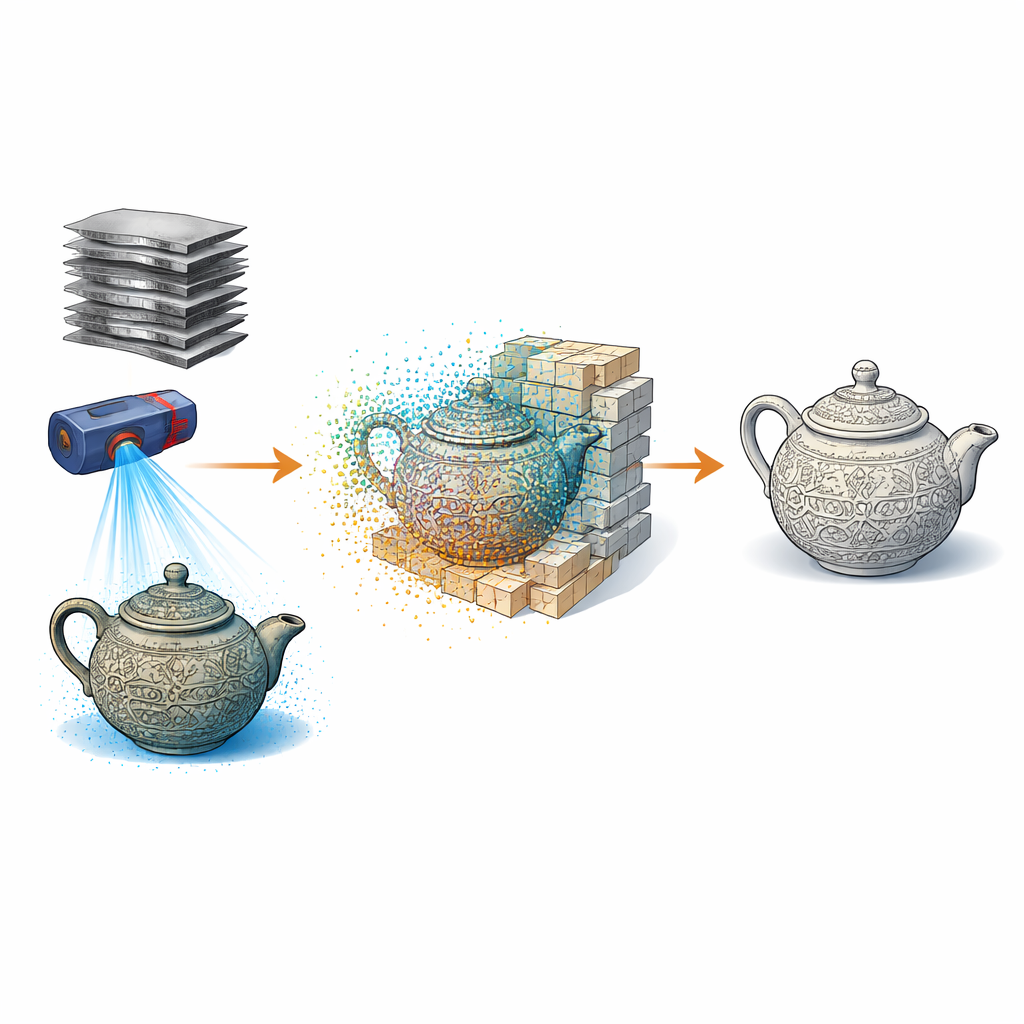
From raw scans to digital twins
To digitize artifacts, researchers start with technologies such as laser scanning and computed tomography (CT). Laser scanners record the outer surface, while CT captures both the outside and the internal structure in a stack of grayscale slices. These scans are then converted into point clouds: millions of tiny 3D dots that mark where the object’s surface lies. The challenge is to turn this cloud of points—often uneven, noisy, or incomplete—into a smooth, continuous surface that accurately represents the original object without gaps or distortions.
The problem with today’s digital shells
Existing surface reconstruction methods often face a trade-off. Some produce watertight, smooth models but wash out sharp edges, carved details, or thin features that matter for art and archaeology. Others keep local detail but are fragile in the face of noise and irregular sampling, which are common in real scan data. Standard CT techniques such as the Marching Cubes algorithm can introduce a “scalloping” effect, where surfaces become slightly rippled, and rely on fixed grids that waste memory and still miss fine patterns. Deep learning approaches can help but are computationally heavy and may add artificial noise or deformations.
A smarter way to sample shape
The authors propose a multi-resolution approach that adapts itself to the complexity of the object. They build an octree, a 3D grid that automatically subdivides space into smaller cubes where the surface bends sharply and keeps larger cubes in smoother regions. To decide where refinement is truly needed, they borrow the idea of “oversampling” from signal processing: just as audio engineers sample fast-changing sounds more densely, the algorithm samples high-curvature parts of the surface more finely. Curvature is estimated robustly so that random noise does not trick the method into oversampling meaningless spikes. This strategy yields dense sampling only where it improves the reconstruction, saving both memory and time.
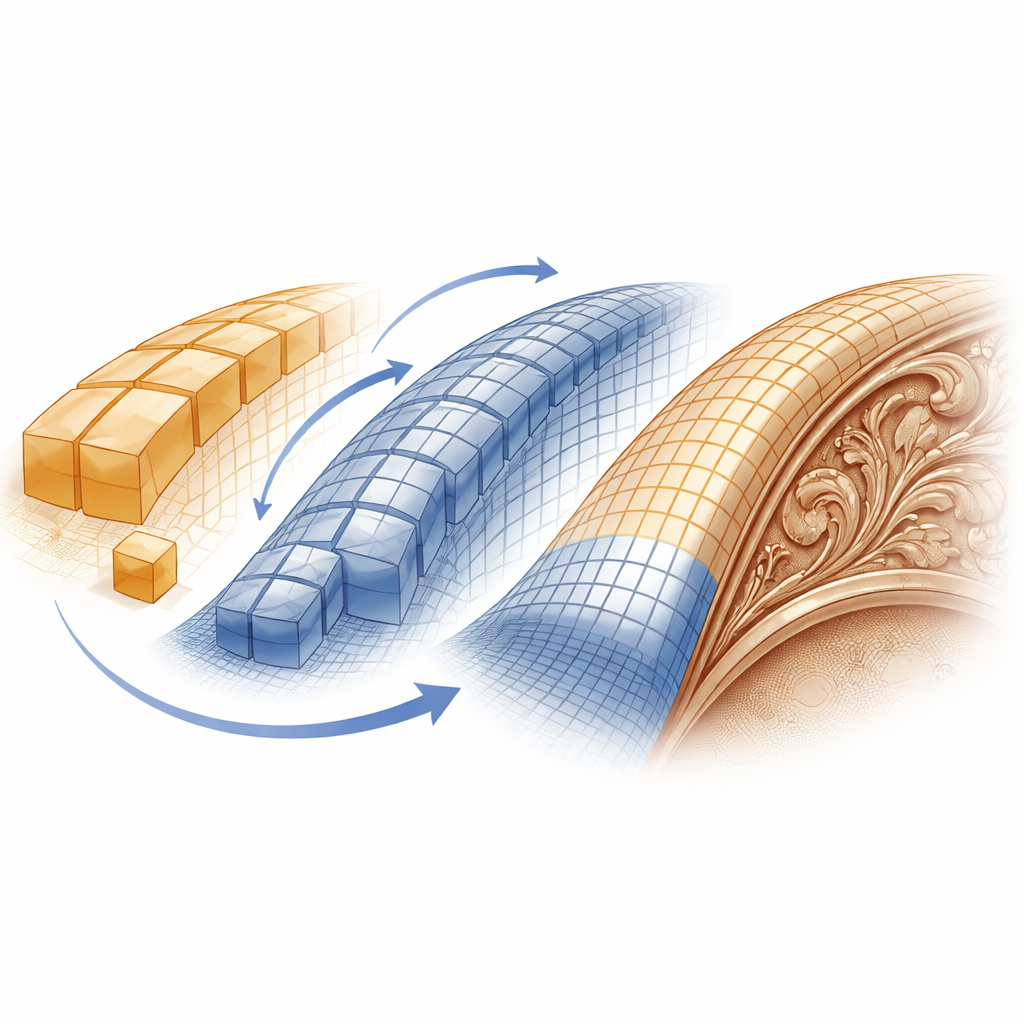
Shaping an invisible surface
Inside this adaptive grid, the surface is not drawn directly but described by an implicit function—a mathematical “field” that is zero exactly on the surface and positive or negative on either side. The new method fits this function globally so that it agrees with both the positions and directions of the input points. It enforces that the function’s slope near each point aligns with the local surface orientation and stays well-behaved overall, avoiding wavy artifacts. The problem is cast as an energy minimization and solved efficiently with a multi-level numerical scheme and parallel computation. Finally, a specialized isosurface extraction step converts this invisible field into a clean, watertight triangle mesh suitable for visualization and analysis.
Putting it to the test on art and beyond
The researchers benchmark their technique on standard 3D models, very large point clouds with tens of millions of points, and real cultural heritage data from CT scans and laser scans. Compared with established methods and several modern neural approaches, their algorithm achieves lower geometric error, preserves intricate details such as teapot spouts, carved motifs, and engraved patterns, and does so with fewer grid cells and shorter running times. It also remains stable when noise is added, keeping surfaces smooth without blurring important features, and scales well to massive datasets like the well-known Lucy statue.
What this means for preserving the past
For non-specialists, the key outcome is that we can now build more faithful digital stand-ins for fragile artifacts, capturing both their overall shape and subtle surface work with fewer compromises. By combining adaptive sampling with a carefully controlled mathematical surface description, the method delivers high-resolution models that are both reliable and efficient to compute. This strengthens the digital foundation on which conservation decisions, virtual restorations, and public exhibits increasingly rely, helping ensure that the fine details of cultural heritage are not lost to time.
Citation: Tuo, M., Jin, S., Jia, C. et al. Frequency-domain oversampling for multi-resolution surface reconstruction: towards digital modeling of cultural heritage. npj Herit. Sci. 14, 244 (2026). https://doi.org/10.1038/s40494-026-02482-y
Keywords: 3D surface reconstruction, cultural heritage digitization, CT scanning, point cloud modeling, digital preservation