Clear Sky Science · en
Early experiments in the making of Moravian ceramics in North Carolina c. 1770–1820
Clay, Color, and a New Home
In the late 1700s, a small religious community from Central Europe carried their pottery skills across the Atlantic to what is now North Carolina. This article explores how these Moravian potters learned to work with unfamiliar soils, minerals, and firing conditions in their new home. By combining scientific analysis with old workshop records, the authors reveal how each pot became a kind of experiment in adapting European craft traditions to American ground.
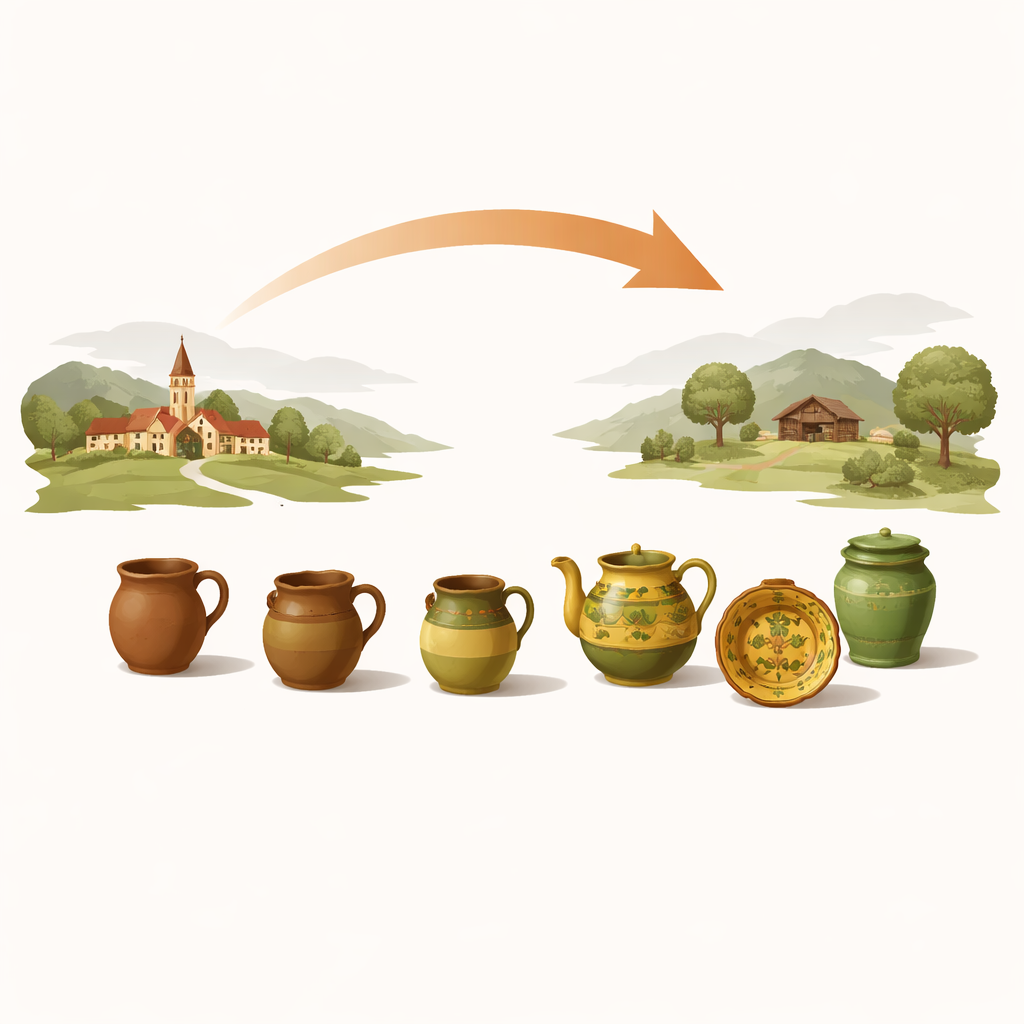
A Journey Written in Pots
The Moravian community had a long but interrupted history of ceramic making in Europe before settling in North Carolina in the mid‑18th century. After persecution scattered their workshops, some members eventually founded new settlements in Bethabara and later Salem. There, pottery served both everyday needs and outside customers. Two master potters dominated the years around 1770–1820: Gottfried Aust, trained in Saxony, and his apprentice and successor, Rudolf Christ. Their shared workshop style can make it hard to tell who made what, or exactly when, just by looking at the decoration. Instead of chasing signatures, this study asks a different question: how did these potters change their materials and recipes as they learned to work in a new landscape?
Three Layers of Craft
Most early North Carolina Moravian wares belonged to a family called slipware. These pieces were built from dug and purified clay, then coated with a smooth, usually lighter slip—a watered-down clay layer—before being decorated with colored surfaces and finally covered by a clear, shiny lead-based glaze. Green came from copper compounds, light browns from iron, deep browns from manganese, and rich reds from an iron‑rich slip applied as a thick paste. Ideally, the final glaze would be perfectly transparent over the pale ground. In practice, many North Carolina examples have a soft yellow cast, influenced both by local materials and by fashionable imported ceramics such as English Queensware, which proudly displayed a creamy, warm tone instead of stark white.
Reading Pots with X‑Rays
To uncover what lay behind these colors, the researchers examined sixteen intact pieces from Old Salem Museums & Gardens using X‑ray fluorescence (XRF), a non‑invasive method that detects elements in the outer layers of an object. They measured multiple spots on each color area and, where possible, on bare clay. Instead of trying to calculate exact chemical recipes—which is difficult on curved, layered surfaces—they compared the relative strength of signals from elements such as lead, tin, antimony, copper, iron, and manganese. Using statistical tools that group similar measurements, they could see which glazes and clays shared a common origin or recipe, and which ones represented clear departures. Archival records—letters, inventories, and a handwritten recipe book brought by a German traveler, Carl Eigenberg—provided a historical backdrop for these patterns.
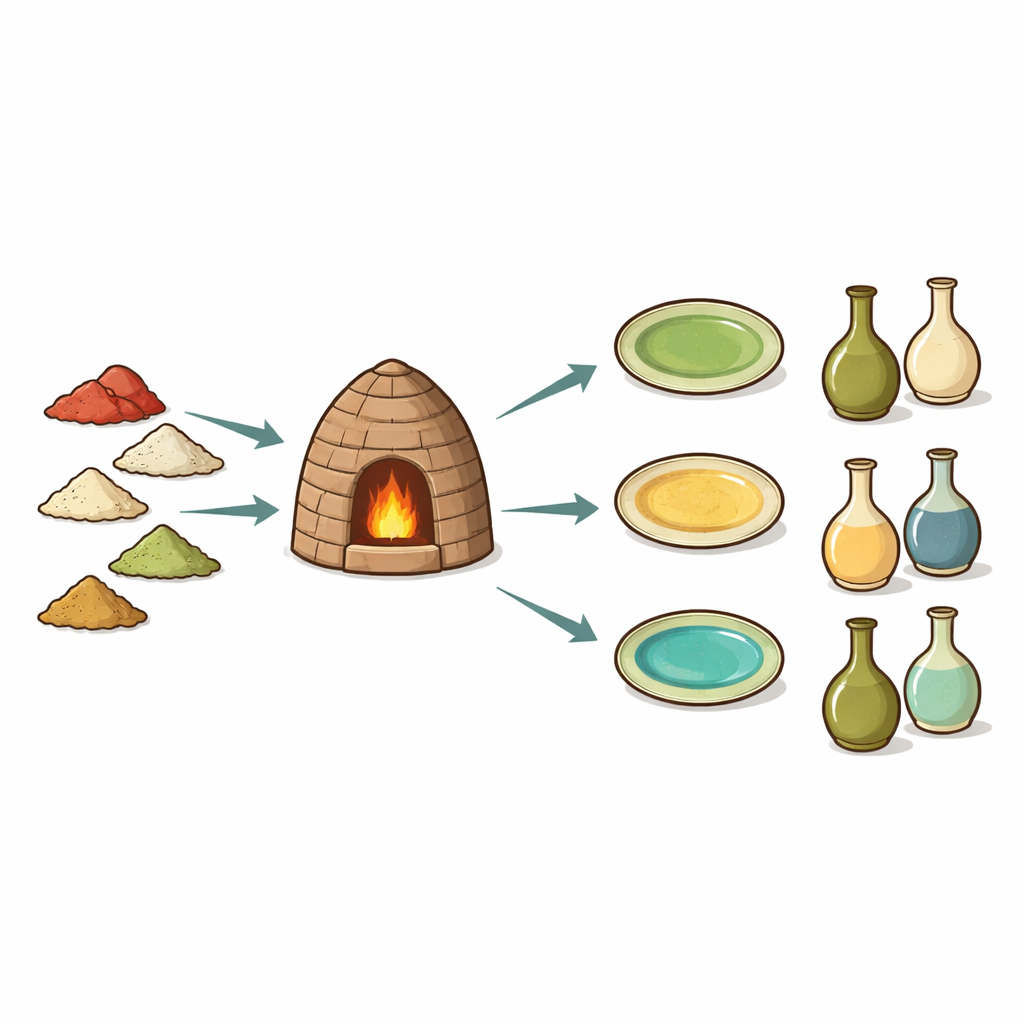
Experiments in Color and Technique
The analysis shows that Aust and Christ were not simply repeating fixed formulas; they were constantly testing new possibilities. One plate and a teapot linked to Aust contain unusually high amounts of antimony, hinting at attempts to create warmer yellow tones related to pigments known as Naples yellow. Two later floral plates, associated with Christ, cluster together because of their distinct mixtures of iron, copper, and lead in both red and white areas, suggesting that he was actively adjusting his glaze recipes once he took over the Salem workshop. Green-glazed pieces—a bottle with an eagle and a pitcher—share closely matched copper- and iron-rich glazes, tying them to the same batch of materials and to a tight window around 1820, even though the pitcher’s handle style echoes earlier work. Brown glazes vary as well: a bear-shaped bottle shows far stronger signals from color‑giving metals than a squirrel bottle or a brown pitcher, pointing to a specially enriched recipe. Perhaps most striking is a blue‑green ring bottle whose surface is packed with tin and relatively less lead. This object likely represents Christ’s trials with tin-glazed earthenware, a technology and recipe set that Eigenberg introduced and that required new kilns and ingredients.
Tracing Clay and Collaboration
The clay beneath the glazes also tells a story. Some pieces show the presence of nickel in the ceramic body, while others do not, hinting that the potters sometimes switched clay sources. Archival inventories describe wagonloads of white clay being moved from Bethabara to Salem, underscoring how raw materials travelled between sites. This means that simple labels like “Bethabara ware” or “Salem ware” can be misleading: the same clay and colorants could feed multiple kilns. Rather than belonging solely to single master craftsmen, these pots emerged from shared recipes, exchanged pigments, and group decisions about what to try next.
What These Pots Tell Us Today
Seen through this combined scientific and historical lens, Moravian ceramics from North Carolina become evidence of problem‑solving in real time. Tiny differences in metals within a glaze, or in the clay beneath, document how potters responded to new soils, imported pigments, and fashionable European styles, as well as to the limits of their own kilns. The authors argue that paying attention to materials and processes, rather than only to names and dates, reveals pottery as a deeply collaborative craft shaped by networks of knowledge, trade, and experiment. For today’s viewer, each cup, plate, and bottle is not just a pretty object but a record of how a community learned to make a foreign place their own, one firing at a time.
Citation: Sarnecka, Z., Bonizzoni, L., Brown, J.M. et al. Early experiments in the making of Moravian ceramics in North Carolina c. 1770–1820. npj Herit. Sci. 14, 241 (2026). https://doi.org/10.1038/s40494-026-02479-7
Keywords: Moravian pottery, historical ceramics, glaze analysis, technical art history, North Carolina craft