Clear Sky Science · en
An integrated method study on spatial differentiation and environmental attribution of Shanxi’s traditional villages
Why Where Villages Stand Still Matters
Across the loess hills and river valleys of Shanxi Province in northern China, hundreds of traditional villages still hold stories of how people adapted to a harsh, dry landscape. This study asks a deceptively simple question: did these communities spring up at random, or did their locations follow hidden rules shaped by terrain and water? By blending digital maps, statistics, and computer algorithms, the researchers show that where villagers chose to live reflects a long, quiet dialogue between human needs and the surrounding land—insight that now helps guide how these cultural treasures can be protected.
Patterns Hidden in the Landscape
The team began by mapping 619 nationally recognized traditional villages across Shanxi. Instead of a scattered, even spread, they found tight clusters, especially in the southeast and central basins, aligned roughly along a north–south belt. These hotspots hug river valleys such as the Fen River and trace the edges of major mountain chains, while the far north shows only sparse dots of settlement. Using well-established spatial tools, the authors confirmed that such clustering is extremely unlikely to be due to chance alone, signaling that deeper environmental forces were at work.
Choosing Gentle Ground and Winter Sun
Next, the study examined how village sites relate to features of the land itself: height above sea level, steepness of slopes, how rough or smooth the ground is, and whether a spot lies on a ridge, hillside, or valley floor. Villages overwhelmingly sit at medium elevations rather than on high peaks or in the very lowest plains. They favor very gentle slopes and relatively smooth surfaces, avoiding jagged, deeply carved terrain that would complicate building houses, farming, and moving around. A clear tilt toward south- and southeast-facing hillsides suggests people deliberately sought sunnier, warmer microclimates in Shanxi’s cold, dry winters, using the land’s orientation like a passive heating system.
Living Close to Water but Out of Harm’s Way
Because Shanxi’s climate is semi-arid and its rivers are prone to flash floods, water is both a gift and a threat. The researchers measured how far each village lies from the nearest river and combined information about underground rock, landforms, and soils to estimate how well different areas store and circulate water. Villages tend to cluster at modest distances from rivers—close enough for daily use and irrigation, but far enough to reduce flood damage. They also lean toward zones where the geology and terrain favor groundwater and rainfall storage, and toward soils that drain well without losing water too quickly. These preferences point to an old but sophisticated understanding of how to secure reliable water in an unpredictable environment.
Three Environmental Styles of Village Life
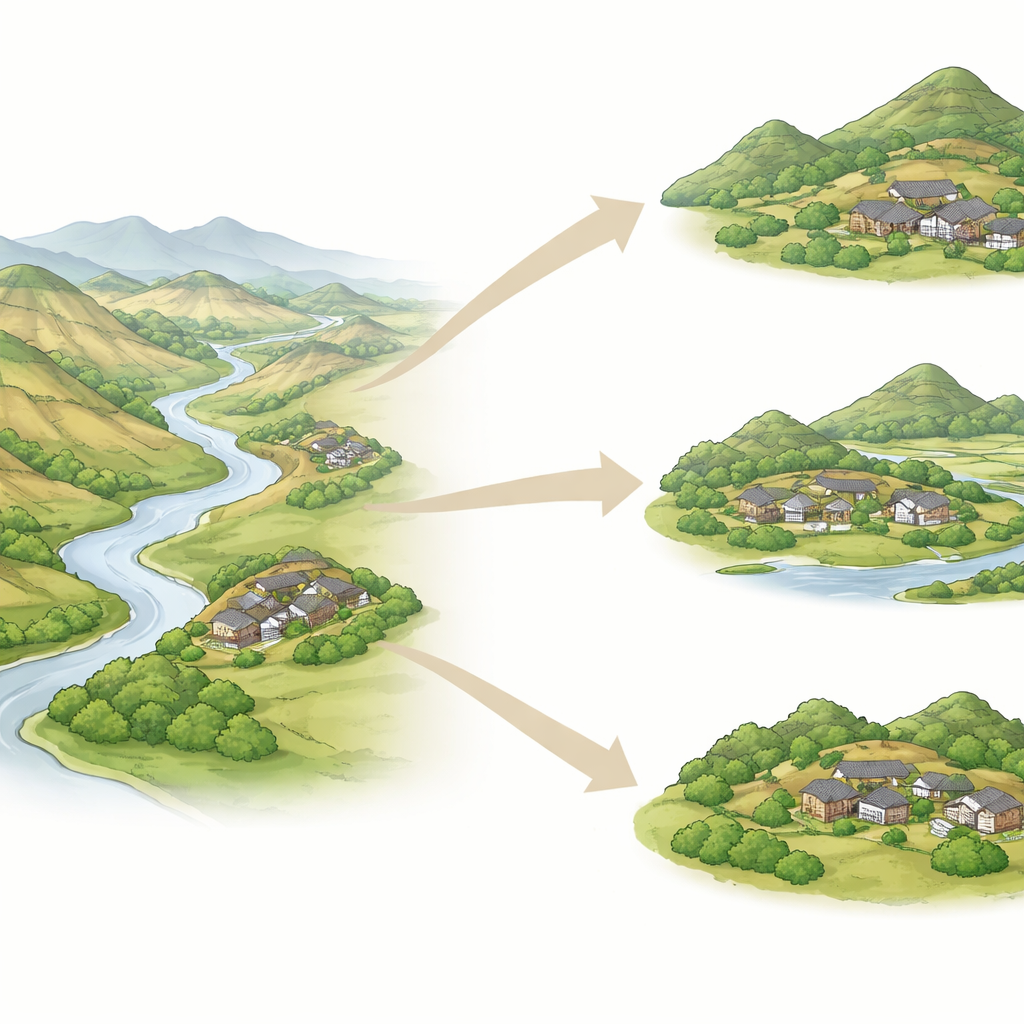
To see how all these factors combine, the study used an unsupervised machine learning method, which groups villages with similar environmental settings without telling the computer what to look for. Three broad "styles" emerged. One is the high-steep mountainous type, where settlements push into tougher, steeper ground but still find relatively stable niches. Another is the river valley plain type, nestled on low, level land with especially favorable water conditions—prime zones for farming and dense clustering. The third is a hilly platform type, occupying moderate slopes and elevations, striking a balance between safety, access to resources, and ease of building. Together, these types show that traditional villages reflect not one ideal location but several workable compromises with the land.

What This Means for Saving Old Villages
For non-specialists, the core message is straightforward: Shanxi’s traditional villages are not scattered accidents; they are the result of centuries of practical trial-and-error in balancing shelter, sun, soil, and water. By proving that these communities have clear, measurable environmental "signatures," the study offers a scientific basis for protection policies. Safeguarding the surrounding slopes, rivers, and groundwater conditions is as important as restoring old houses, and different village types call for different conservation strategies. In short, preserving these living heritage sites means preserving the finely tuned relationships with the landscapes that made them possible.
Citation: Zhao, Q., Li, L. & Wang, J. An integrated method study on spatial differentiation and environmental attribution of Shanxi’s traditional villages. npj Herit. Sci. 14, 205 (2026). https://doi.org/10.1038/s40494-026-02472-0
Keywords: traditional villages, human–environment interaction, spatial distribution, cultural heritage conservation, Shanxi Province