Clear Sky Science · en
Pose-based embodied interaction for digital Dunhuang dance heritage
Dancing with Ancient Murals
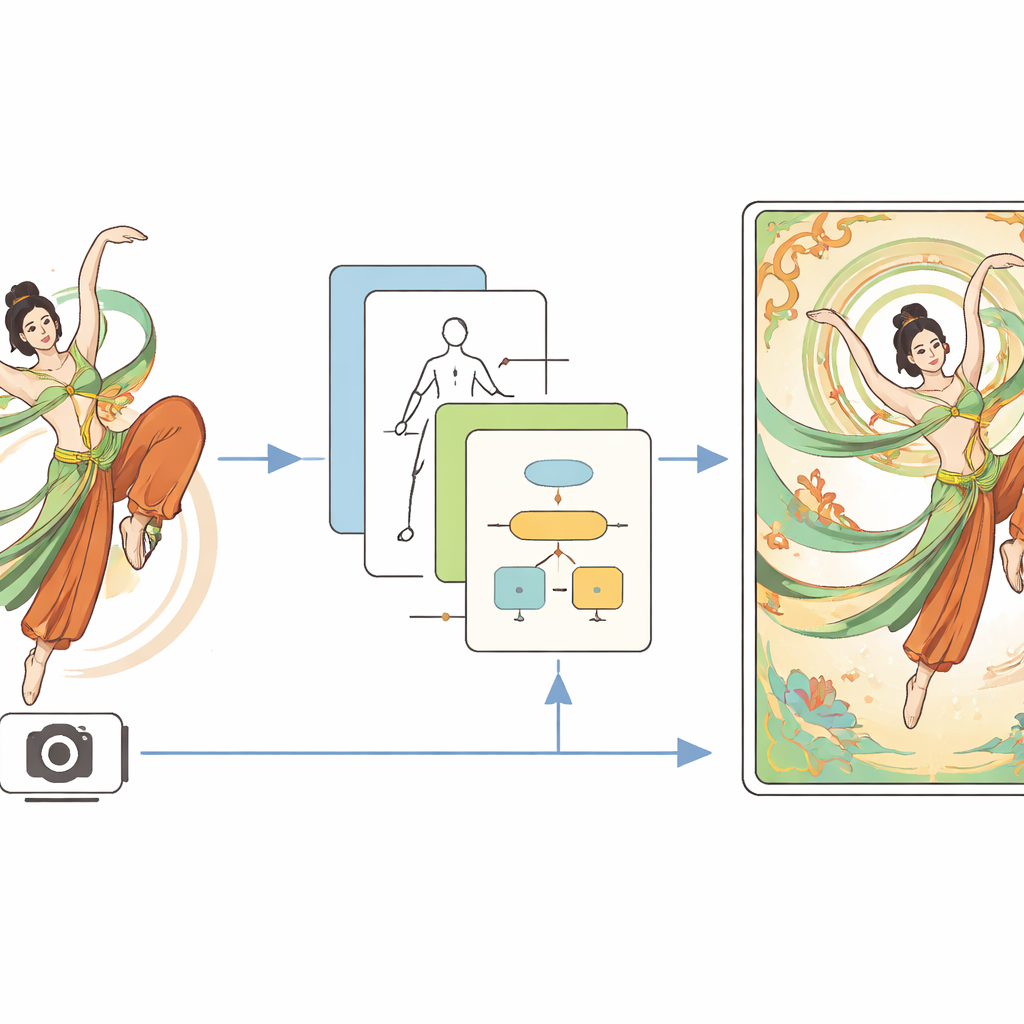
Dunhuang dance, inspired by the swirling figures on the murals of China’s Mogao Caves, is both visually stunning and technically demanding. For visitors and students, it can be hard to move from admiring these painted bodies on a wall to performing their flowing curves in real life. This paper introduces a camera-based interactive system that lets anyone with a laptop step into those mural poses, receive real-time guidance on how close they are to the ideal form, and instantly turn their best moments into Dunhuang-style digital posters.
From Cave Paintings to Living Motion
Intangible cultural heritage like dance is harder to preserve than statues or murals because it lives in bodies, not stone. While Dunhuang’s caves have been scanned and archived in exquisite visual detail, most digital projects still ask people to look, not move. The authors argue that to truly keep this tradition alive, learners need embodied practice—trying the poses, adjusting in the moment, and feeling the style in their muscles. They set out to build a system that does exactly this, using only consumer hardware such as a standard webcam and laptop, so that museums, classrooms, and cultural centers can adopt it without expensive equipment.
Teaching a Computer to Read a Pose
To train the system, the team collected 23 videos of professional and semi-professional Dunhuang dancers performing five classic poses. From these, they extracted about 1,230 still frames that capture both correct and imperfect versions of each pose. Human annotators—including dance experts and non-experts—labeled each frame as "Good" or "Bad" based on clear criteria like arm height, torso curvature, and symmetry, with substantial agreement between raters. A lightweight tool from Google called MediaPipe then converted each dancer’s image into 33 key body points—such as shoulders, hips, elbows, and wrists—represented as simple 2D coordinates. This turned rich images into compact numerical descriptions of posture.
How the System Judges Your Movement
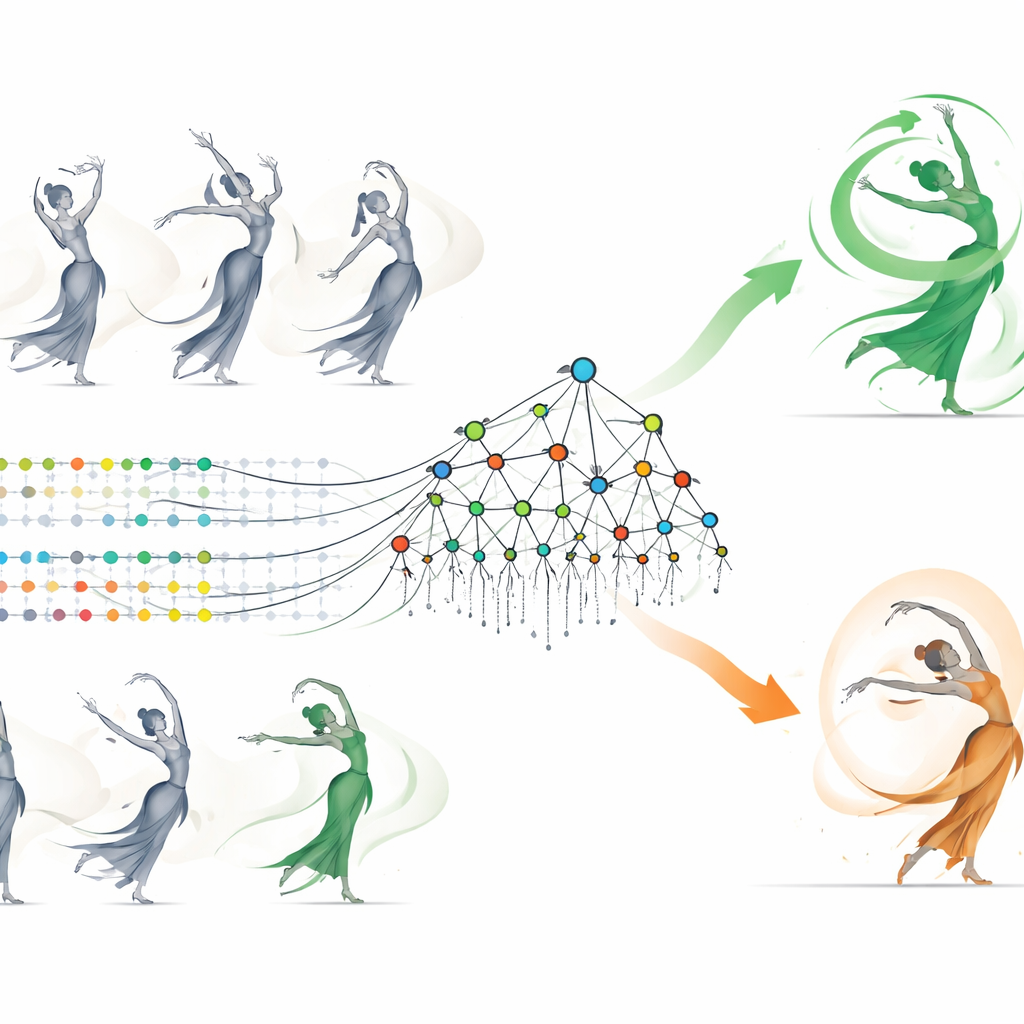
On top of these skeletal points, the researchers compared eight classic machine-learning methods to see which could best tell good and bad poses apart. Instead of deep neural networks, which demand huge datasets and powerful graphics cards, they focused on algorithms that run quickly on everyday machines. A method called Random Forest, which combines many simple decision trees, emerged as the clear winner, correctly classifying pose quality about 98.5% of the time and rarely missing a truly correct pose. It also handled a tougher task: recognizing not just quality, but which of the five poses the user was attempting, reaching over 97% accuracy even when some stances looked very similar.
From Motion to a Personal Dunhuang Poster
Once trained, the model was embedded in an interactive program with four main stages. First, the user chooses a target pose and optional visual effects, then stands before a webcam. The system tracks their skeleton in real time at around 20–25 frames per second, constantly checking both which pose they are doing and how well they are doing it. When someone holds the correct pose steadily for a couple of seconds, the system captures a frame, cuts them out from the background, and composites their figure into a Dunhuang-inspired scene—complete with mural-style colors, halos, and ribbons aligned to their joints. Users can view and download this vertical poster, which blends their live movement with the visual language of the ancient cave art.
Why This Matters for Keeping Traditions Alive
For non-specialists, the key takeaway is that preserving a dance tradition is not just about recording videos; it is about inviting people to embody those movements themselves. This work shows that relatively simple, transparent algorithms and a modest dataset can deliver fast, accurate feedback that feels responsive enough to guide learning. By turning correct poses into shareable Dunhuang-style posters, the system turns practice into a playful cultural experience rather than an exam. The authors see this as a step toward "performative preservation": using interactive technology so that heritage is not only watched and archived, but also re-enacted and felt, helping ancient mural figures continue to "dance" through the bodies of today’s learners.
Citation: Fu, Q., Zhou, Y. & Ding, X. Pose-based embodied interaction for digital Dunhuang dance heritage. npj Herit. Sci. 14, 223 (2026). https://doi.org/10.1038/s40494-026-02470-2
Keywords: Dunhuang dance, intangible cultural heritage, pose recognition, interactive learning, cultural heritage technology