Clear Sky Science · en
Cleaning the “silver mirror” with a triethanolamine-based strategy for black-and-white silver salt negatives
Why old film sometimes looks strangely shiny
Many archives, museums, and families hold black‑and‑white negatives that quietly record the past. Over time, though, these films can develop a bright, bluish metallic sheen on their surface, often called a “silver mirror.” This shine may look intriguing, but it actually hides details, blurs faces, and makes images harder to see and digitize. The study summarized here describes a new, safer way to gently clean this metallic layer from historic negatives while keeping the fragile films themselves intact.
What is going wrong on the film surface
Black‑and‑white negatives are built from light‑sensitive silver compounds embedded in a thin gelatin layer laid over a plastic support. Decades of fluctuating temperature and humidity can damage the top protective coating and disturb the chemistry inside. Tiny silver‑sulfur particles (Ag2S) then migrate toward the surface and pile up into a thin, reflective skin. Under reflected light this looks like a silvery blue haze, especially over darker parts of the picture. That shiny crust scatters light, lowers contrast, and masks fine details, turning sharp photographs into murky, hard‑to‑read images.
Past cleaning methods and their drawbacks
Conservators have tried several ways to tackle this silver mirror, from rubbing with soft plastic erasers to washing with various solvents and strong chemicals. Physical rubbing can scrape the image layer and leave behind plastic fragments. Some liquid treatments rely on harsh or poisonous substances, such as cyanides or aggressive acids, which are dangerous for people and can weaken the film in the long run. Gentler rinses, like water–alcohol mixtures, tend to swell the gelatin unevenly, risking cracking and warping without fully removing the metallic layer. Overall, existing methods either fail to clean completely, are unsafe to handle, or threaten the long‑term stability of precious negatives.
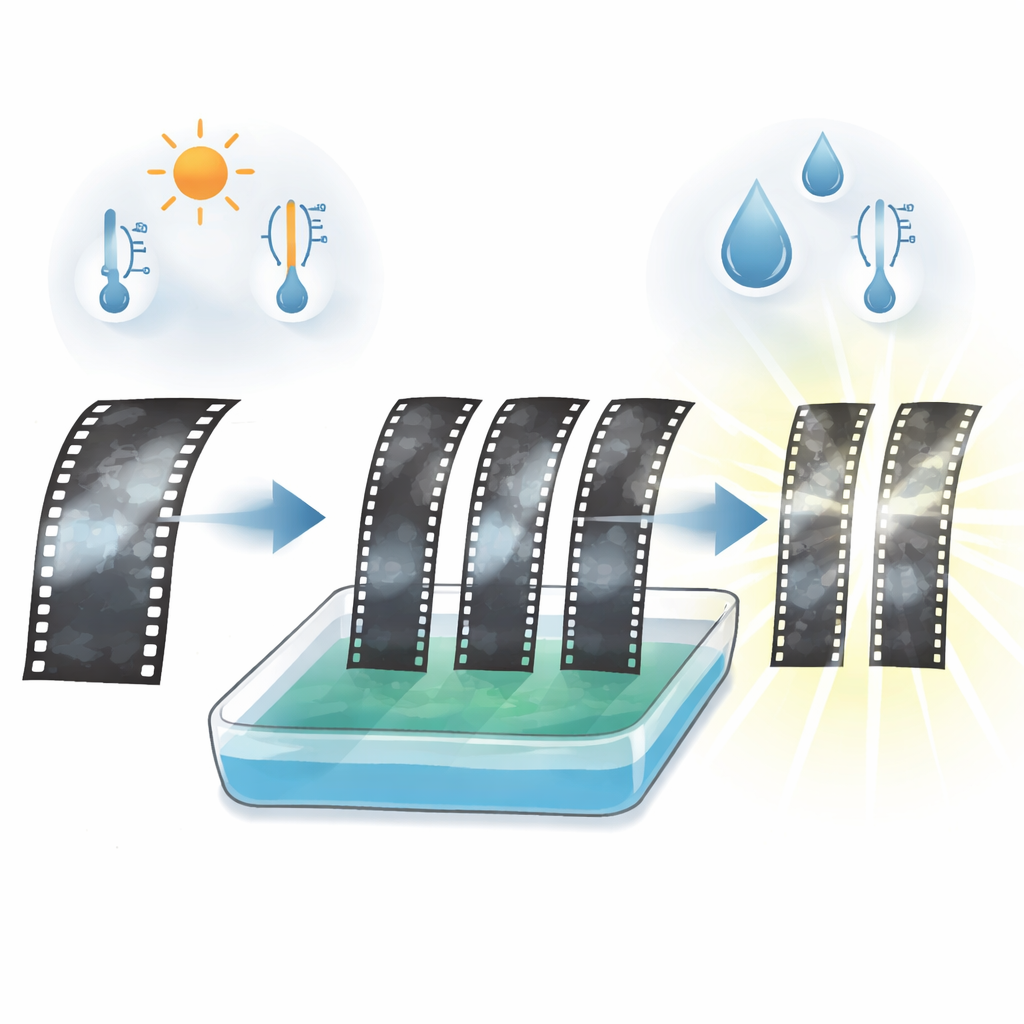
A new gentle bath for damaged negatives
The authors systematically tested a range of common laboratory liquids on silver‑mirrored negatives, watching how each one changed the film’s appearance, its ability to transmit light, and its surface smoothness. Two candidates stood out for actually clearing the metallic sheen: glycerol and triethanolamine (TEA), a mild, alkaline, alcohol‑like liquid. TEA gave the best improvement in light transmission and the greatest drop in surface reflection, clear signs that the reflective layer was being removed. To help TEA spread evenly across the hydrophobic, mirror‑coated surface, the team added a non‑ionic surfactant (a soap‑like agent) called TO‑8. By adjusting the mixture, they found that a solution with 4% TO‑8 and 96% TEA spread smoothly, diffused uniformly, and avoided bubbles or edge effects while the film soaked.
How the cleaning actually works
With the optimized solution in hand, the researchers immersed damaged negatives and gently wiped them during a three‑hour treatment. Over time, cotton swabs picked up brown residues and the metallic sheen faded. Using surface‑sensitive X‑ray measurements, they showed that the shiny layer was mainly made of Ag2S, and that after treatment these sulfur‑bearing particles were almost completely gone, exposing the original metallic silver image beneath. Infrared analysis of the gelatin revealed subtle shifts in its internal structure: the TEA‑rich bath encouraged the protein strands to rearrange into more ordered “sheet‑like” segments that hold silver‑sulfur particles less tightly. This restructuring, together with swelling of the gelatin and the improved wetting provided by TO‑8, makes it easier for the Ag2S grains to detach and wash away without dissolving the actual picture silver.
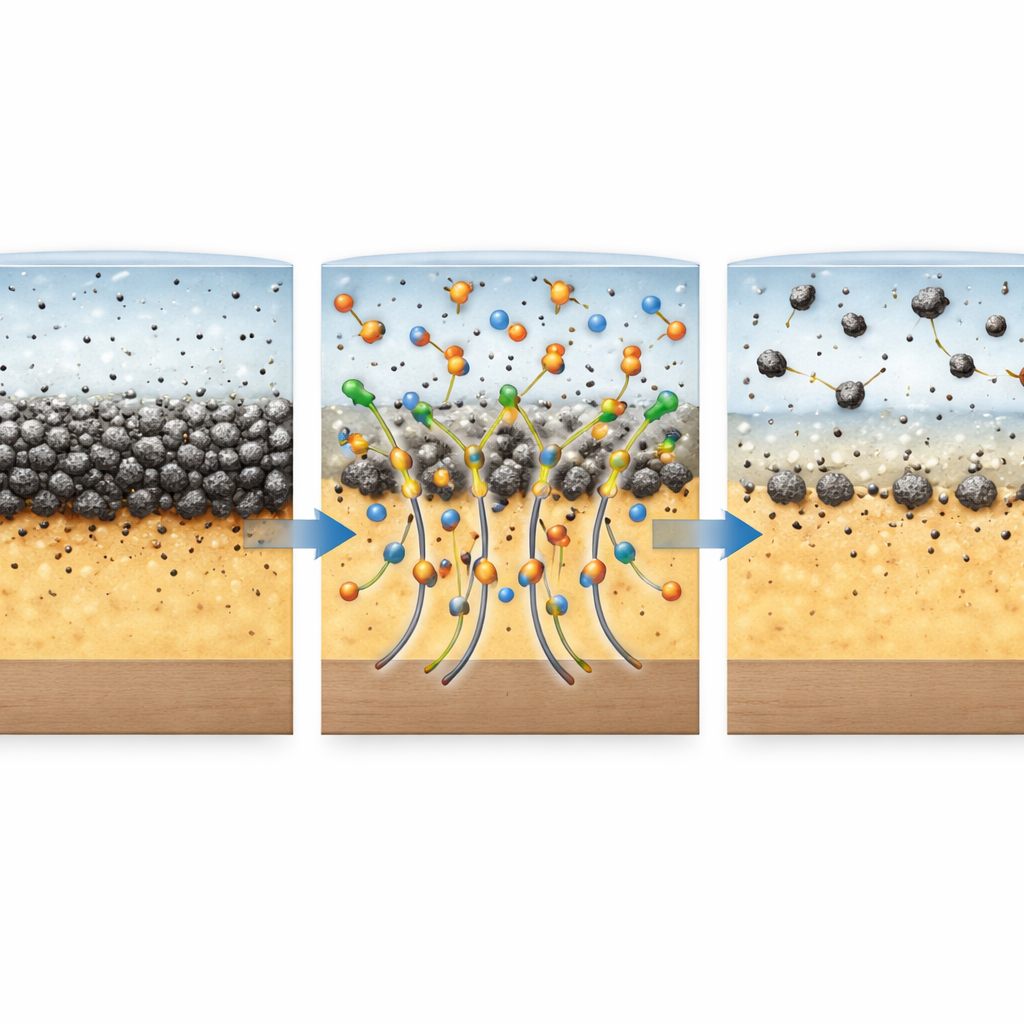
Saving clarity without sacrificing strength
Cleaning is only useful if the film remains physically robust afterward. To test this, the team artificially aged similar negatives in warm, humid conditions, then compared samples before and after cleaning in folding and stretching tests. Across different aging stages, cleaned and uncleaned pieces showed very similar mechanical strength, suggesting that the TO‑8/TEA bath does not noticeably weaken the material. Digital scans before and after treatment told the visual story: bright and dark streaks and speckled noise nearly vanished, mid‑tones became more balanced, and previously hidden details in clothing, architecture, and faces became clearly visible again. The tonal range of the cleaned images shifted toward a more natural, information‑rich distribution.
What this means for our photographic heritage
For archivists, museum professionals, and anyone caring for family negatives, this work offers a practical recipe: a surfactant‑enhanced TEA bath that can strip away the unwanted silver mirror while preserving both the physical strength and the visual content of historic films. Although very long‑term effects still merit study, the method is far safer than many older chemical treatments and more effective than simple surface wiping. By restoring transparency and contrast without harsh interventions, this approach helps rescue the legibility of twentieth‑century black‑and‑white photography, keeping visual records of people and places accessible for future generations.
Citation: Shi, Y., Ruan, Y., Luo, J. et al. Cleaning the “silver mirror” with a triethanolamine-based strategy for black-and-white silver salt negatives. npj Herit. Sci. 14, 213 (2026). https://doi.org/10.1038/s40494-026-02466-y
Keywords: silver mirroring, photographic conservation, black-and-white negatives, gelatin film cleaning, image restoration