Clear Sky Science · en
A multi-purpose large area scanner for x-ray fluorescence and reflectance imaging and its application to Asian art
Peeking Beneath the Surface of Art
Many historic paintings hide stories just below the surface—earlier sketches, reused papers, repairs, and subtle choices of color that are invisible to the naked eye. This article describes how researchers at the National Museum of Asian Art built a large, flexible scanning system that can gently examine big, fragile works of art without taking them off-site or cutting out samples. Using a famous Japanese folding screen decorated with painted fans as a test case, the team shows how their scanner can reveal the pigments, hidden drawings, and past restoration work that together tell the full life story of an artwork.
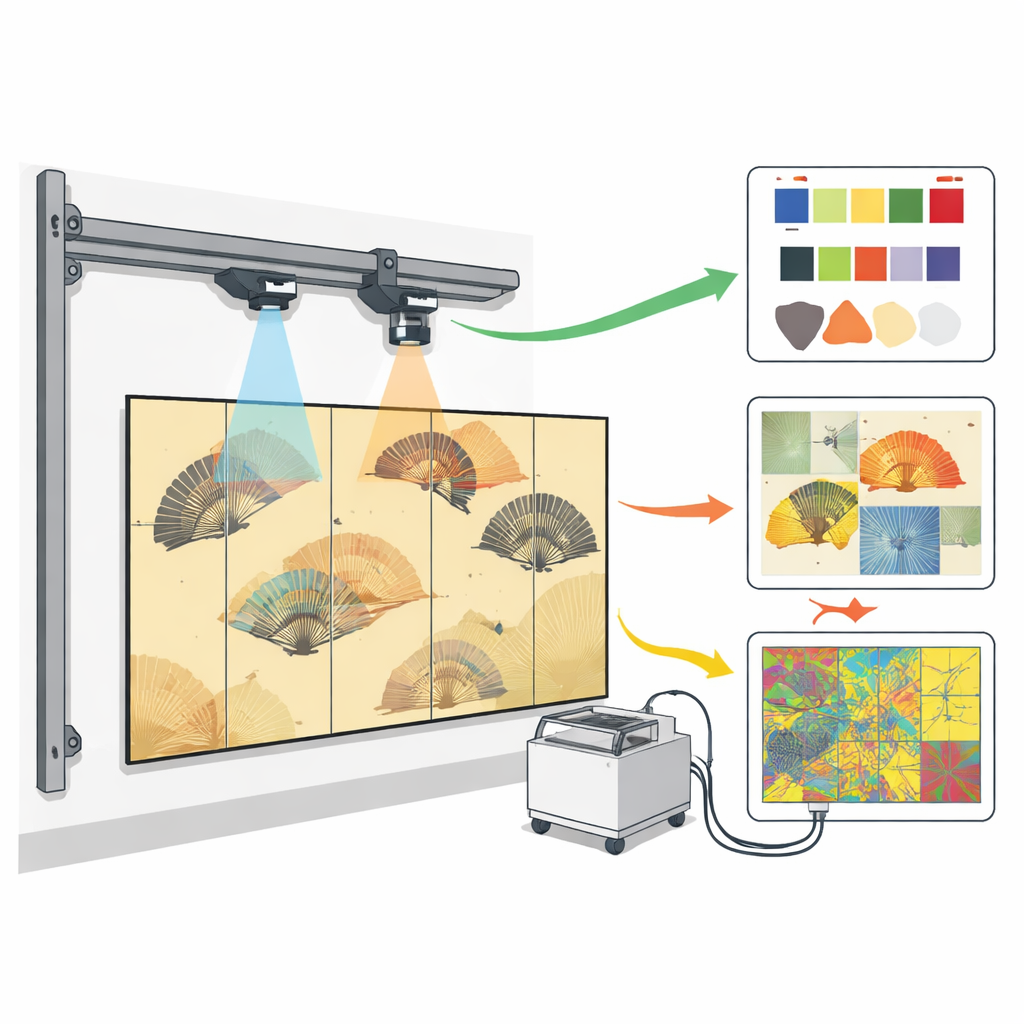
A Custom Scanner Built Around the Artwork
Conventional scientific cameras and x-ray instruments are usually designed for small objects, like coins or laboratory samples. Large artworks—such as wall-size paintings or long handscrolls—are awkward to move and often must stay flat, which makes detailed analysis difficult. To solve this, the authors designed a wall-mounted, motorized rail system that can travel 4.5 meters horizontally and 1 meter vertically. A movable carriage glides along these rails and can accept different “heads,” such as an x-ray fluorescence unit or a reflectance imaging camera. Because the scanner’s frame is open rather than boxed-in, curators can slide very wide panels or screens underneath. The same motion platform serves multiple types of imaging, saving space, money, and setup time.
Seeing Elements and Colors Without Touching the Paint
The first major tool attached to the scanner is an x-ray fluorescence (XRF) system. When the x-ray beam hits the painting, different chemical elements in the pigments emit characteristic signals, which are captured by a detector. By pausing at thousands of points in a grid, the system creates “element maps” that show where mercury, lead, copper, silver, gold, and other elements appear across the artwork. In the fan screen, these maps confirmed shell gold and gold leaf in the waves and decorations, silver details in garments and landscapes, and classic red and orange pigments such as vermilion and red lead. Subtle patterns—like traces of silver that have darkened to silver sulfide, or unusual mixtures of iron and copper in brown areas—help identify both original materials and later retouching.
Using Invisible Light to Reveal Hidden Designs
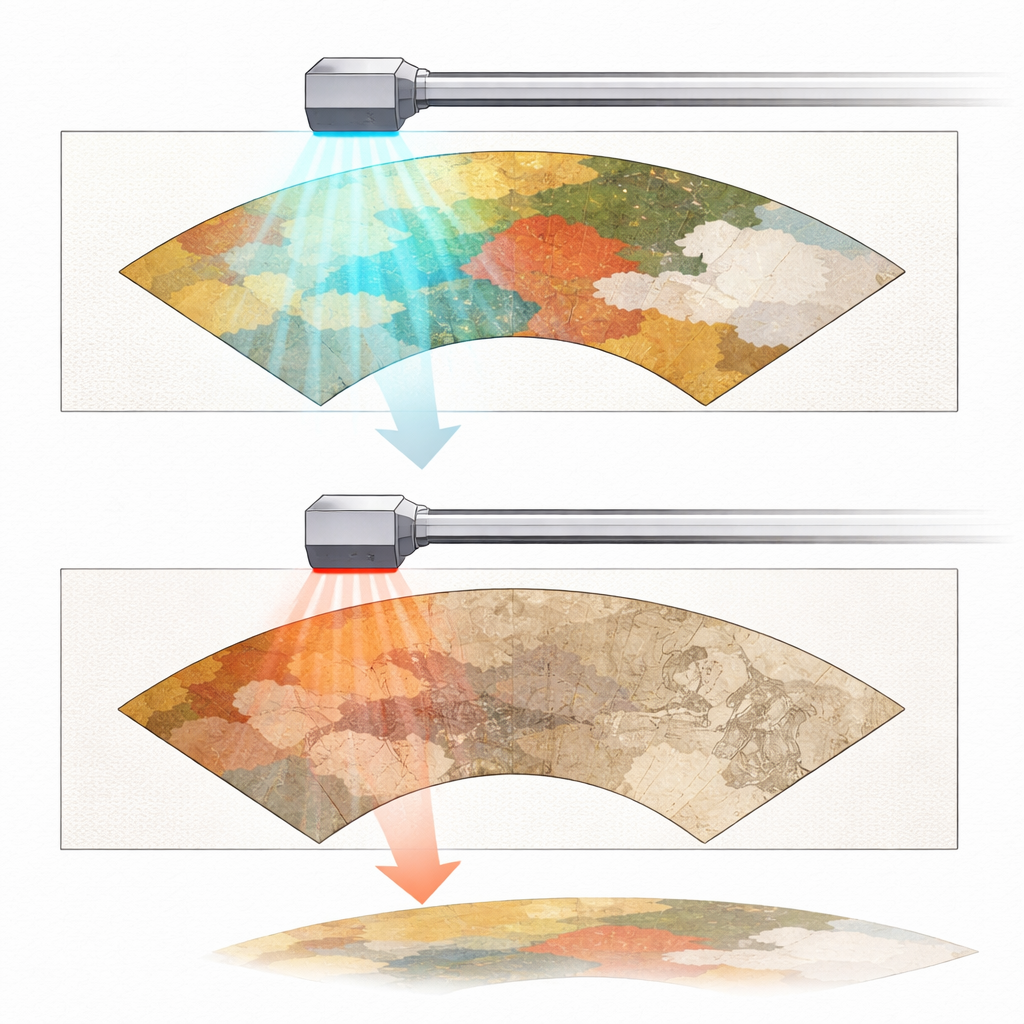
The second major tool is a camera that records reflected light from the visible into the near-infrared, followed by a separate short-wave infrared camera on a commercial system. These cameras capture hundreds of narrow color bands, far beyond what human eyes can see. By moving the scanner in a smooth “push-broom” path, the system builds up detailed image cubes that can be processed to highlight specific pigments and underdrawings. On one fan panel, short-wave infrared images made a faint sketch of a building and a figure—possibly a monk—stand out clearly, even though they are barely visible in normal light. In other areas, infrared signatures showed differences between ink and silver waves, revealed retouching of damaged silver, and confirmed pigments such as azurite, malachite-like copper greens, shell white, and mixtures that create pink garments or pale blues.
Tracing the Life and Repairs of a Japanese Screen
Looking fan by fan, the combined techniques uncovered how the screen was made and altered over time. While the overall palette matches what is known from other early Edo period paintings, the scanner picked up variations that suggest different paper stocks, pigment sources, and later conservation work. For example, one fan’s paper support has much lower levels of certain elements, hinting at a distinct origin. X-ray maps detected mercury from red ink stamps hidden in the lining papers of the wooden panel, not in the visible paint. Short-wave infrared imaging even revealed characters written on papers reused behind the fan faces, visible only when the conservation team later lifted the fans. These findings show how artists and restorers recycled materials and how structural layers beneath the paint influence what scientists see today.
Why This Matters for Museums and the Public
The study concludes that a versatile, open-architecture scanner can transform how museums study large artworks. By combining x-ray and different flavors of infrared imaging on a single moving platform, researchers can gather rich, high-resolution data with minimal handling of fragile objects. The Japanese fan screen case study demonstrates that such non-invasive tools can confirm traditional pigments, spot subtle differences between panels, and expose hidden drawings, writing, and reused papers that deepen our understanding of an artwork’s history. For museum visitors and art lovers, this means more accurate stories about how masterpieces were created, altered, and preserved—and, in many cases, the thrilling discovery of images and marks that were never meant to be seen again.
Citation: Clarke, M.L. A multi-purpose large area scanner for x-ray fluorescence and reflectance imaging and its application to Asian art. npj Herit. Sci. 14, 242 (2026). https://doi.org/10.1038/s40494-026-02449-z
Keywords: art conservation, hyperspectral imaging, x-ray fluorescence, Japanese painting, cultural heritage science