Clear Sky Science · en
PBDWNet: a multi-scale porcelain surface bubble segmentation network based on frequency-domain fusion and deformable feature awareness
Hidden Clues in Ancient Porcelain
When archaeologists unearth broken pieces of ancient porcelain, they are really finding tiny time capsules. Locked inside the glassy glaze of each shard are microscopic bubbles that quietly record how and where the object was made. Reading those bubbles, however, is extremely hard for the human eye and for ordinary computer programs. This study introduces a specialized artificial intelligence system, PBDWNet, designed to spot and trace these tiny bubbles with great precision, opening new ways to date, classify, and understand cultural relics.
Why Tiny Bubbles Matter
Porcelain is more than beautiful tableware; it is a material record of Chinese civilization and its global trade. Traditional analysis of shards relies on visible features such as shape, color, and painted decoration, and therefore demands years of expert experience. But in many excavations, fragments are small, worn, or visually similar, making it difficult to tell where and when they were produced. Microscopic bubbles inside the glaze offer an objective alternative. Their size, shape, density, and spatial arrangement change with the raw materials, firing temperature, glaze thickness, and atmosphere inside the kiln. By carefully measuring these patterns, researchers can build “micro‐fingerprints” that help determine a fragment’s origin and manufacturing technology.
The Challenge of Seeing the Unseen
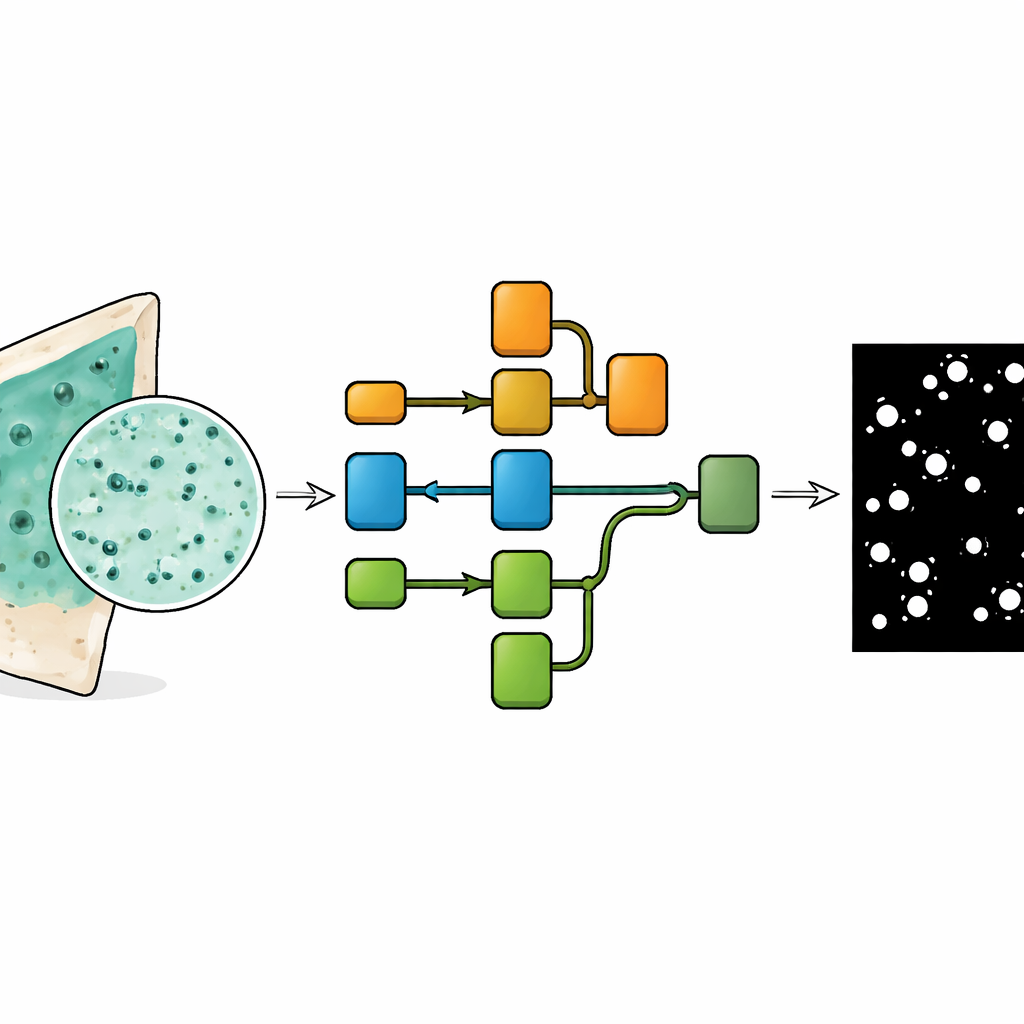
Although these glaze bubbles are rich in information, they are also extremely hard to detect. Under a microscope, bubbles are tiny, low in contrast, and often blend into a noisy, textured background. Classic image processing tricks—like simple thresholds, edge detectors, or shape operations—tend to break their outlines, confuse them with background patterns, or miss the smallest examples. Even modern deep learning systems that excel on everyday photographs struggle here, because they are not tuned for faint, irregular structures on complex ceramic surfaces. They often lose fine details, ignore subtle boundaries, and are easily distracted by glare or rough textures in the glaze.
A Three-Pathway Network Built for Bubbles
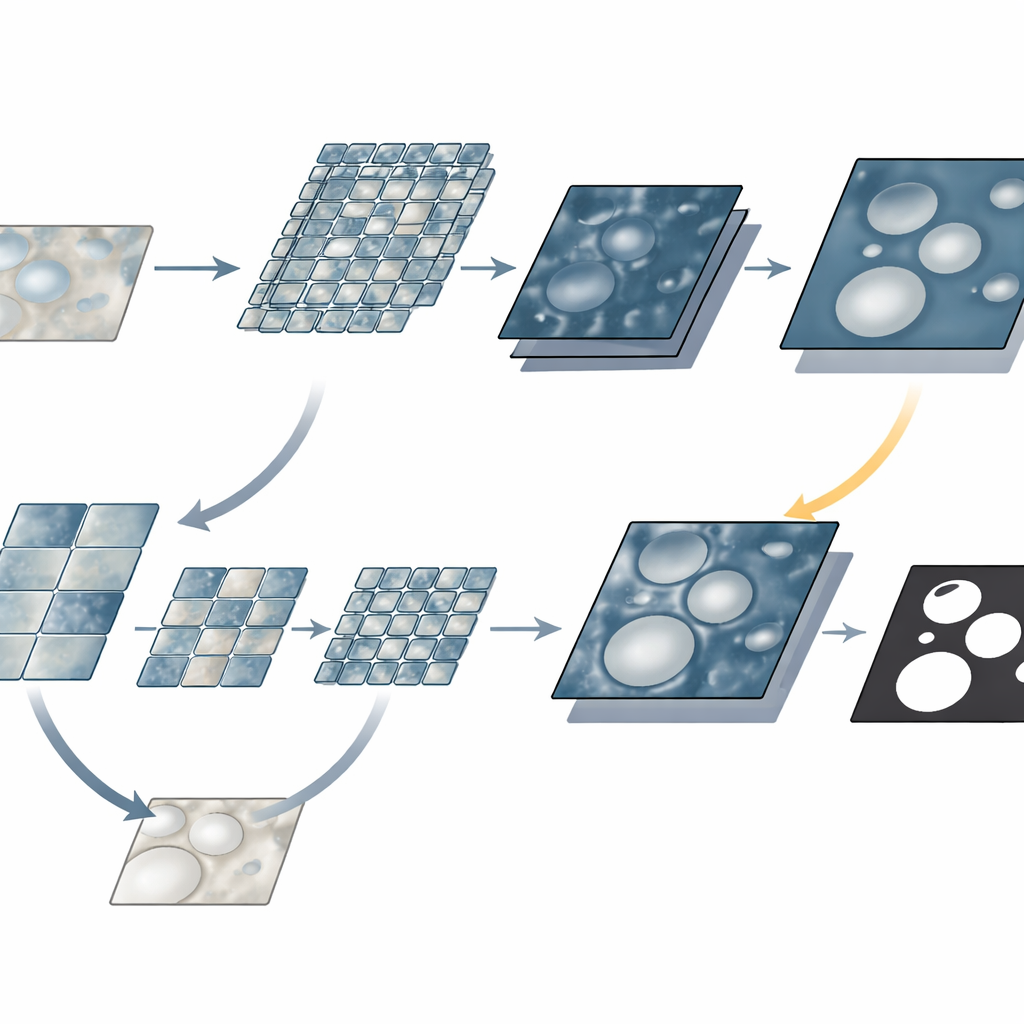
PBDWNet is a custom-built neural network that tackles these difficulties by processing each image along three coordinated pathways. The main path is based on a proven deep architecture that gradually transforms the raw microscope image into a rich internal representation while preserving relatively high resolution. On top of this, the authors add a “deformable feature awareness” branch, which lets the network bend its sampling grid around the irregular shapes of real bubbles. Instead of looking with a rigid square window, it can stretch and shift to follow curved outlines, focusing more precisely on where the bubble actually lies.
In parallel, a “wavelet” branch decomposes the image into low- and high-frequency components, roughly corresponding to broad structure and sharp edges. This frequency-based view allows the model to keep the overall glaze structure while highlighting thin bubble rims and other fine textures, and at the same time suppressing noise that does not follow bubble-like patterns. Carefully designed fusion steps then recombine information from all three paths, so that global context, detailed shapes, and clean edges reinforce one another rather than compete. The network is trained using a dual-output setup, which guides both intermediate and final predictions to be accurate at the level of individual pixels.
Putting the Method to the Test
To evaluate PBDWNet, the researchers used a dedicated dataset of high-magnification microscope images of porcelain shards, collected and expertly annotated at Northwest University. This dataset, called PRMI, captures a wide range of bubble sizes, densities, and surface appearances. The team compared their model with ten leading segmentation systems widely used in computer vision. Across standard measures of accuracy and overlap between predicted bubble shapes and human-drawn outlines, PBDWNet consistently came out on top, achieving the highest overall F1-score and the best intersection-over-union for both bubbles and background. Visual comparisons show that it keeps small bubbles intact, cleanly separates neighboring bubbles, and avoids “bleeding” into the surrounding glaze even when edges are blurred.
What This Means for Cultural Heritage
For non-specialists, the key takeaway is that this work turns otherwise invisible patterns in ceramic glaze into reliable, measurable clues about the past. By precisely tracing microscopic bubbles, PBDWNet helps convert each porcelain fragment into a data-rich object whose manufacture, origin, and technological sophistication can be inferred more objectively. While the current system still depends on carefully labeled training data and may need adaptation to very different lighting or materials, it already demonstrates how tailored AI tools can deepen our understanding of cultural artifacts. In practical terms, such technology can support more accurate dating, provenance studies, and even authenticity checks, strengthening the scientific foundations of archaeology and museum work.
Citation: Xing, J., Zhang, R., Liu, Y. et al. PBDWNet: a multi-scale porcelain surface bubble segmentation network based on frequency-domain fusion and deformable feature awareness. npj Herit. Sci. 14, 260 (2026). https://doi.org/10.1038/s40494-026-02440-8
Keywords: porcelain glaze bubbles, cultural heritage imaging, semantic segmentation, microscopy analysis, archaeological provenance