Clear Sky Science · en
Open-source digital image correlation application for monitoring humidity-induced deformation in canvas paintings with metrological evaluation
Why museum walls quietly move
When you walk through a gallery, the paintings seem perfectly still. Yet every change in temperature and humidity makes the canvases breathe in and out—swelling, shrinking, and slowly accumulating stress that can lead to cracks or tears. This study explores a low-cost, non-contact way to watch those tiny movements unfold in real time, giving conservators a new tool to protect artworks without ever touching them.
How air and water tug on paintings
Many materials in a painting—wooden stretchers, canvas, glue, and chalky primers—absorb and release water from the air. As humidity rises, they usually swell; as it falls, they shrink and can become brittle. Because each layer responds differently, invisible internal pushing and pulling builds up between them. Over years, this can cause familiar forms of damage: lifting paint, fine cracking patterns, or even outright splits in the structure. Canvas adds another twist: above very high humidity, it can actually shrink instead of expand, so predicting what will happen is far from straightforward.
Watching a canvas dry, pixel by pixel
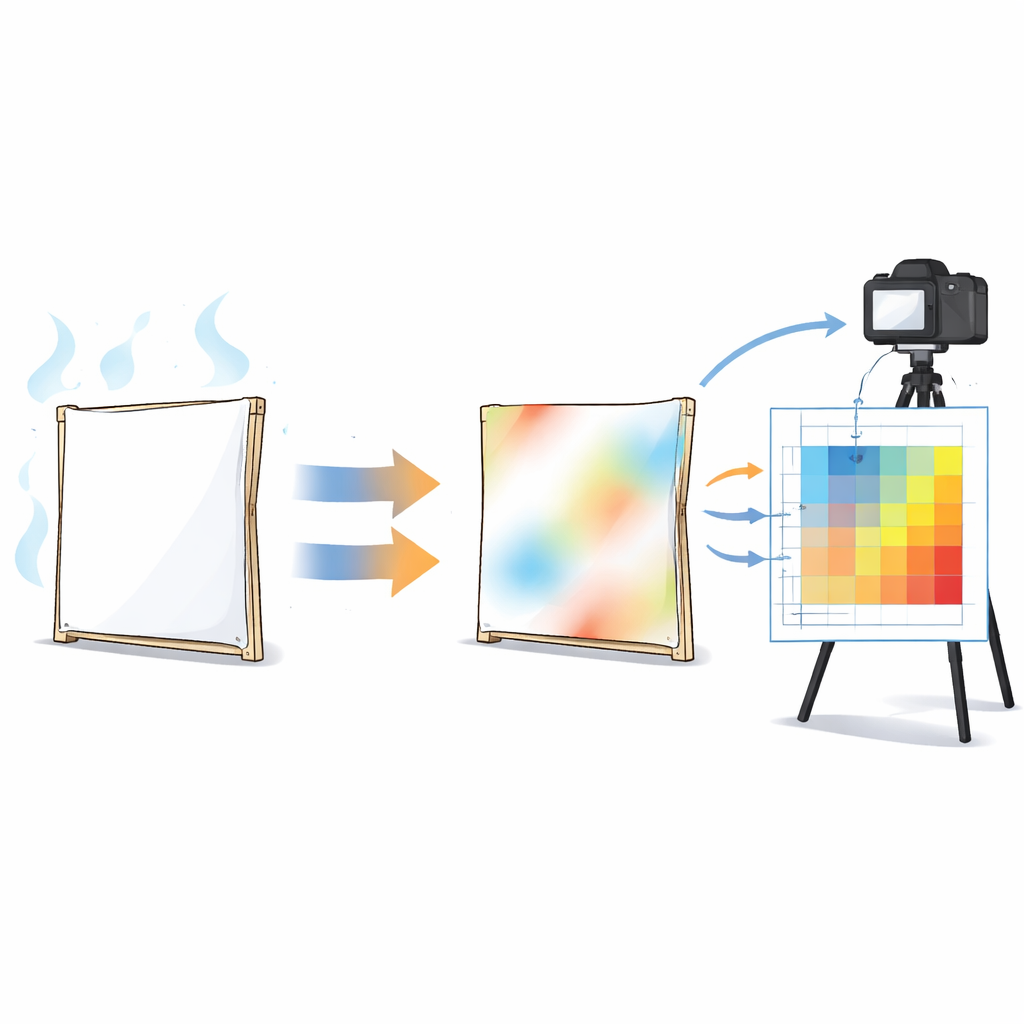
To capture these subtle motions, the researchers created small mock-up canvases similar to many real paintings: cotton fabric stretched on wooden bars and primed with gesso. They sprayed a fine black-and-white speckle pattern on the surface, then exposed the canvases to hot, very humid air before moving them into a cool, dry room. Using an ordinary consumer digital camera on a tripod, they took rapid sequences of photographs as the canvases dried.
Turning patterns into a deformation map
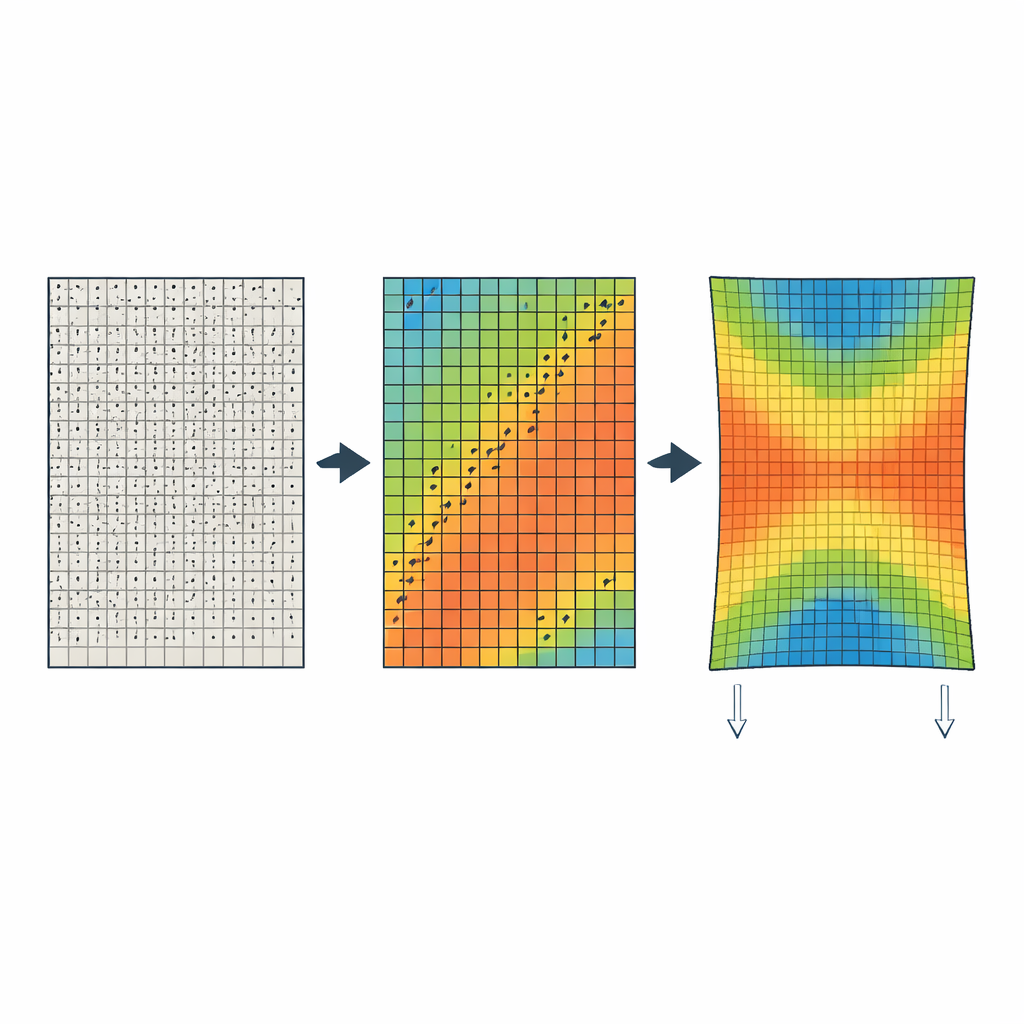
The heart of the method is a free, open-source software package called Ncorr, which performs digital image correlation. In simple terms, the program divides each photograph into many tiny square patches and tracks how each patch shifts from one image to the next as the canvas moves. From these tiny shifts, it reconstructs a full map of stretching and compression across the entire surface. The team carefully tuned the analysis and assessed the inevitable camera and processing noise, working out how small a real movement they could confidently distinguish from random fluctuations.
What the canvases revealed as they dried
When a canvas lay flat during drying, it shrank strongly along the edges where it was gripped by the wooden frame, while the center behaved differently, showing patterns of both contraction and slight expansion. This confirmed that the stretcher strongly shapes how the fabric can move, concentrating stretching near the tacking edges and compression toward the middle. When the same kind of canvas was instead held upright, a new effect appeared: the weight of the water it had absorbed pulled downward, so the lower part of the painting shrank more while the upper region showed relative expansion. In other words, gravity acting on absorbed moisture could be as important as the frame itself in deciding where stress builds up.
Measuring tiny movements that still matter
The researchers also asked a crucial practical question: are the movements they can see large enough to relate to real damage? By analysing the signal-to-noise ratio of their measurements, they showed that the setup could reliably detect strains of about four hundredths of a percent—well below the levels at which brittle layers such as gesso or some paint mixtures are known to begin cracking or deforming permanently. This means the method can spot worrying trends before visible damage appears, even though it uses a standard camera rather than expensive scientific hardware.
What this means for the care of art
For a non-specialist, the takeaway is that museum paintings are not passive objects; they subtly reshape themselves with every spell of damp or dry weather. This study demonstrates that with affordable equipment and open software, conservators can now map those changes across an entire canvas, identify the spots most at risk, and test how individual objects respond to proposed climate settings. In the long run, this kind of gentle, image-based monitoring can help museums balance strict preservation needs with more flexible and sustainable environmental control, keeping artworks safer while reducing costs and energy use.
Citation: Liao, YW., Gibson, A. & Grau-Bové, J. Open-source digital image correlation application for monitoring humidity-induced deformation in canvas paintings with metrological evaluation. npj Herit. Sci. 14, 207 (2026). https://doi.org/10.1038/s40494-026-02415-9
Keywords: canvas paintings, humidity damage, digital image correlation, art conservation, heritage science