Clear Sky Science · en
The asymmetrical ROS–METTL3–ESR1 axis in paraspinal muscle progenitor cells determines the progression of adolescent idiopathic scoliosis
Why a Crooked Spine Matters
Adolescent idiopathic scoliosis is a twisting and sideways curving of the spine that often appears around puberty, especially in girls. For many families it arrives as a surprise during a routine school screening, and doctors still cannot fully explain why some children’s backs begin to bend while others remain straight. This study peeks beneath the skin, into the back muscles and even into individual cells, to uncover a hidden chemical imbalance that may help drive the curve—and points to a simple, naturally occurring compound that might one day slow or soften the condition.
Uneven Muscles on the Two Sides of the Spine
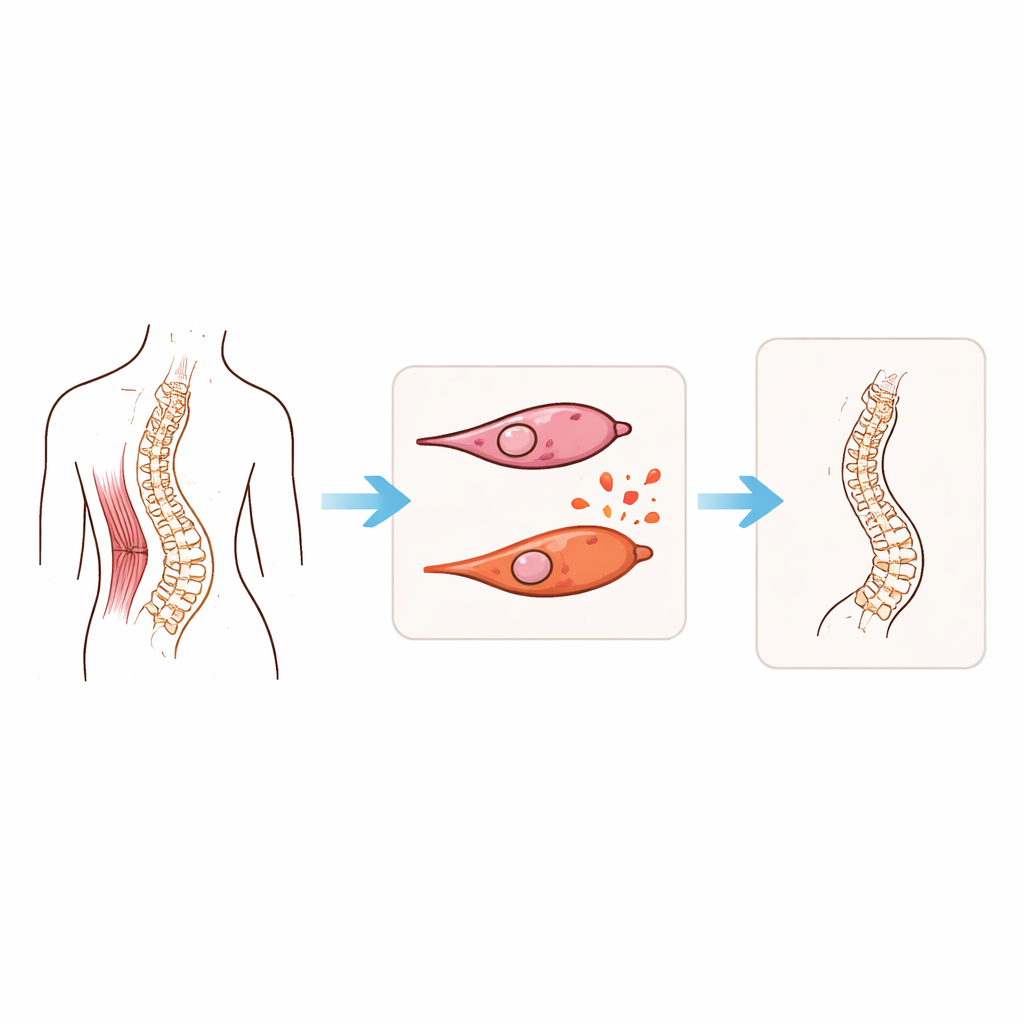
Doctors have long noticed that in scoliosis, the muscles hugging the spine are not the same on both sides. On the inner, “concave” side of the curve, the muscle fibers are smaller, more fibrous and weaker than on the outer, “convex” side. The researchers focused on the stem and progenitor cells in these muscles—the repair crews that build and renew muscle tissue. By comparing tissue from both sides of the spine in teenagers with scoliosis, and in a control group with a different type of spinal deformity, they found that only in adolescent idiopathic scoliosis were the inner-side muscles bathed in much higher levels of reactive oxygen species, unstable molecules often grouped under the label “oxidative stress.”
A Chemical Switch That Protects Muscle Cells
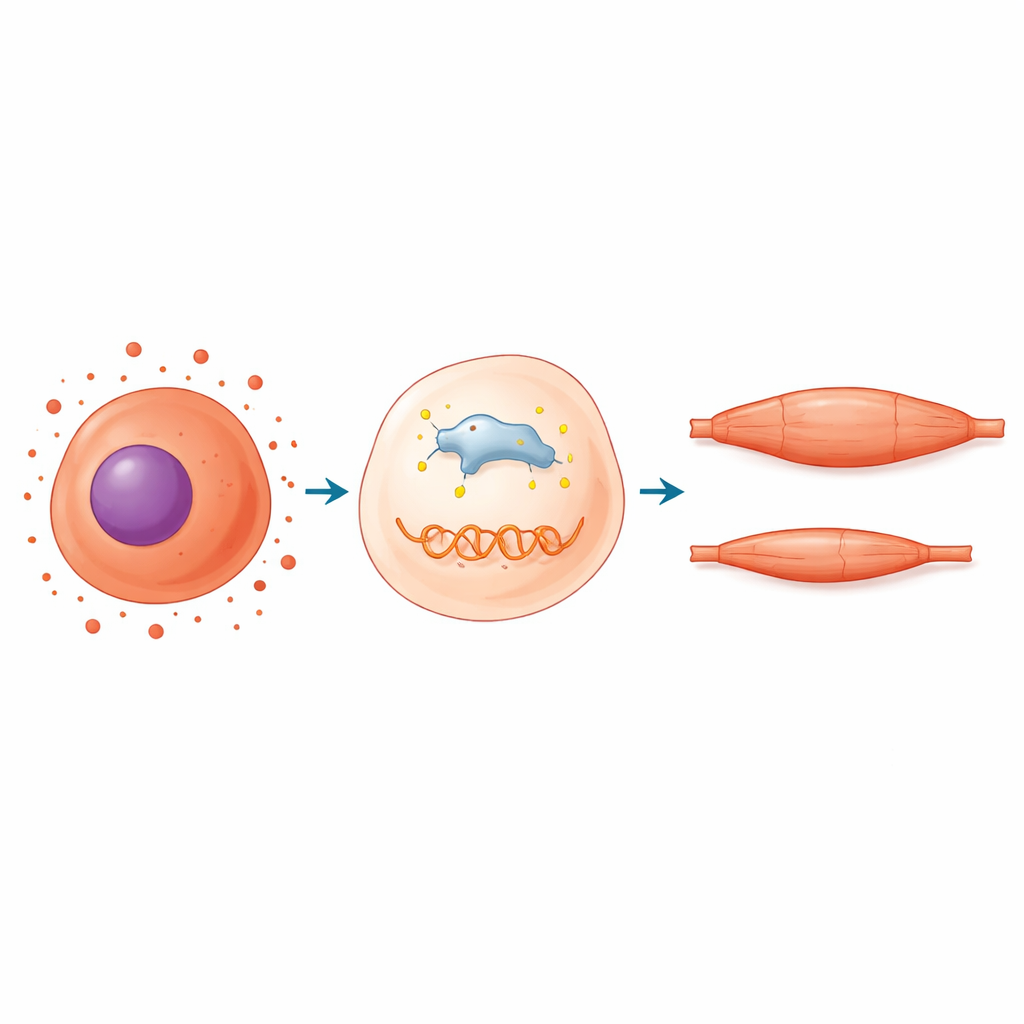
Inside these muscle stem cells sits a molecular “writer” called METTL3 that adds small chemical tags to RNA, the working copy of genes. These tags help keep certain messages stable so that key proteins are made in the right amounts. One of those proteins is ESR1, a sensor for estrogen that influences how muscle cells grow and mature. The team showed that excess oxidative stress on the concave side reduced the amount of METTL3 in the cells, which in turn made the ESR1 message less stable. With fewer ESR1 signals, the muscle stem cells struggled to turn into strong, full-sized muscle fibers, leaving the inner-side muscles thinner and weaker.
From Cell Imbalance to a Curved Spine
To see whether this chain of events could actually bend a spine, the scientists turned to specially bred mice. They created a model in which the animals walk upright on their hind legs and then increased oxidative stress only in the back muscles on one side. Over several weeks, these mice developed a clear sideways curve and front-to-back imbalance in the spine, much like human scoliosis. In the stressed muscles, the researchers again found lower METTL3 activity, fewer chemical tags on the ESR1 message, reduced ESR1 protein and smaller muscle fibers. This supported the idea that an uneven chemical environment in the paraspinal muscles can, by itself, help drive spinal curvature.
A Common Nutrient as a Possible Helper
The team then asked whether they could tip the balance back. They chose betaine, a naturally occurring compound found in foods such as beets and whole grains, known both for its antioxidant power and for donating “methyl” groups used in chemical tagging reactions. In dishes, adding betaine to human muscle stem cells from the concave side improved their ability to form long, fused muscle fibers and restored chemical tags and ESR1 levels. In mice with one-sided oxidative stress, injections of betaine into the weaker-side muscles reduced oxidative stress, boosted METTL3 and ESR1, increased muscle fiber size and, importantly, lessened the severity of the spinal curve over time.
What This Could Mean for Teens and Parents
Taken together, the findings suggest that an uneven “ROS–METTL3–ESR1 axis”—in simple terms, an imbalance in damaging oxygen byproducts, a protective RNA-tagging enzyme and an estrogen sensor—helps decide whether the spine of a growing child continues to curve. By showing that a safe, well-known nutrient can partially reset this axis in animals, the work raises the possibility of future treatments that strengthen the weaker-side back muscles from the inside out. Such approaches are still far from the clinic, but they offer a hopeful new path toward gentler, biology-based ways to slow or prevent scoliosis progression during the vulnerable adolescent years.
Citation: Li, B., Kuati, A., Sui, W. et al. The asymmetrical ROS–METTL3–ESR1 axis in paraspinal muscle progenitor cells determines the progression of adolescent idiopathic scoliosis. Exp Mol Med 58, 725–738 (2026). https://doi.org/10.1038/s12276-026-01658-7
Keywords: adolescent idiopathic scoliosis, paraspinal muscles, oxidative stress, RNA methylation, betaine