Clear Sky Science · en
Tunable emission directionality in transparent quantum-dot LEDs via photonic interface engineering
Windows That Light Up
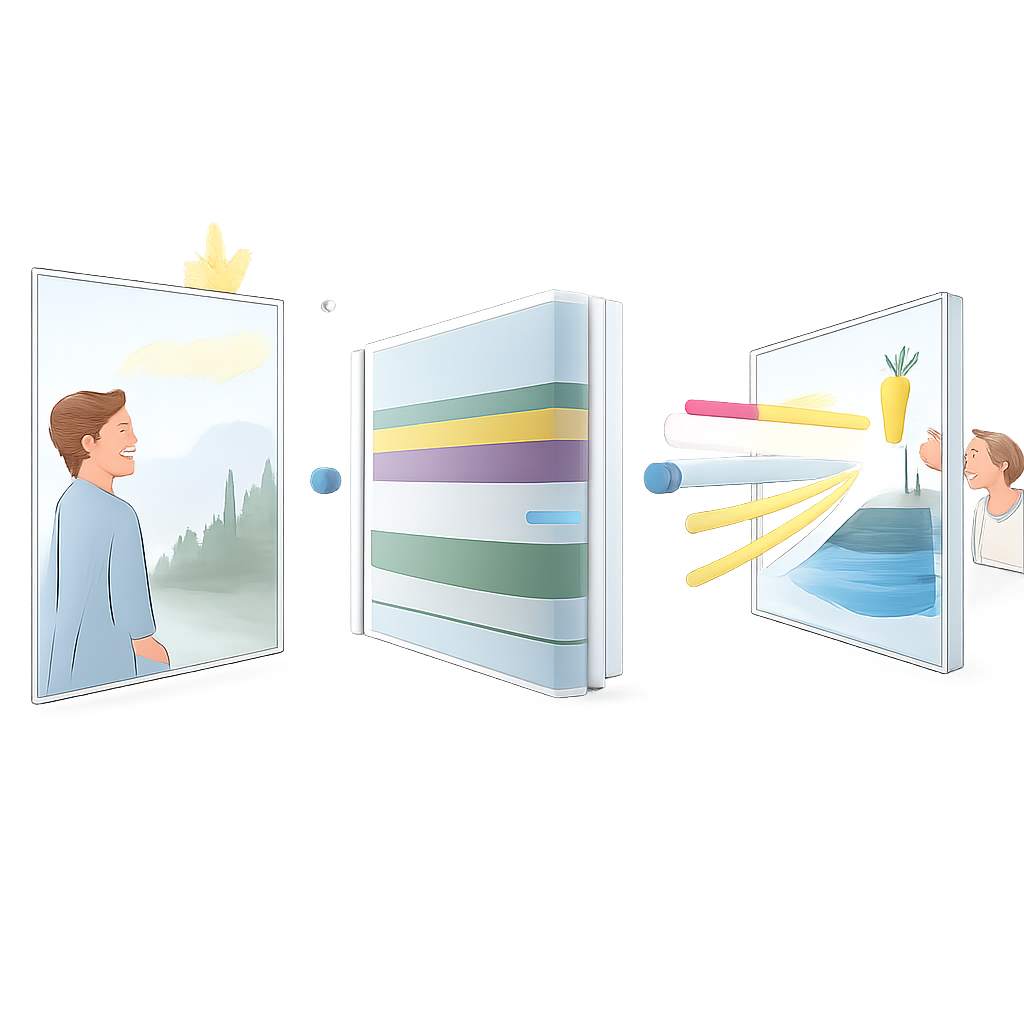
Imagine a shop window, car windshield, or pair of glasses that looks like ordinary clear glass—until it lights up with bright, colorful information, all without blocking your view. This article explores a new way to build such see-through screens using quantum-dot LEDs, and more importantly, how to steer their light so that most of it goes to the intended viewer rather than leaking out in the wrong direction.
Why See-Through Screens Are Hard to Perfect
See-through displays are at the heart of augmented reality glasses, smart windows, and head-up displays in cars. They must juggle three demands at once: the screen has to be bright and efficient, it has to stay highly transparent like glass, and it should send light mostly toward the viewer, not equally in all directions. Transparent quantum-dot LEDs already make bright, pure colors and can be made as thin, clear films by sandwiching the light-emitting layer between transparent electrodes. The catch is that these devices naturally shine both forward and backward, so a large fraction of the light is wasted on the side nobody is watching, and curious onlookers on the other side can see your information.
The Hidden Power of Reflections
The researchers show that this three-way balance—direction of light, efficiency, and transparency—is largely controlled by how much light is reflected at the surfaces of the transparent electrodes. Those reflections depend on the optical “heaviness” of the materials, described by their refractive index. Through simulations, they vary the refractive indices of the top and bottom electrodes and calculate how much light goes out each side, how transparent the device remains, and how efficiently it turns electricity into visible light. Increasing reflection on one side tends to push more light out the opposite side, but also usually reduces see-through clarity. Their maps reveal only a few sweet spots where all three goals can be satisfied at once, and they use these as blueprints for real devices.
Balanced Glow from Both Sides
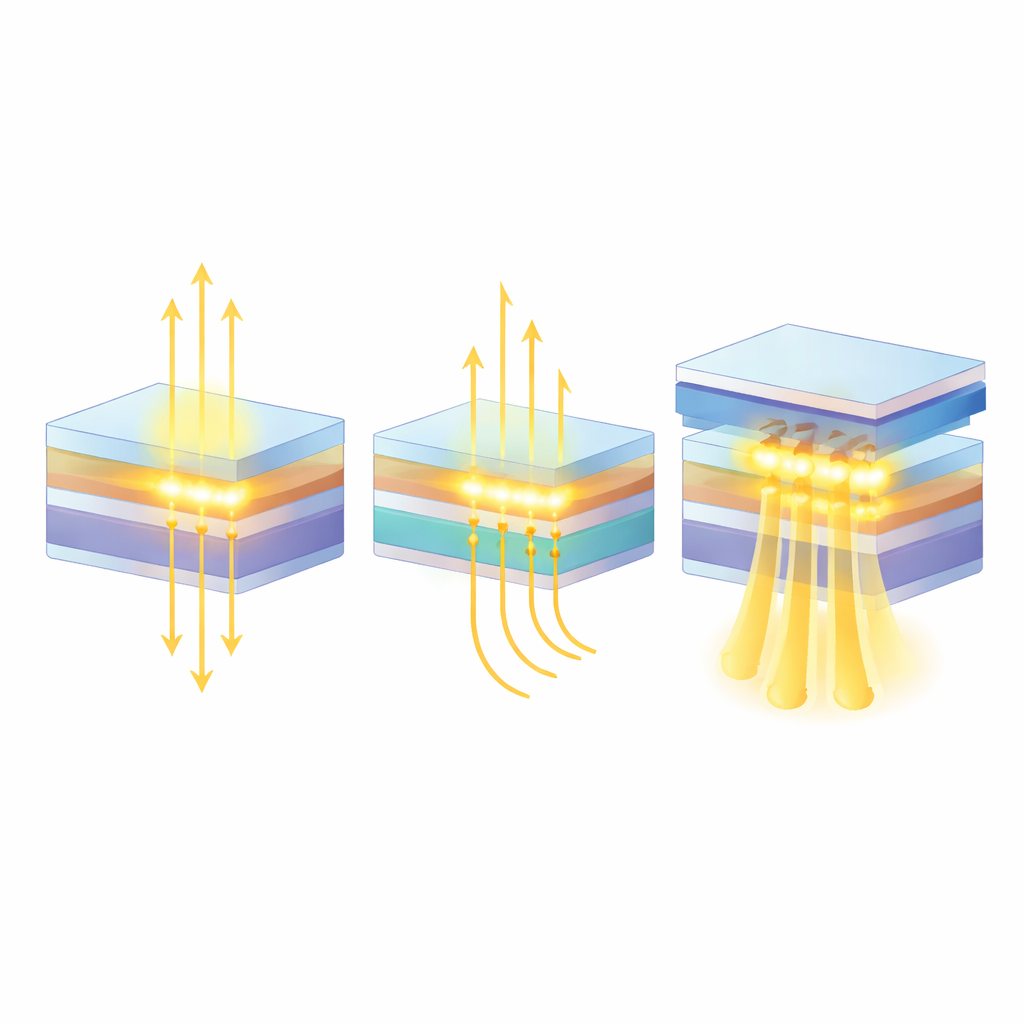
For applications like public signage or dual-sided shop-window displays, equal brightness on both sides of the screen is ideal. To achieve this, the team builds composite electrodes made of stacked transparent materials whose combined optical behavior can be finely tuned. By placing a high-index zinc sulfide layer under a standard transparent conductive oxide at the bottom, and pairing another oxide with a thin fluoride layer at the top, they hit a design that gives nearly identical brightness on both sides. These transparent quantum-dot LEDs reach about 90% average transparency—so they look almost like clear glass—while still delivering strong light output and similar efficiency from each face, making them suitable for graphics that float over real-world scenes without obscuring them.
Steering Light to One Viewer
Other uses, like AR glasses or car windshields, need light mainly on one side: you want the driver to see the image clearly, but not people standing outside the car, and you do not want to waste power. To tilt the balance, the researchers first redesign the bottom transparent electrode using a treated conductive polymer. A mild acid wash changes the internal structure of this polymer so that its optical index nearly matches that of the glass, while its electrical conductivity improves dramatically. This combination lets more light escape smoothly into the glass below, boosting brightness on the viewer’s side while dimming the opposite side, all without sacrificing much transparency.
Turning the Top into a Tiny Mirror
To push directionality even further, the team then focuses on the top electrode. They grow an ultra-thin silver film, helped by a nanometer-thick seed layer that lets the metal spread into a smooth sheet instead of breaking into islands. Around this silver they add carefully chosen transparent layers that increase reflection without adding too much absorption. The result is a kind of built-in, partially transparent mirror on the top side. With this structure, more than 90% of the emitted photons leave through the bottom, giving roughly a ten-to-one brightness ratio between the viewer’s side and the opposite side, while still keeping the device moderately see-through—good enough for automotive windows or smart eyewear where strong images and limited outside glare are crucial.
What This Means for Everyday Devices
In everyday terms, this work shows how to turn clear windows into smart, glowing surfaces whose light can be shared equally between two audiences or targeted almost entirely to one, simply by adjusting invisible reflective layers. Instead of accepting a trade-off between clarity, brightness, and privacy, designers can now choose recipes that emphasize the features their product needs most. This lays the groundwork for future shop fronts, car dashboards, and AR glasses that look like plain glass when off, yet become efficient, vivid displays that keep your information where it belongs—on your side of the window.
Citation: Haotao Li, Jiming Wang, and Shuming Chen, "Tunable emission directionality in transparent quantum-dot LEDs via photonic interface engineering," Optica 12, 1728-1736 (2025). https://doi.org/10.1364/OPTICA.578429
Keywords: transparent displays, quantum-dot LEDs, see-through screens, augmented reality, head-up displays