Clear Sky Science · en
High efficiency glass-based VUV metasurfaces
Why tiny glass patterns for invisible light matter
Most of the light our eyes see is just a small slice of the spectrum. Far beyond violet lies vacuum ultraviolet (VUV) light, which is crucial for studying elusive particles like neutrinos and dark matter, advancing medical imaging, and pushing semiconductor manufacturing. Yet the tools for shaping and focusing this light are bulky, fragile, and inefficient. This paper reports a flat, glass-based lens no thicker than a human hair that can efficiently focus VUV light, opening the door to smaller, cheaper, and more capable instruments in science and technology.
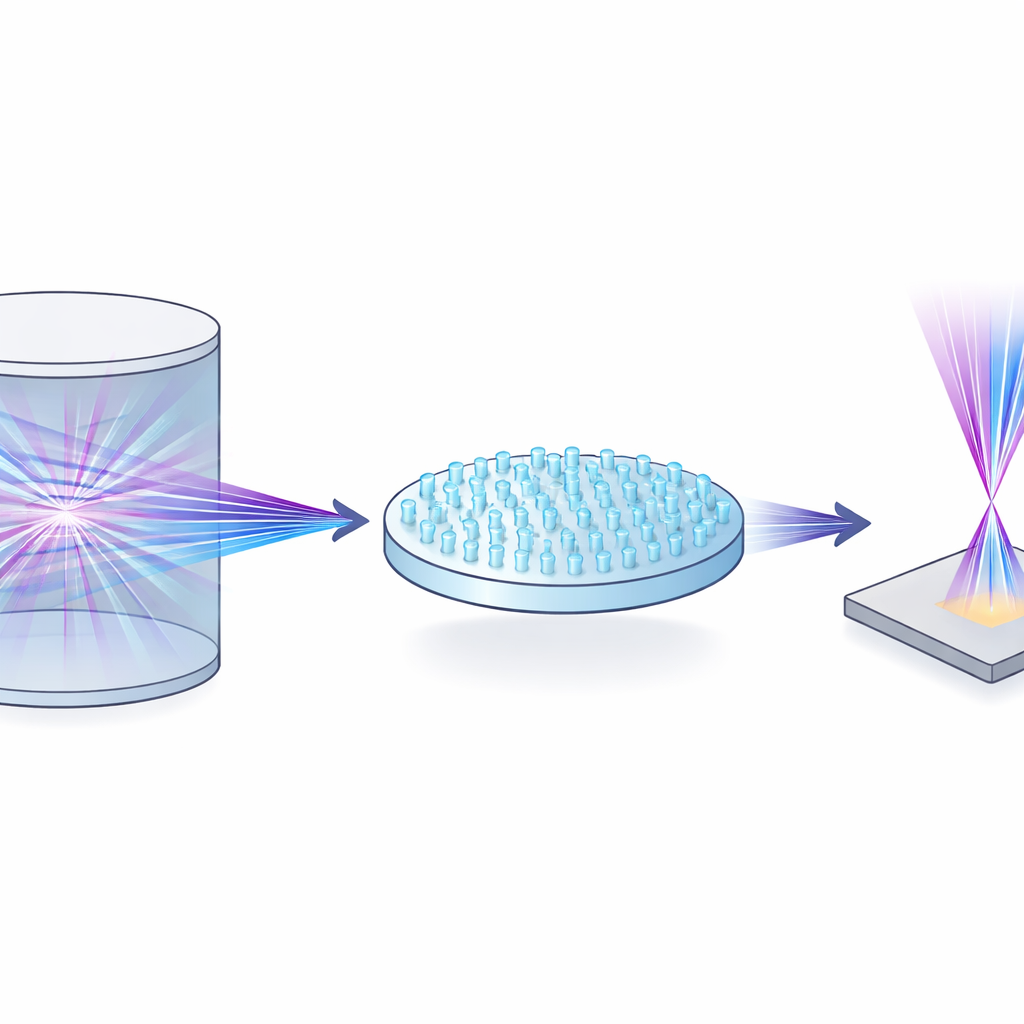
Flat lenses that shrink complex optics
Traditional lenses bend light by passing it through curved pieces of glass. Metalenses take a very different approach: they use dense carpets of tiny structures, far smaller than the wavelength of light, patterned on an otherwise flat surface. By tailoring the size of each “nanopost,” engineers can nudge the passing light so that it emerges with just the right delays to form a sharp focus. Until now, such devices have worked mainly for visible and near‑ultraviolet light, where materials are plentiful and the required structures are easier to fabricate.
The challenge of focusing VUV light
Vacuum ultraviolet light, with wavelengths between about 100 and 200 nanometers, is strongly absorbed by most materials and even by air. Experiments that rely on this light, such as large liquid‑argon or liquid‑xenon detectors for rare particle interactions, typically use bulky crystal lenses or mirrors made from fragile and expensive materials like calcium fluoride or magnesium fluoride. Many detectors instead convert VUV photons into visible light using special coatings, but this wastes much of the signal. To improve sensitivity without exploding costs, researchers need optical elements that are thin, robust, highly transparent in the VUV, and capable of gathering as many photons as possible.
Designing a new kind of glass lens
The authors built a metalens that focuses 175‑nanometer light, the characteristic glow of xenon used in many particle detectors. They chose an ultra‑pure fused silica glass known as JGS1, which remains transparent down to these short wavelengths. On the surface, they etched a dense array of glass pillars 400 nanometers tall, arranged on a regular grid with 160‑nanometer spacing. By carefully varying pillar diameters—from about 60 nanometers upward—they shaped the phase of the transmitted light to mimic a classic focusing lens, but within a layer vastly thinner than a conventional optic. A key idea was to loosen a standard design rule that demands extremely fine spacing to avoid unwanted diffraction. Using simulations, the team showed they could slightly increase the spacing, easing fabrication, yet still maintain high efficiency across the lens.
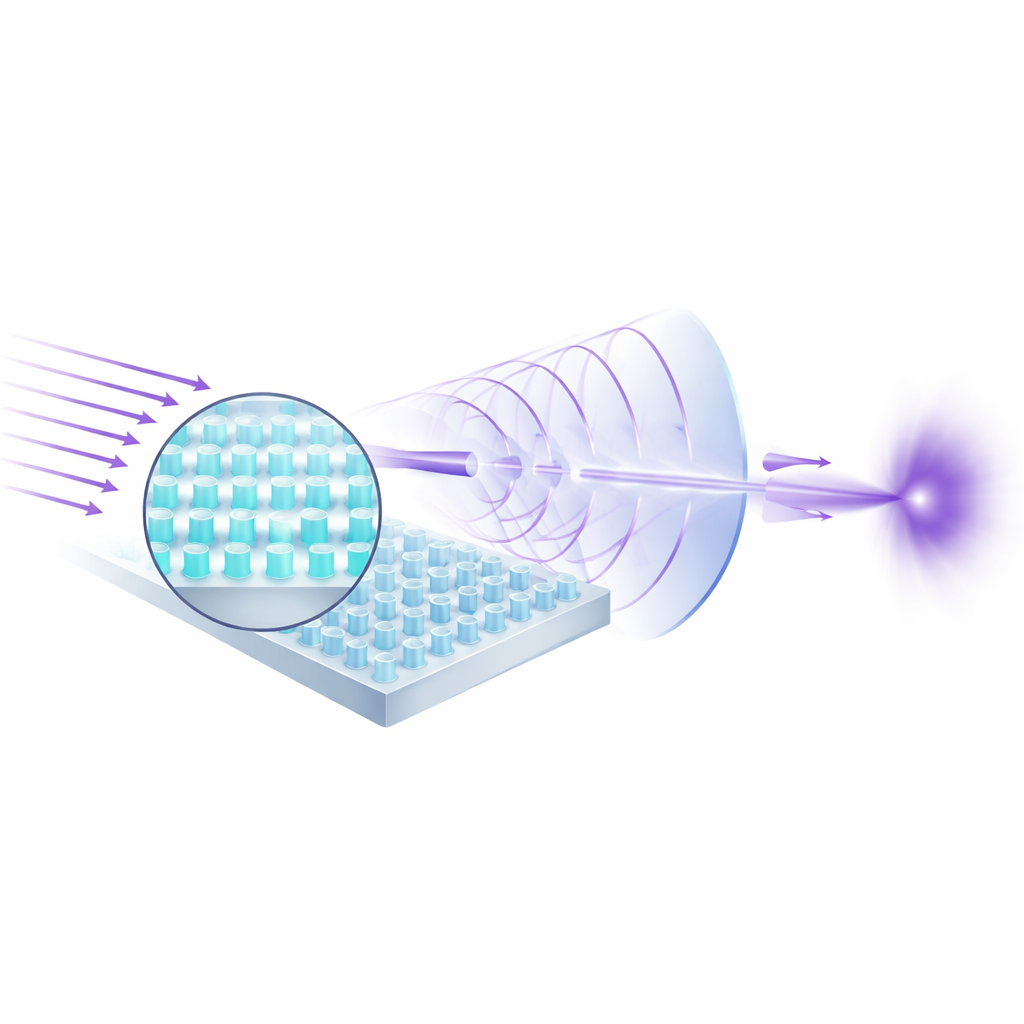
Measuring how well the lens performs
Because off‑the‑shelf microscopes and cameras do not work in the VUV, the team devised an indirect way to test their lens. They illuminated it with carefully prepared VUV beams at 175, 190, and 200 nanometers in an argon‑filled enclosure, then scanned a sensitive detector to map where the light went. From these measurements, they extracted how much power was directed into the focused beam and how the bending angle matched the intended focusing pattern. Near the center, the metalens funneled up to 65–77% of the incoming light into the desired focus, depending on wavelength, and maintained an average efficiency of about 53% at 175 nanometers across its full aperture—by far the best reported performance for flat optics below 300 nanometers. The lens also continued to work at oblique incidence angles up to 30 degrees, which is promising for light‑collection applications.
First images with a VUV flat lens
To demonstrate actual imaging, the researchers fabricated a larger version of the lens with a 1‑centimeter focal length and used it to form pictures of a test pattern under illumination at 190 and 195 nanometers. Working in a special optical setup, they projected the pattern onto a modified camera sensor that could detect this short‑wavelength light. Despite low signal levels and some noise, the resulting images clearly showed that the flat glass lens can relay fine detail, consistent with a resolution on the order of a micrometer as inferred from separate tests.
What this means for future detectors and devices
This work demonstrates that flat, glass‑based lenses can efficiently focus some of the hardest‑to‑handle light in the spectrum while keeping the device thin, robust, and compatible with semiconductor fabrication methods. By balancing strict theoretical sampling rules against real‑world manufacturing limits, the authors achieved record‑high transmission for VUV metalenses and showed that the design can be scaled and refined for imaging. In practical terms, such lenses could help future particle detectors capture more of the faint VUV glow from rare events, improve certain medical scans, and enable more compact tools for chip manufacturing and biotechnology, all by putting a carefully patterned glass wafer where bulky optics once stood.
Citation: Augusto Martins, Taylor Contreras, Chris Stanford, Mirald Tuzi, Justo Martín-Albo, Carlos O. Escobar, Adam Para, Alexander Kish, Joon-Suh Park, Thomas F. Krauss, and Roxanne Guenette, "High efficiency glass-based VUV metasurfaces," Optica 12, 1681-1688 (2025). https://doi.org/10.1364/OPTICA.573503
Keywords: vacuum ultraviolet optics, metalens, flat optics, particle detectors, fused silica nanostructures