Clear Sky Science · en
Geophysical sensing using Jones matrices extracted from submarine optical cable transceivers carrying live traffic
Turning the World’s Internet Cables into Earthquake Ears
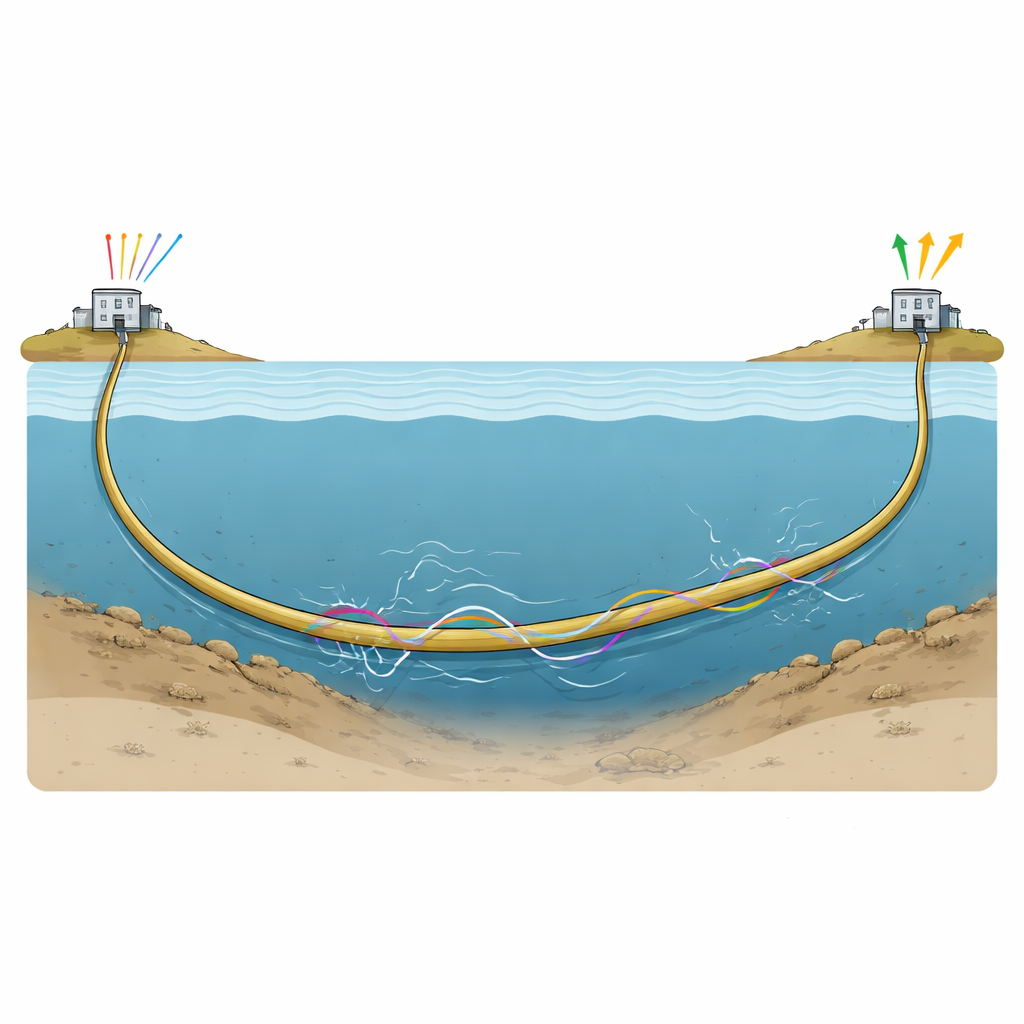
Every day, vast amounts of data cross oceans through hair-thin glass fibers buried in the seafloor. This study shows that those same communication cables can quietly double as a global network of undersea ears, listening for earthquakes and subtle shifts in the ocean, all without tapping or exposing anyone’s data. By watching how light inside the fibers is ever so slightly twisted by the environment, the authors demonstrate a powerful new way to monitor our restless planet using infrastructure that already exists.
How Light in a Cable Feels the Earth Move
Light traveling inside an optical fiber does not simply go straight; its electric field has a direction, or polarization, that can rotate as it moves. This rotation is summarized mathematically in what engineers call a Jones matrix, which describes how any input polarization is transformed as it emerges from the far end of the cable. The key insight of this work is that the Jones matrix is sensitive to everything the cable experiences along its route: pressure from ocean swells, slow shifts in seafloor sediments, and the rapid strains produced by passing seismic waves. Modern coherent receivers in telecom systems already reconstruct this matrix in real time to keep signals clear, and crucially, it can be extracted without revealing anything about the actual information being transmitted.
From Complex Math to a Simple Sensing Signal
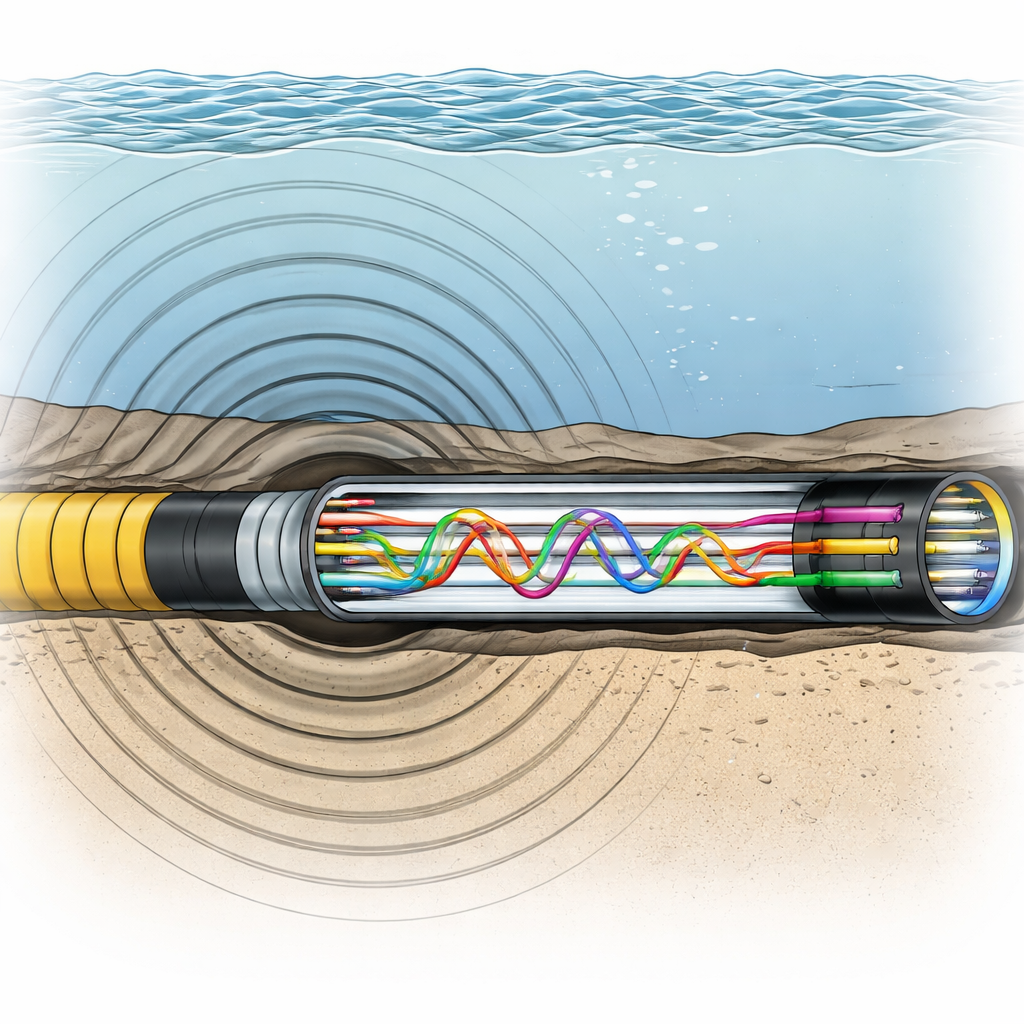
In reality, fibers are imperfect: their internal properties change randomly every few tens of meters, and light’s polarization is repeatedly mixed and scrambled. The authors develop a rigorous framework to separate slow, background changes in the cable from the rapid, small variations caused by environmental events. They express the Jones matrix as an overall phase and a rotation vector that describes how polarization is turned on a geometric sphere. By mathematically moving into a rotating “reference frame” that follows the slow drift, they isolate only the small, fluctuating rotation vector that encodes local pressure changes along the cable. These fluctuations turn out to be directly proportional to how the hydrostatic pressure of the seawater varies in space and time, which is exactly what a seismologist or oceanographer wants to know.
Listening to the Mediterranean Seafloor in Real Time
The team put this theory to the test on Sparkle’s MedNautilus submarine system, which links Catania in Sicily with Haifa and Tel Aviv in Israel. Using commercial transceivers operating under normal traffic conditions, they sampled the Jones matrices every half second for several days. After processing, they computed spectrograms—time–frequency maps—of the three components of the rotation vector and then summed them to form a single, orientation-independent measure of polarization disturbance. On both the Catania–Haifa and Catania–Tel Aviv links, a clear, sharp feature appeared at the time of a magnitude 5.8 earthquake near the Dodecanese Islands on June 2, 2025. The same signature showed up in signals traveling in opposite directions and in different fibers sharing the same cable, confirming that the effect comes from the seafloor, not from the electronics.
What the Cable Reveals About the Quake
By looking at the detailed time traces of the polarization changes and applying simple filters to suppress slower background noise, the authors were able to estimate when the first, fastest seismic waves reached each cable. On the Catania–Haifa segment, the signal arrived about 30 seconds after the earthquake origin time; on the more distant Catania–Tel Aviv cable, it appeared after about 116 seconds. Combining these arrival times with the known positions of the cables and the earthquake epicenter yields propagation speeds for the primary waves of around 4.3–4.7 kilometers per second, consistent with a sediment-rich crust beneath the eastern Mediterranean. The spectrograms also revealed resonances and microseisms linked to tides, acoustic modes, and thick sediment layers, particularly along the route that crosses the Nile Delta region.
A Quiet, Global Sensor Hiding in Plain Sight
To a non-specialist, the central message is that existing undersea internet cables can double as highly sensitive, always-on geophysical sensors, without installing new hardware or interrupting data traffic. By carefully reusing the polarization information that telecom systems already compute for signal correction, this method can detect earthquakes, track how seismic waves move through sediments, and sense subtle pressure changes in the deep ocean. Because the approach is robust to the random scrambling of light inside the fibers and does not expose user data, it offers a practical path toward turning the world’s submarine communication network into a vast, passive observatory of our dynamic planet.
Citation: Antonio Mecozzi, Cristian Antonelli, Alberto Marullo, Danilo Decaroli, Luca Palmieri, Luca Schenato, Siddharth Varughese, Pierre Mertz, and Antonio Napoli, "Geophysical sensing using Jones matrices extracted from submarine optical cable transceivers carrying live traffic," Optica 12, 1712-1719 (2025). https://doi.org/10.1364/OPTICA.572883
Keywords: submarine optical cables, earthquake detection, fiber-optic sensing, polarization monitoring, undersea geophysics