Clear Sky Science · en
Miniaturized-voxel light field panel display based on an ultra-slim and large-area freeform directional backlight
Why Tiny 3D Pixels Matter
Imagine watching a 3D movie or inspecting a medical scan without glasses, seeing objects float deep in front of and behind a flat screen, and being able to move your head freely without the image breaking apart. Today’s 3D displays can do some of this, but they usually face harsh trade-offs: if you want a wide viewing angle, you lose clarity; if you want crisp detail, you lose depth; if you want a large display, the hardware becomes bulky. This paper describes a new kind of flat-panel 3D display that tackles these trade-offs by shrinking the basic building blocks of 3D images—called voxels, or volume pixels—while keeping the system thin enough for practical products.
The Promise and Problem of 3D Screens
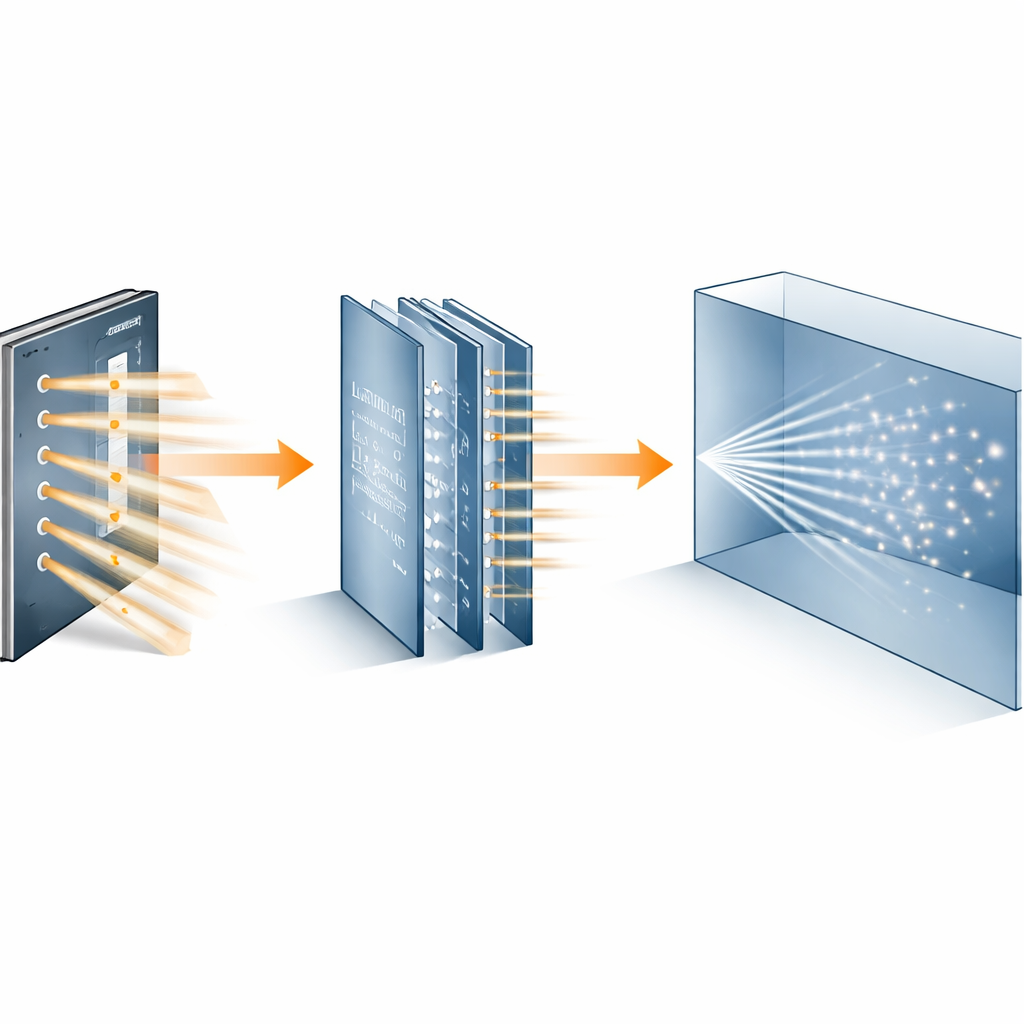
Three-dimensional displays have been explored for decades for uses ranging from entertainment to surgery and engineering. Many advanced systems can create impressive 3D scenes, but they often rely on complex optics, moving parts, or thick projection setups. A key bottleneck is how many distinct, resolvable points of light can be created in a given volume in front of the screen. These points are the voxels that together form a 3D scene. Current light field displays, which try to recreate the directions and intensities of light coming from a scene, are limited by how much information a flat panel can supply and by how efficiently the optics convert panel pixels into 3D voxels. As a result, designers must compromise between viewing freedom, sharpness, and the depth or size of the 3D image volume.
A New Kind of Engine Behind the Screen
The authors propose a different approach: instead of using a thick, fuzzy backlight that sends light in many directions, they build an ultra-thin backlight that emits light in very precise, narrow beams. This backlight is assembled from many tiny channels, each with a light-emitting diode and a carefully shaped “freeform” lens. Together, these channels form a large-area sheet of light that is both highly directional and very uniform across a 32-inch panel. Because the beams are so well behaved, the system can pack many more distinct light rays into the viewing space without them overlapping and blurring the image. Two additional ultra-thin layers filled with microscopic prism structures gently mix neighboring beams to smooth out any brightness seams, but they do so without making the light spread out more, preserving the sharp directionality that the freeform lenses create.
How Tiny 3D Building Blocks Are Formed
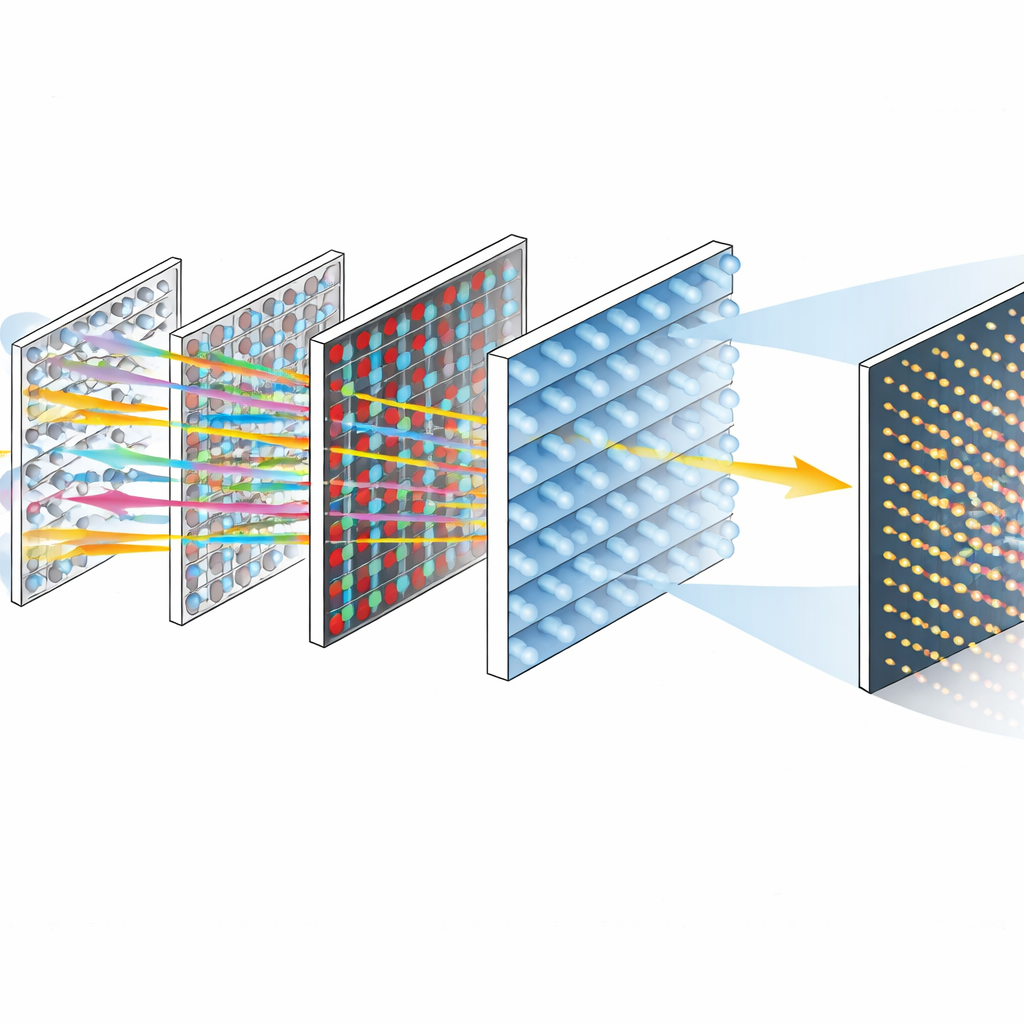
On top of this engineered backlight, a standard liquid crystal display panel encodes the scene—deciding the color and brightness of each beam. Above that sits a pair of lens sheets, called lenticular arrays, oriented at right angles to control the light in both horizontal and vertical directions. Unlike conventional arrangements where the lenses line up directly with the pixel grid, the lenses here are placed at a slight slant. This produces a narrower, peak-shaped concentration of light for each voxel and allows the system to place voxels much closer together in space while still keeping them separate. Because the incoming light is already narrowly directed, the lens arrays can steer it with great precision over a wide viewing angle, creating a nearly linear mapping between positions on the panel and positions in the 3D volume. That means voxels stay similar in size and shape over a large depth, reducing distortion as the viewer moves.
Putting the Concept to the Test
The researchers built a working 32-inch prototype to show that this concept is practical. The entire optical stack, including the new backlight and lens layers, fits in a cabinet only 28 millimeters thick—far thinner than earlier directional backlight systems that can exceed half a meter in depth. The prototype produces a wide viewing angle of about 122 degrees and a 3D volume measuring roughly 72 by 40 centimeters across and one meter deep. In demonstrations, scenes like an astronaut floating in front of a space station appeared crisp from multiple viewpoints, with smooth motion parallax as the observer moved. When compared directly to a more traditional 3D display that uses a scattering backlight, the new system produced voxels about six times smaller at half a meter distance, and the voxel size grew much more slowly with depth, keeping details clearer farther from the screen.
What This Means for Everyday 3D
To a layperson, the most important outcome is that this design turns the same flat panel pixels into far more usable 3D information—over 100 times more efficiently within the tested volume. By tightly controlling how light leaves the screen, the display can create many tiny, distinct points in space without a bulky box of optics behind it. That combination of thin form factor, large display volume, wide viewing angle, and sharp 3D detail moves glasses-free 3D much closer to the slim televisions and monitors people already buy. If developed further, this miniaturized-voxel light field panel concept could underpin future 3D medical displays, interactive learning tools, and entertainment systems that offer rich depth and freedom of movement without compromising on size or image quality.
Citation: Zijun Zhang, Zhaohe Zhang, Xiaoyu Fang, Shuaiteng Liu, Zhanghan Liu, Jiawei Zheng, Ruiang Zhao, Hong Wang, Jun She, Haifeng Li, Xinzhu Sang, Xu Liu, Xunbo Yu, and Rengmao Wu, "Miniaturized-voxel light field panel display based on an ultra-slim and large-area freeform directional backlight," Optica 12, 1632-1639 (2025). https://doi.org/10.1364/OPTICA.571647
Keywords: 3D display, light field, directional backlight, voxel resolution, glasses-free 3D