Clear Sky Science · en
Line-by-line control of 10,000 modes in a 20 GHz laser frequency comb
Shaping Light, One Color at a Time
Imagine being able to adjust the brightness of each individual "tooth" in a comb made of light, with thousands of teeth spread across the visible spectrum. That is what this research achieves. By gaining fine-grained control over these tiny color lines in a special kind of laser, scientists can build better tools for finding Earth-like planets, probing the laws of physics, and enabling next-generation quantum and communication technologies.
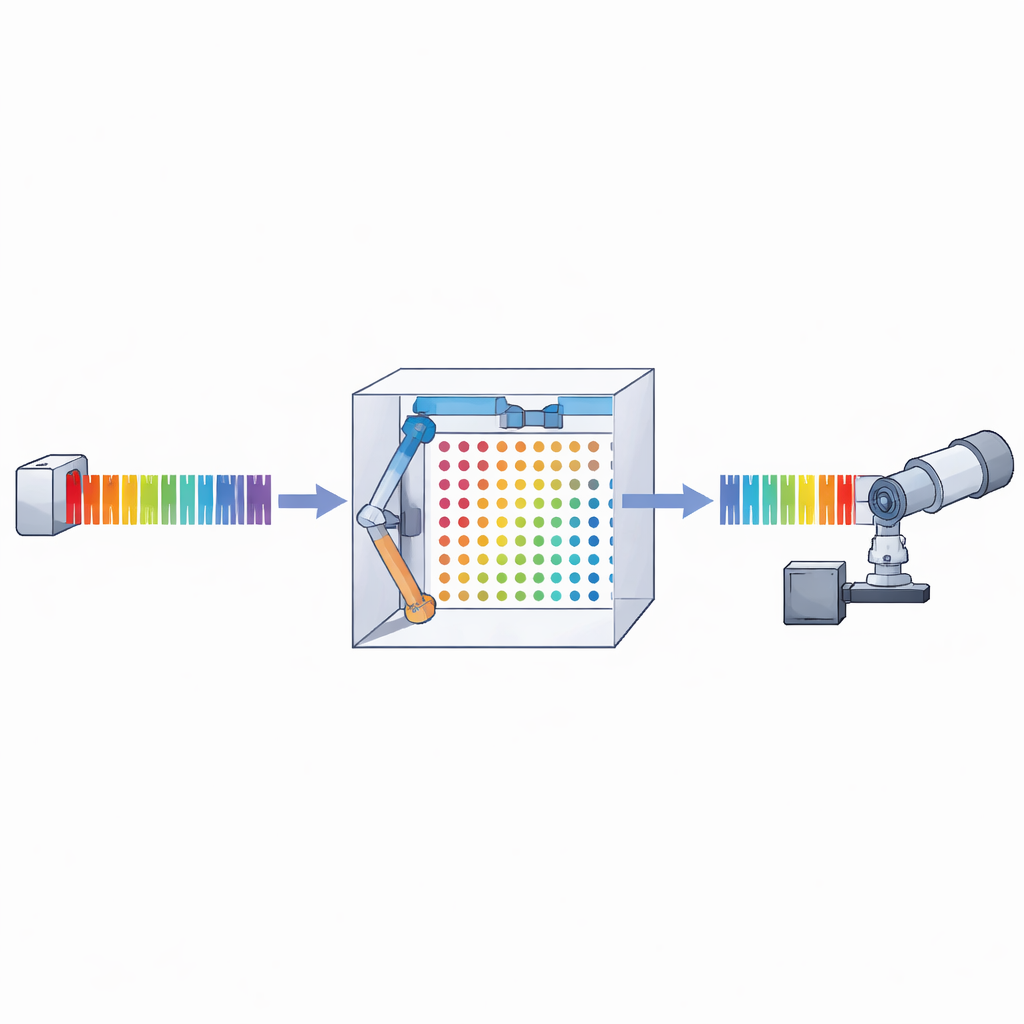
A Light Ruler for the Cosmos
Modern astronomy relies on exquisitely precise measurements of starlight. To detect the subtle tug of an Earth-sized planet on its star, or to watch for tiny drifts in the expansion of the universe, astronomers need spectrographs—light-splitting instruments—whose wavelength scales are calibrated with extraordinary accuracy. Laser frequency combs act as ultra-regular "light rulers": they produce thousands of evenly spaced, razor-sharp color lines across a wide range of wavelengths. In practice, however, the raw light from these combs is uneven. Some lines are far brighter than others, which can saturate camera pixels, bury faint lines in noise, and distort the instrument’s response. Flattening this spectrum so each line delivers nearly the same photon flux has been a stubborn challenge.
From Blunt Adjustments to Fine Control
Earlier systems could smooth only broad chunks of the comb’s spectrum, changing the overall envelope but not each line individually. They used devices that spread the colors out in one direction onto a programmable light modulator with limited resolution. That allowed control of at most a few hundred comb lines, and the monitoring spectrometers could not actually resolve individual lines. This meant that rapid wiggles in the spectrum—caused, for example, by weak internal reflections—could not be corrected, and even small errors in calibration could feed back and destabilize the flattening process. For demanding astronomical use, with thousands of lines and tight stability requirements, such approaches were no longer sufficient.
Drawing a Two-Dimensional Map of the Comb
The authors introduce a new spectral shaper that tackles these problems head-on by spreading the comb in two dimensions instead of one. They start with a visible to near-infrared comb spanning roughly 550–950 nanometers, produced by a fast titanium–sapphire laser that is broadened in a special optical fiber and filtered to a 20 gigahertz spacing. This light is then sent into a carefully designed cross-dispersing setup using a high-resolution grating and a prism, which together create a two-dimensional pattern of comb lines at the focal plane. A liquid-crystal-on-silicon spatial light modulator (SLM) sits at this plane. Each comb line appears as a small, resolved spot covering only a few SLM pixels, and by changing the phase delay at those pixels, the system can smoothly attenuate the intensity of that single line.
Teaching the Device Which Pixel Controls Which Line
Achieving true line-by-line control requires painstaking calibration. The team records how the pattern of comb lines appears on a separate high-resolution spectrograph, then systematically varies the SLM settings to learn the mapping between detector coordinates and SLM pixels for thousands of lines. They build look-up tables that relate an applied voltage on the SLM to the measured brightness of each line, and they identify subtle cases where a single line can appear in more than one diffraction order. By deliberately darkening duplicate regions on the SLM, they avoid interference that would otherwise cause slow intensity flicker. With this four-step calibration—order assignment, detector-to-SLM mapping, free-spectral-range mapping, and line-specific response curves—they obtain independent, stable control of about 10,000 comb modes, with a bandwidth-to-resolution ratio exceeding 20,000.
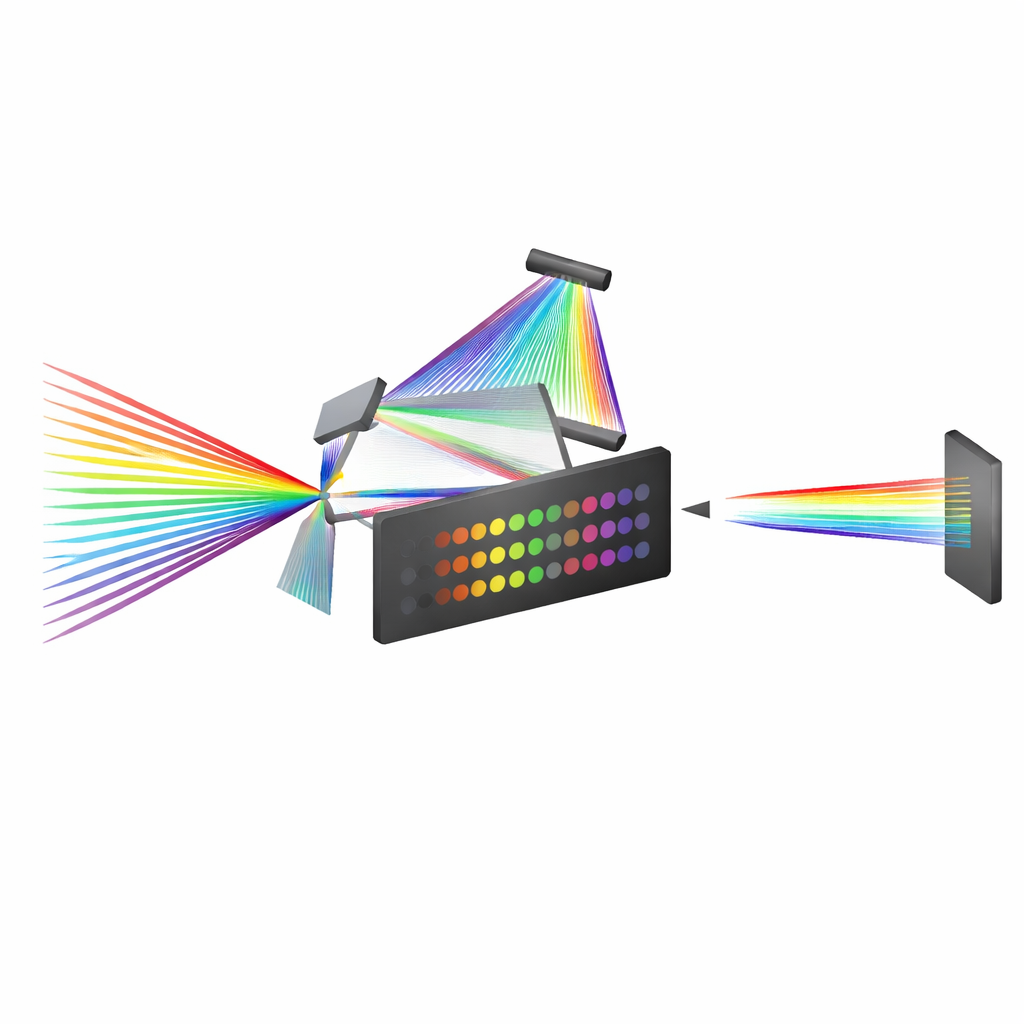
Flattening, Filtering, and Writing Shapes in Light
Once calibrated, the shaper can iteratively adjust each line until the measured spectrum matches a chosen target. The authors demonstrate flattening the comb so that nearly all lines fall within a narrow range around three different brightness levels, compressing the original dynamic range by up to about 9 decibels. They also show more adventurous patterns: increasing the line spacing on selected orders by keeping only every third, fourth, or fifth line, while suppressing the rest, and even erasing lines in a pattern that forms the initials of their university on the detector. Crucially, the system can adapt at hertz rates to ongoing drifts in the input spectrum, maintaining stability over time. For future giant telescopes, this means a calibration light source that can provide both a dense grid of lines and, on demand, a sparse set for measuring the spectrograph’s point-spread function—without swapping hardware.
Why This Matters Beyond Astronomy
To a layperson, this work can be seen as building an ultra-precise dimmer board for thousands of colors of light at once. In astronomy, it promises sharper radial-velocity measurements and more reliable checks on fundamental physics. But the same ability to sculpt comb spectra with gigahertz-level resolution is attractive for quantum technologies, where shaped light can produce complex entangled states, and for advanced electronics metrology using superconducting devices driven by tailored optical pulses. The authors note that their demonstration does not yet reach the limits of available components: better modulators, optics, and detectors could extend the control even further, and adding phase control would turn this platform into a full optical waveform synthesizer. In short, they have shown that large-scale, fine-grained control of light’s color structure is not just possible but practical, opening the door to a new generation of precision tools in science and technology.
Citation: William Newman, Jake M. Charsley, Yuk Shan Cheng, and Derryck T. Reid, "Line-by-line control of 10,000 modes in a 20 GHz laser frequency comb," Optica 12, 1720-1727 (2025). https://doi.org/10.1364/OPTICA.571303
Keywords: laser frequency comb, astronomical spectrograph calibration, spectral shaping, spatial light modulator, astrocomb