Clear Sky Science · en
Ultra-widely tunable high-power terahertz parametric generation based on synchronized sub-nanosecond pump and nanosecond seeder
Sharper Eyes for the Invisible Spectrum
Terahertz waves sit between microwaves and infrared light, an often overlooked slice of the spectrum that can see through packaging, reveal chemical fingerprints, and probe delicate biological structures. The paper behind this summary describes a new kind of terahertz source that is both powerful and widely tunable, making it much more useful for real-world tasks such as security screening, medical imaging, radar, and studying fast-changing processes in materials and molecules.
Why Terahertz Light Matters
Terahertz radiation behaves a bit like a hybrid between radio waves and infrared light. It can pass through many common materials such as plastics, paper, and clothing, while still being strongly affected by molecular vibrations and rotations. That means each substance leaves a unique signature in terahertz frequencies, which can be used to identify chemicals, inspect drugs through their packaging, or differentiate healthy and diseased tissue. Because terahertz waves are non-ionizing, they promise safer imaging than X-rays. They are also valuable for astronomy and for controlling quantum states in advanced electronics, where highly specific frequencies and narrow spectral lines are essential.
The Bottleneck: Power and Tuning at the Same Time
Despite the promise of terahertz technology, building a source that is both strong and smoothly tunable over a wide range of frequencies has been difficult. Many existing systems rely on exotic organic crystals that are hard to grow and damage easily, or on inorganic crystals that are robust but inefficient. Other schemes demand vast ultraviolet laser power and complex accelerators, making them impractical outside of large facilities. A class of devices called terahertz parametric generators, which convert visible or infrared laser light into terahertz radiation inside a crystal, had emerged as a promising approach. Yet they faced a trade-off: designs that offered broad tunability tended to be weak, while high-power versions were locked to narrower bands because they lacked effective ways to “seed” and control the generated waves.
A New Way to Drive the Terahertz Engine
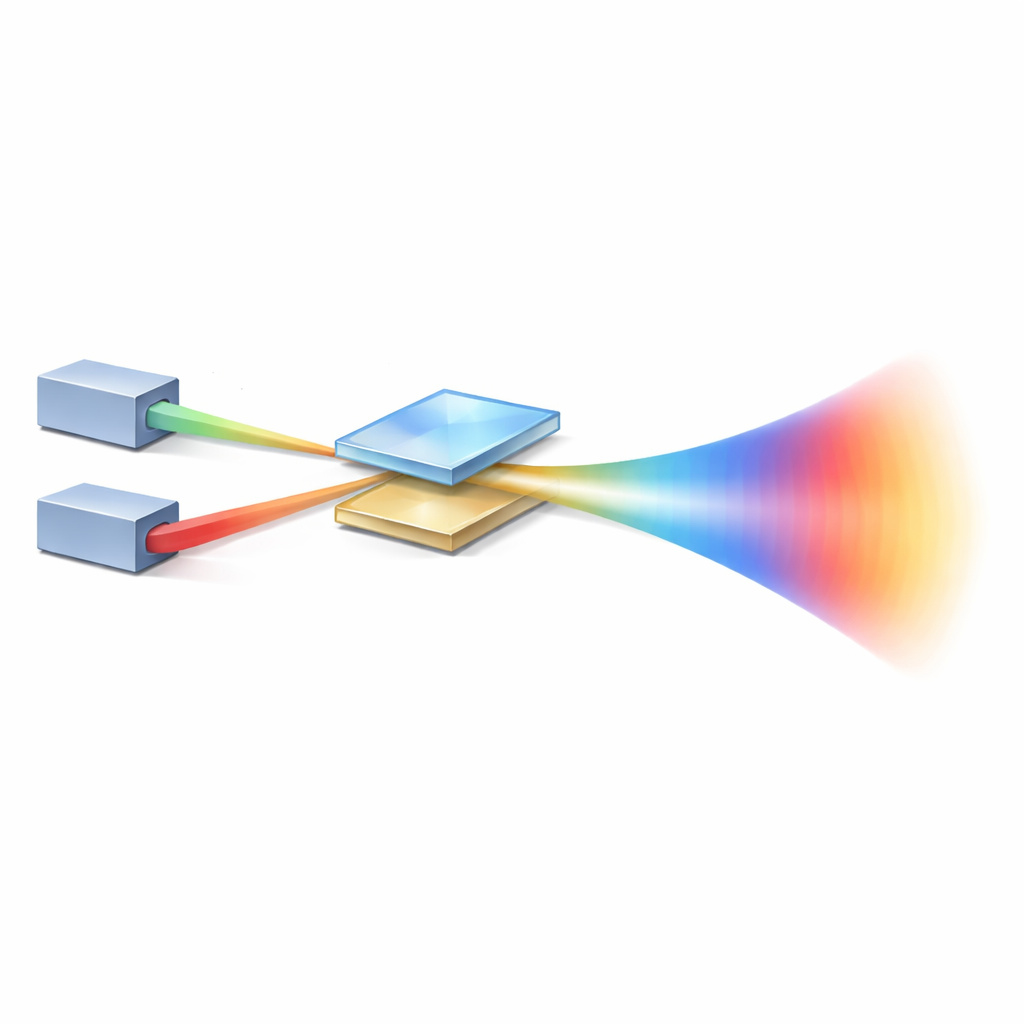
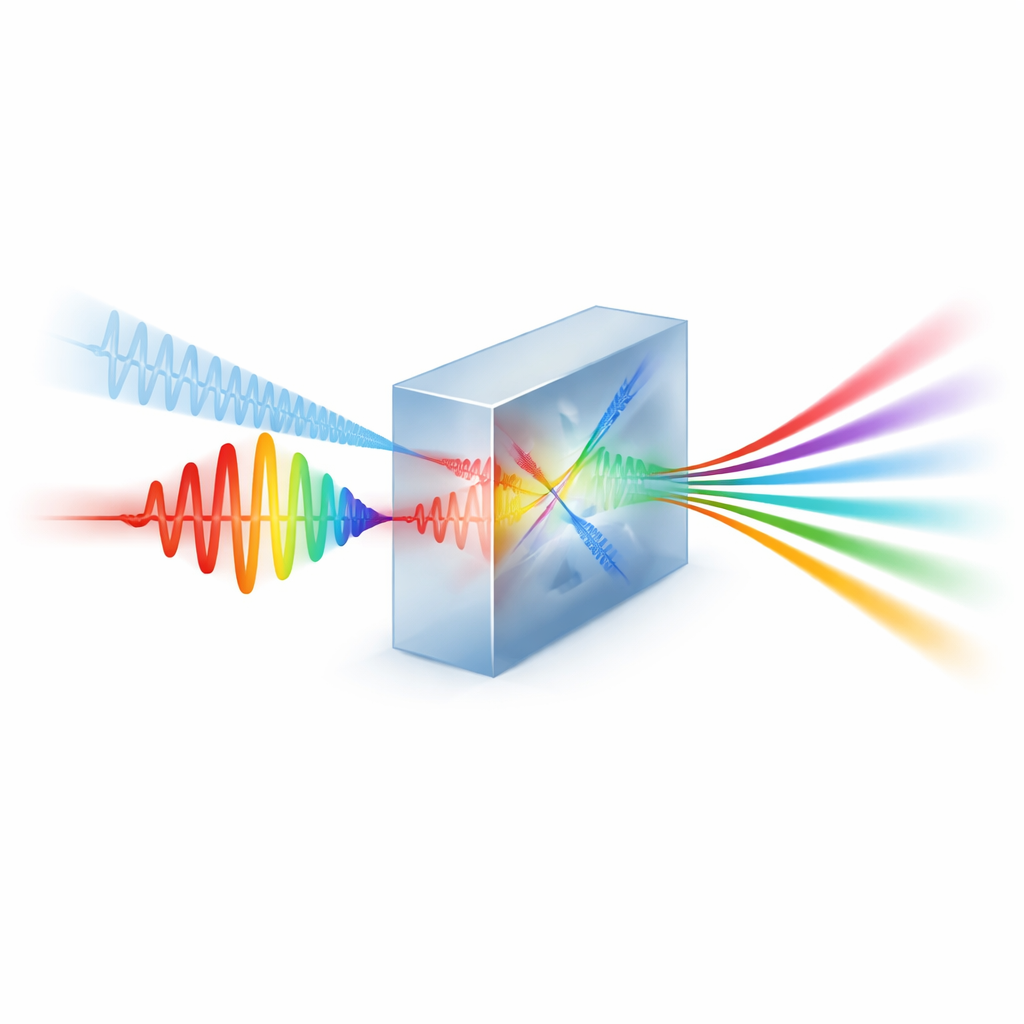
The authors solve this problem by combining two very different types of laser pulses in a carefully synchronized setup. A sub-nanosecond pump laser delivers extremely short, intense bursts of infrared or green light, which helps suppress an unwanted effect called stimulated Brillouin scattering that normally wastes energy and limits performance. At the same time, a separate nanosecond laser system feeds a tunable optical parametric oscillator, which produces a controllable “seed” beam with longer pulses and adjustable wavelength. The key innovation is an optical triggering technique: a small part of the nanosecond laser output is injected into the microchip pump laser to lock their timing, shrinking the natural timing jitter from microseconds down to a few hundred picoseconds. This ensures that both beams overlap inside specially cut nonlinear crystals, where their interaction generates terahertz waves with high efficiency.
Stretching the Terahertz Dial
To cover as much of the terahertz band as possible, the team uses two different crystals, MgO-doped lithium niobate and KTP, and switches the pump between infrared (1064 nm) and green (532 nm) light. By stacking the crystals and adjusting the crossing angle between the pump and seed beams, they can continuously tune the difference in frequency between the two lasers, which directly sets the terahertz output frequency. In this single setup, they achieve coverage from 0.55 to 13.6 terahertz, missing only a few narrow gaps caused by absorption resonances in the crystals. The system delivers up to 1.06 milliwatts of average power at 1.68 terahertz, corresponding to peak powers above 1 kilowatt, with good beam quality that closely matches an ideal Gaussian profile. The output is stable over time, with only a few percent variation over an hour, making it suitable for precision measurements.
What This Means Going Forward
For non-specialists, the main message is that this work turns terahertz sources from delicate laboratory curiosities into more practical tools. By marrying an ultra-short, high-power pump with a flexible, tunable seeding laser and synchronizing them optically, the researchers create a bright, stable terahertz “dial” that can be swept across a vast range of frequencies. The authors argue that with further scaling of the pump and improvements to the seeder’s spectral purity, this concept could reach even higher energies and finer resolution. Such advances would sharpen terahertz spectroscopy and imaging, improve remote sensing and security scanners, and open new possibilities in areas such as transient-state chemistry, biomedical diagnostics, and quantum technologies.
Citation: Fangjie Li, Kai Zhong, Jing Chi, Hongzhan Qiao, Tong Wu, Kai Chen, Jining Li, Yuye Wang, Degang Xu, and Jianquan Yao, "Ultra-widely tunable high-power terahertz parametric generation based on synchronized sub-nanosecond pump and nanosecond seeder," Optica 12, 1391-1399 (2025). https://doi.org/10.1364/OPTICA.570165
Keywords: terahertz sources, nonlinear optics, parametric generation, tunable lasers, spectroscopic imaging