Clear Sky Science · en
Waveguide excitation and spin pumping of chirally coupled quantum dots
Light on a Chip
Imagine shrinking the bulky equipment of a quantum optics lab down onto a tiny chip. That is the promise of this research: it shows how to control the direction and speed of single particles of light, generated by a single artificial atom, using structures etched into a semiconductor wafer. Such control is a key ingredient for future quantum computers and secure communication networks that send information using individual photons instead of electrical signals.
Guiding Single Atoms with Tiny Railways
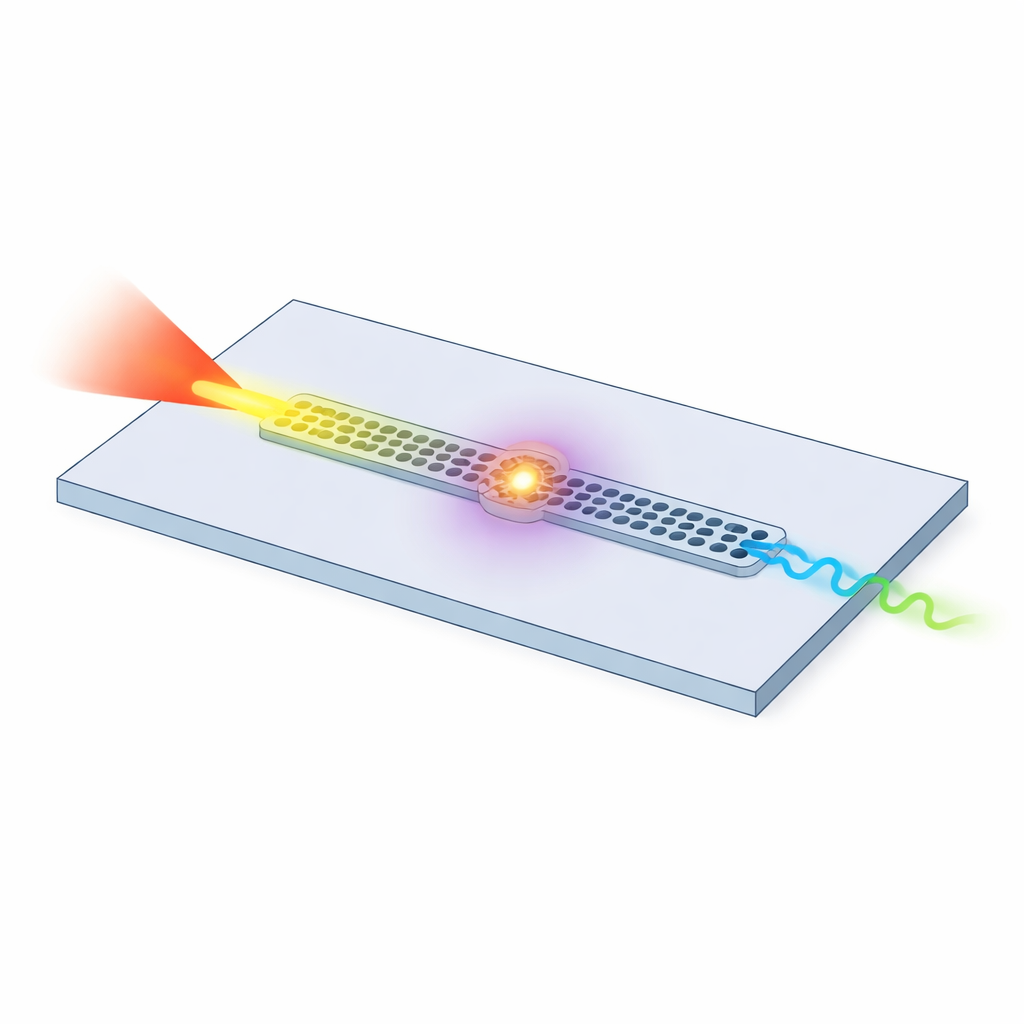
At the heart of the work are quantum dots—nanoscale “artificial atoms” that can emit single photons on demand—and photonic crystal waveguides, which act like microscopic railway tracks for light. Instead of shining a laser straight down from above onto a quantum dot, the team routes light along the plane of the chip through a patterned waveguide and uses it to excite the dot remotely. This in‑plane routing is more compatible with compact devices: it reduces unwanted light leakage, lets one laser address several dots in hard‑to‑reach regions, and opens the door to complex on‑chip quantum circuits where sources, channels, and detectors are all integrated.
Making Light Prefer One Way Over the Other
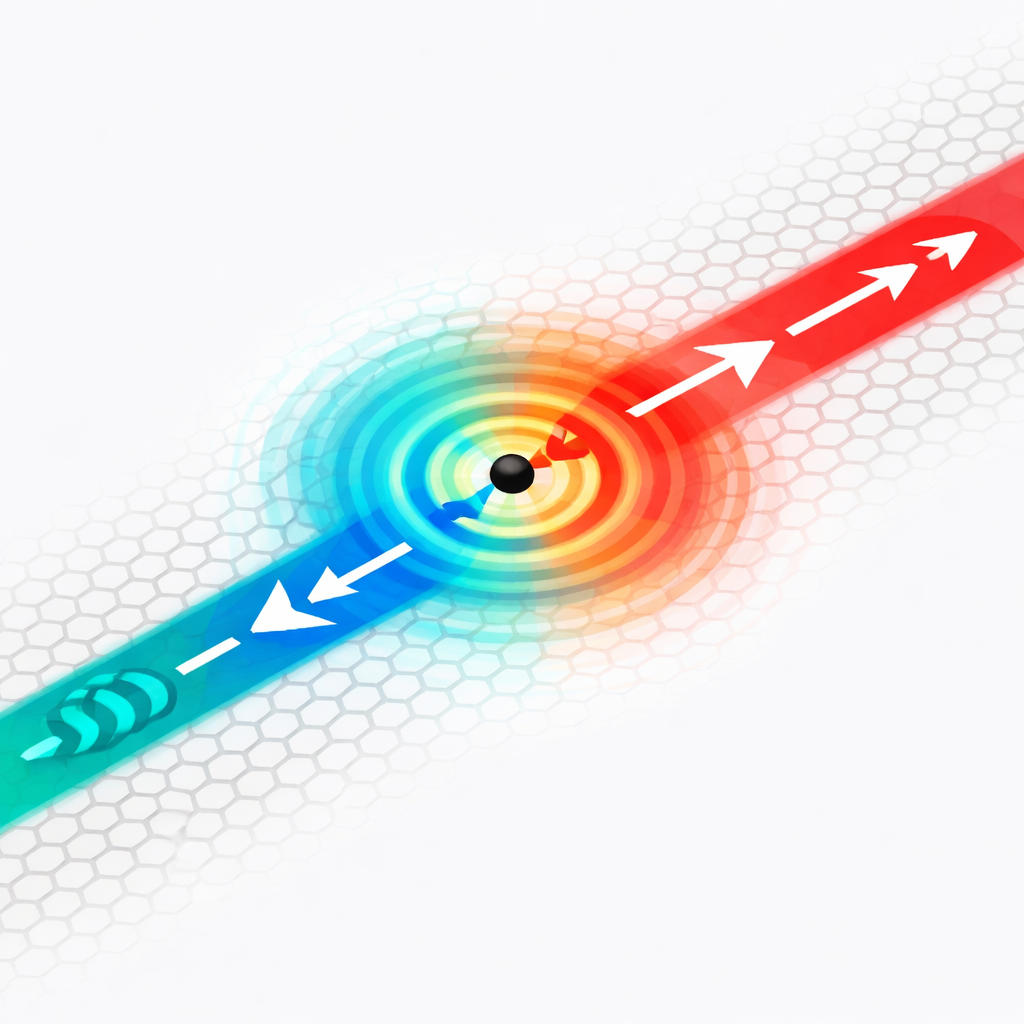
A special feature of these waveguides is “chirality”: the pattern of holes and ridges is engineered so that light traveling left looks different in polarization from light traveling right. When a strong magnetic field is applied, the quantum dot’s internal states also come in two versions that couple differently to these directions. Under conventional local excitation, both states are populated roughly equally, and the waveguide’s chirality only influences how the emitted photons leave the dot. Under the new remote scheme, the excitation light itself arrives through the chiral waveguide, so it selectively prepares one spin state of the dot much more than the other. The same chirality then acts again when the dot emits, effectively doubling the directional bias and yielding a much stronger imbalance in how many photons go left versus right.
Slow Light and Faster Emission
The researchers design a “slow‑light” section in the waveguide, where the light’s group velocity is strongly reduced. In this region, the electromagnetic field builds up and interacts more strongly with the quantum dot. This boosts the rate at which the dot emits photons—a phenomenon known as Purcell enhancement—and increases the fraction of photons coupled into the guided mode, quantified by the so‑called beta factor. Simulations show that when remote excitation is used, regions of the waveguide that simultaneously offer near‑perfect directionality and strong emission enhancement occupy over half of the usable area, more than doubling what is available under standard local excitation. That makes it much easier, in practice, to find dots naturally sitting in “sweet spots” where they behave as bright, highly directional quantum light sources.
Putting the Concept to the Test
Experimentally, the team fabricates a gallium arsenide diode structure with embedded quantum dots and integrates it into a glide‑plane photonic crystal waveguide. They tune the dots electrically and magnetically so that their emission lines fall inside the slow‑light band of the waveguide. By exciting the dots via a higher‑energy “p‑shell” level through the waveguide, they preserve the spin information as the system relaxes to the emitting state. Measurements show that remote excitation markedly increases directional contrast compared with local illumination for every dot studied, in line with a simple model that predicts a nonlinear boost in directionality when chirality acts twice. For one particularly well‑coupled dot, they observe photons leaving the structure with about 90% preference for one direction, together with a six‑fold speed‑up of the emission rate and an estimated beta factor of roughly 97%, all while maintaining clear signatures of single‑photon behavior.
Toward Practical Quantum Light Circuits
In plain terms, this work shows how to use the same tiny optical railway both to “wind up” a quantum dot’s internal spin and to route its emitted photons almost entirely in one direction, all on a compact chip. By combining strong, fast emission with near‑unidirectional flow, the approach sets a benchmark for building scalable quantum photonic circuits where many quantum dots can be linked into networks, exchange information via guided photons, and potentially serve as building blocks for quantum computers and secure communication systems. Future improvements in placing quantum dots exactly where needed could further strengthen this platform as a practical route to real‑world quantum technologies.
Citation: Savvas Germanis, Xuchao Chen, René Dost, Dominic J. Hallett, Edmund Clarke, Pallavi K. Patil, Maurice S. Skolnick, Luke R. Wilson, Hamidreza Siampour, and A. Mark Fox, "Waveguide excitation and spin pumping of chirally coupled quantum dots," Optica 12, 1689-1696 (2025). https://doi.org/10.1364/OPTICA.569882
Keywords: quantum photonics, chiral waveguides, quantum dots, single-photon sources, spin–photon interfaces