Clear Sky Science · en
Strong coupling of chiral light with chiral matter: a macroscopic study
Why Twisty Light Matters
Many of the molecules that make up our bodies and our medicines come in two mirror-image forms, like left and right hands. These twins, called enantiomers, can behave very differently in the body, so telling them apart—and controlling them—is a major challenge in chemistry and pharmacology. This paper explores how to build a tiny optical “hall of mirrors” that responds very differently to left‑ and right‑handed forms of light and matter, potentially enabling sensors that can pick out one molecular twin from the other with great precision.
Left and Right in the World of Light
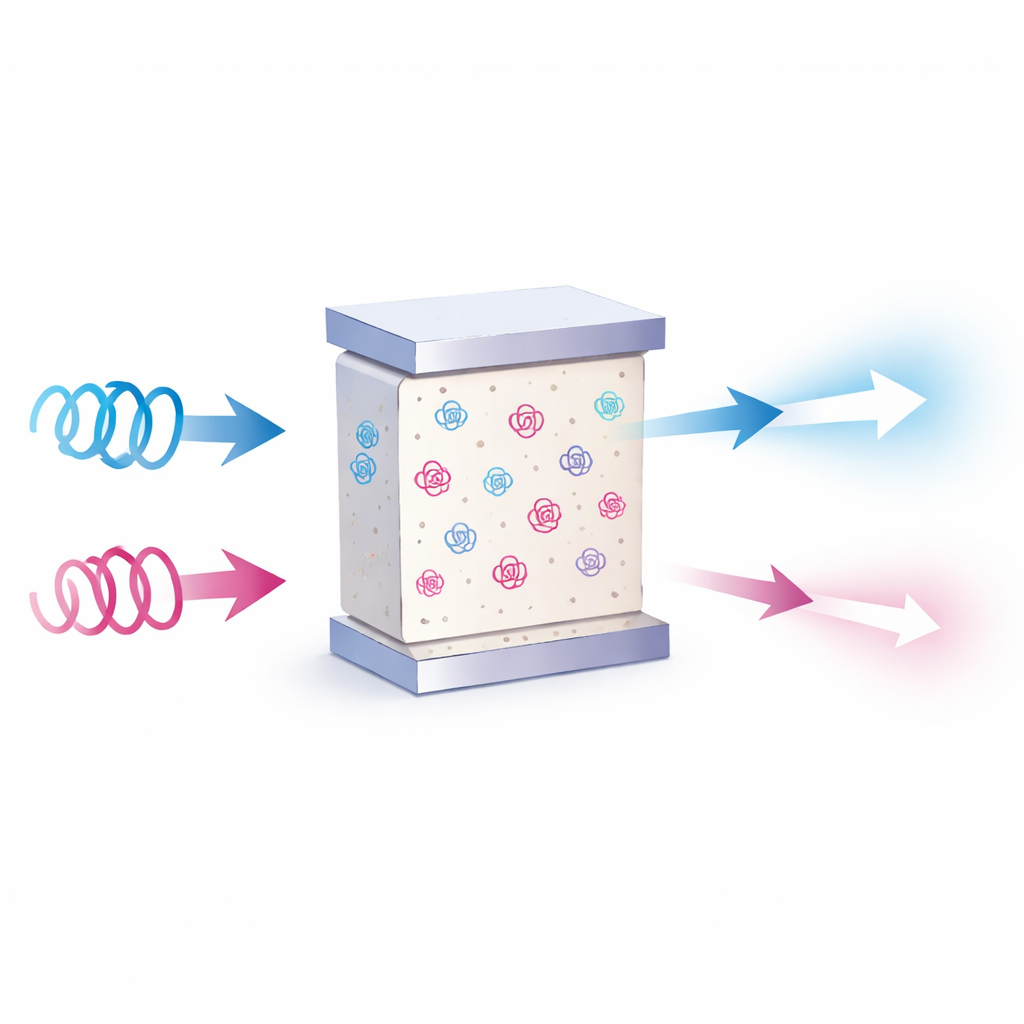
Chirality, or handedness, shows up in both matter and light. A chiral molecule cannot be superimposed on its mirror image, just as a left hand cannot become a right hand by rotation alone. Light, too, can be chiral: in circularly polarized light, the electric field rotates either clockwise or counterclockwise as the wave travels. When chiral light interacts with chiral matter, subtle differences emerge—such as one handedness of light being absorbed slightly more than the other. These effects underpin tools like circular dichroism spectroscopy, widely used to study proteins and other complex molecules. However, in ordinary setups the differences are tiny, so researchers seek structures that dramatically amplify how strongly left and right forms “feel” each other.
Building a Cavity That Remembers Handedness
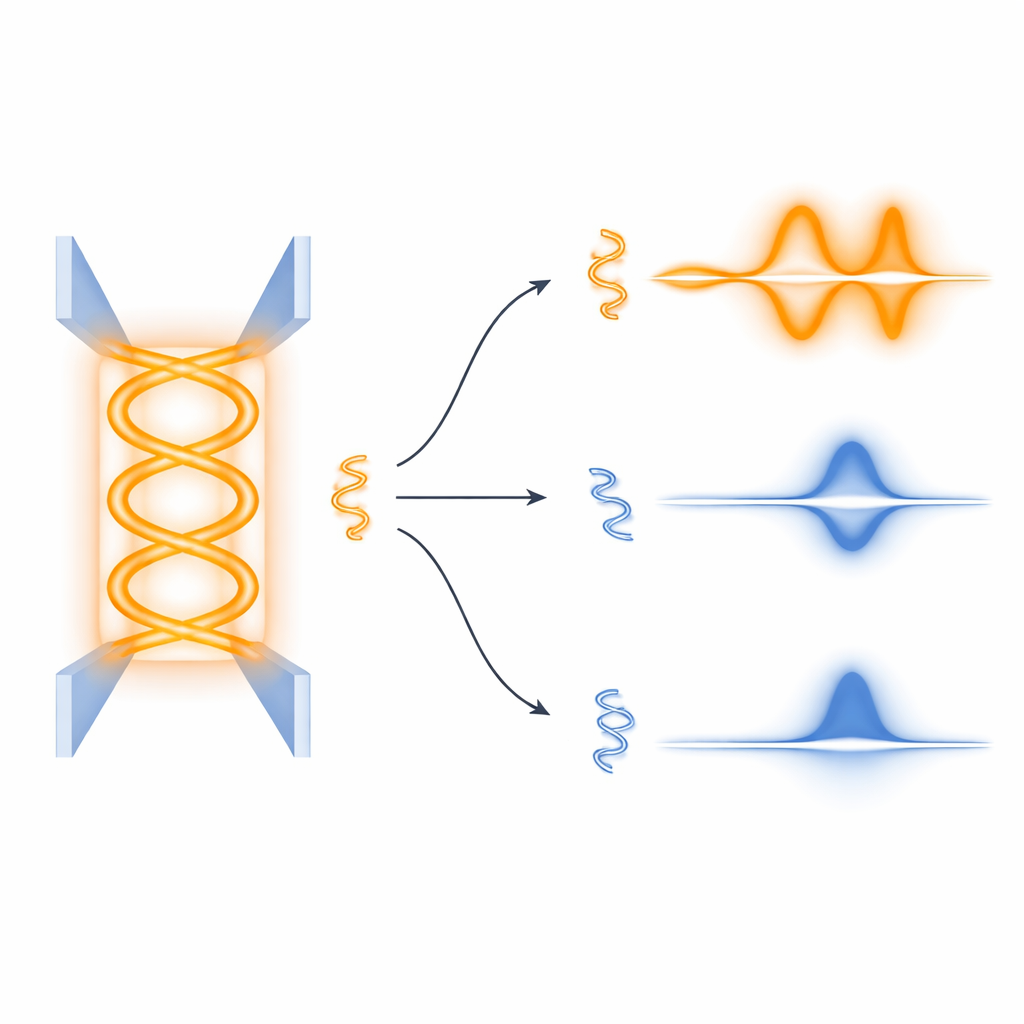
The authors design a special optical cavity—a Fabry–Pérot resonator—that traps light between two mirrors. Unlike ordinary mirrors, which flip the handedness of circularly polarized light upon reflection, their “handedness‑preserving” mirrors send right‑handed light back as right‑handed, and left as left. Each mirror is realized as a carefully engineered stack of layers topped with narrow silicon stripes that make the reflection directionally dependent. Rotating the top and bottom mirrors relative to each other breaks mirror symmetry, so the trapped light forms standing waves whose polarization twists like a helix through the cavity. These modes are chiral not just locally, but throughout the entire volume between the mirrors, creating a three‑dimensional region of strongly chiral electromagnetic fields.
Filling the Cavity with Twisty Matter
Next, the researchers imagine filling the gap between the mirrors with a chiral medium that has a strong optical resonance—similar in spirit to a dye or a molecular layer tuned to a specific color. Instead of tracking every molecule individually, they use a macroscopic description: the material is characterized by effective parameters that describe how it responds to electric and magnetic fields, and a dedicated “chirality” parameter that links the two. They embed a resonant feature (a Lorentz pole) into all three of these parameters so that, at a particular frequency, the medium responds especially strongly. This approach allows them to treat the interaction between light and a dense ensemble of molecules inside the cavity in a unified way, capturing how the cavity modes and the material resonance can merge into new hybrid light–matter states.
When Handedness Locks Together
By combining analytical calculations with full‑wave numerical simulations, the authors show that, under the right conditions, the chiral cavity modes and the chiral medium enter a regime of strong coupling. In this regime, light does not simply pass through or get absorbed; instead, the cavity resonance splits into a pair of new peaks, a telltale signature that photons and molecular excitations are repeatedly exchanging energy. Crucially, this splitting depends on whether the handedness of the cavity mode matches that of the medium. When they have opposite handedness, the fields and molecules barely interact, and the cavity behaves almost as if the material were not resonant at all. When the handednesses match, the interaction is maximized and the splitting between the two peaks becomes large and easily observable.
From Theory to Future Sensors
To a non‑specialist, the key message is that the authors have designed a resonant optical structure in which both light and matter are strongly chiral and can either lock together or ignore each other depending on their handedness. This controlled “on/off” interaction shows up as clear shifts and splittings in the wavelengths that pass through the cavity. Such behavior could be exploited to build new kinds of optical sensors that distinguish left‑ and right‑handed molecules simply by looking at the transmission spectrum. In the long run, this macroscopic framework for chiral strong coupling may help enable compact devices that sort, detect, or even selectively influence one molecular enantiomer over the other—an enticing prospect for pharmaceuticals, chemical analysis, and chiral materials engineering.
Citation: Sergey Dyakov, Ilia Smagin, Natalia Salakhova, Oleg Blokhin, Denis G. Baranov, Ilia Fradkin, and Nikolay Gippius, "Strong coupling of chiral light with chiral matter: a macroscopic study," Optica 12, 1406-1416 (2025). https://doi.org/10.1364/OPTICA.569452
Keywords: chiral light, strong coupling, Fabry–Pérot cavity, enantioselective sensing, optical chirality