Clear Sky Science · en
Visualizing strongly focused 3D light fields in an atomic vapor
Seeing Hidden Shapes of Light
Light from lasers underpins everything from high-speed internet to the microscopes that reveal living cells. Yet even in these familiar tools, much of light’s fine structure remains invisible to ordinary cameras and lenses. This paper shows a new way to "see" the full three-dimensional shape of tightly focused laser beams by letting a thin cloud of atoms act as an ultra-sensitive probe, revealing parts of the light field that conventional detectors simply miss.
When Light Is Twisted and Squeezed
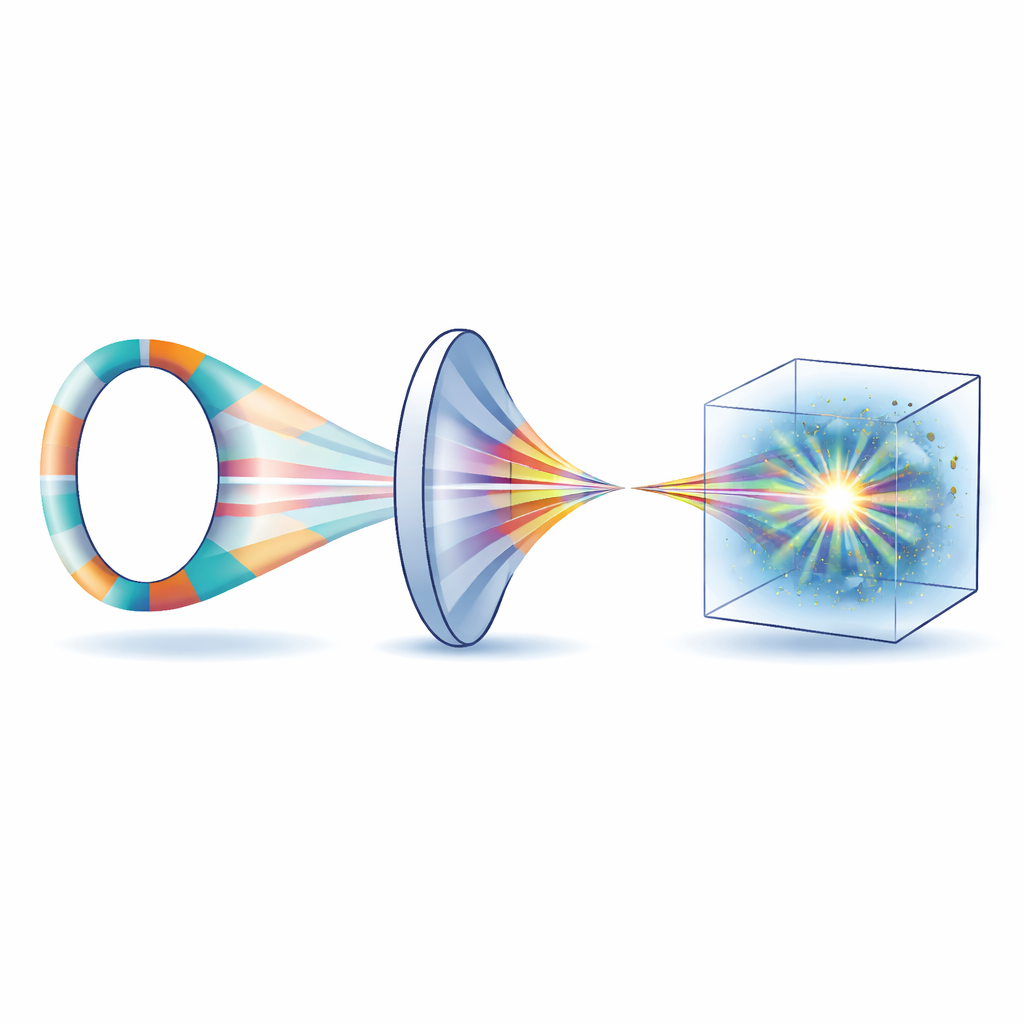
Modern optics can sculpt light into intricate patterns — not just in brightness, but also in how its electric field points across the beam. These so-called structured beams can be made radial, azimuthal, or arranged in more exotic patterns that twist around the beam’s center. When such beams are strongly focused by a high-quality lens, they no longer behave like the simple textbook rays most of us imagine. Instead, a hidden component of the electric field can appear along the direction in which the light travels, forming a truly three-dimensional pattern that is notoriously hard to measure with standard optical components.
Why Ordinary Detectors Miss the Full Picture
Most familiar optical devices — polarizers, photodiodes, cameras — only respond to the part of light that oscillates sideways to its direction of travel. That means they are effectively blind to the "axial" component that points along the beam, which becomes important when the beam is very tightly focused. In the past, researchers have had to infer this axial piece indirectly, for example from the way single molecules glow or from scattering off tiny particles. These approaches are powerful but often complex, inefficient, or limited in the information they can provide about the full three-dimensional field.
Using Atoms as Tiny Compasses for Light
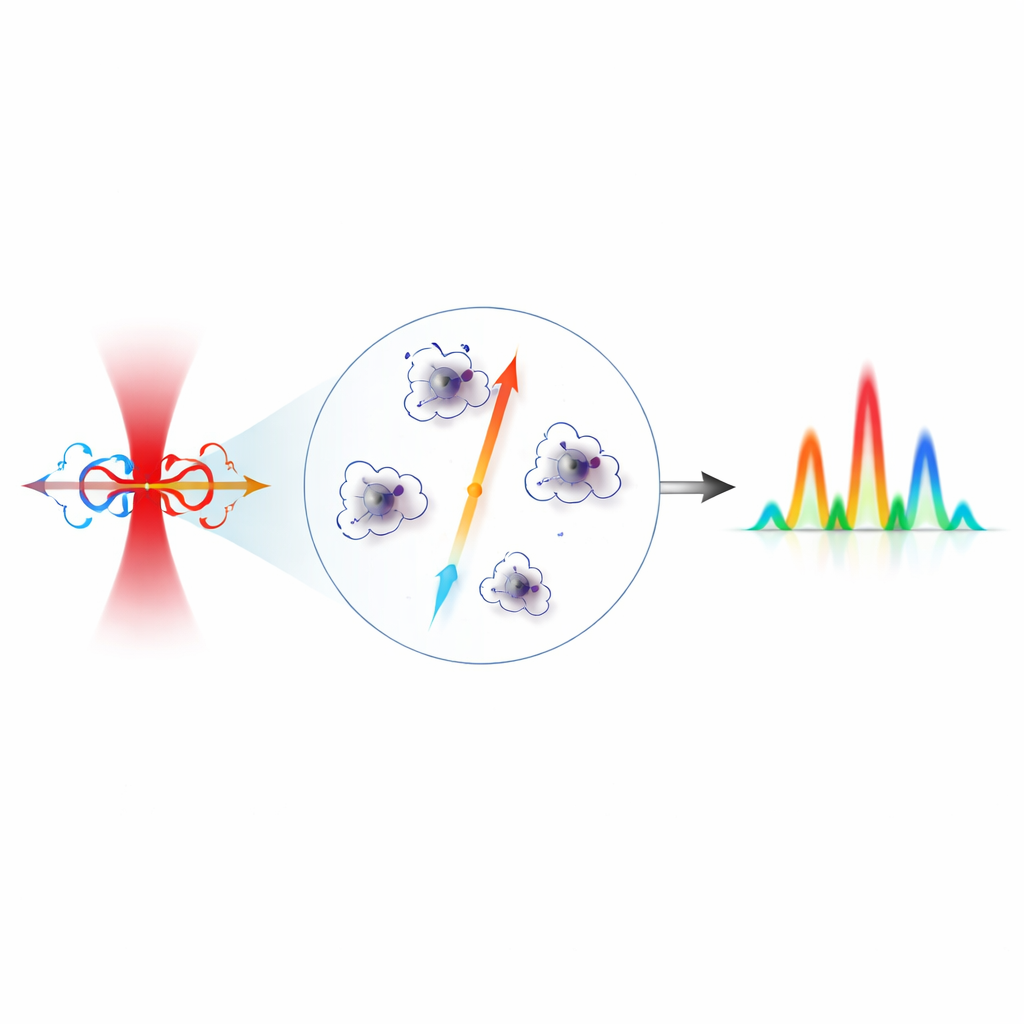
The authors take a different route: they let atoms in a warm rubidium vapor diagnose the light. In a strong magnetic field, the energy levels of these atoms split into many closely spaced lines, each driven by a particular orientation of light’s electric field. Light that oscillates sideways triggers one group of transitions, while light pointing along the beam axis drives another, normally "forbidden" in standard arrangements. By sending strongly focused structured beams through a millimeter-size cell of rubidium and scanning the laser frequency, the team measures how much light is absorbed in each transition. In effect, the atoms act like three-dimensional compasses, turning differences in polarization into distinct features in the absorption spectrum.
Drawing Maps of the Hidden Field
To test how well this atomic probe works, the researchers generate a series of input beams whose polarization patterns gradually change from purely azimuthal to purely radial, and also more complex patterns with twofold and sixfold rotational symmetry. Vector diffraction theory predicts that only beams with a radial component will develop a strong axial field when focused; azimuthal beams should remain purely sideways. The measurements confirm this: absorption linked to the axial-driving transition is weakest for azimuthal input and grows linearly as the beam becomes more radial. Using a camera to record how absorption varies across the beam, they show that the spatial pattern of this special transition faithfully reproduces the radial "petals" of the original polarization structure, even for the higher-order patterns with multiple lobes.
New Eyes for Quantum Technologies
In simple terms, this work shows that a thin cloud of magnetized atoms can act as a three-dimensional polarization camera for tightly focused light. By watching which atomic transitions are excited, and where across the beam they occur, the researchers directly reveal the elusive axial component that standard optics cannot see. This not only confirms long-standing theoretical predictions about focused vector beams, but also opens a route to controlling atomic states by carefully tailoring the structure of light. Such control could improve magnetometers, optical filters, and other quantum sensing tools, and may ultimately let engineers encode and read out information in light and atoms with unprecedented precision.
Citation: Sphinx Svensson, Clare R. Higgins, Danielle Pizzey, Ifan G. Hughes, and Sonja Franke-Arnold, "Visualizing strongly focused 3D light fields in an atomic vapor," Optica 12, 1553-1559 (2025). https://doi.org/10.1364/OPTICA.568785
Keywords: structured light, atomic vapor, polarization, quantum sensing, rubidium spectroscopy