Clear Sky Science · en
Transportable single-crystal silicon ultra-stable cavity toward space applications
Why Space Needs Exceptionally Steady Light
From testing Einstein’s theories to hunting for gravitational waves, many modern experiments rely on lasers whose color—and thus frequency—hardly changes at all. In space missions, these “ultra-stable” lasers must stay steady while surviving launch vibrations, extreme cold, and long-term operation. This paper reports a new kind of compact silicon-based device that keeps a laser extraordinarily stable, is robust enough to be transported, and is designed with future space deployment in mind.
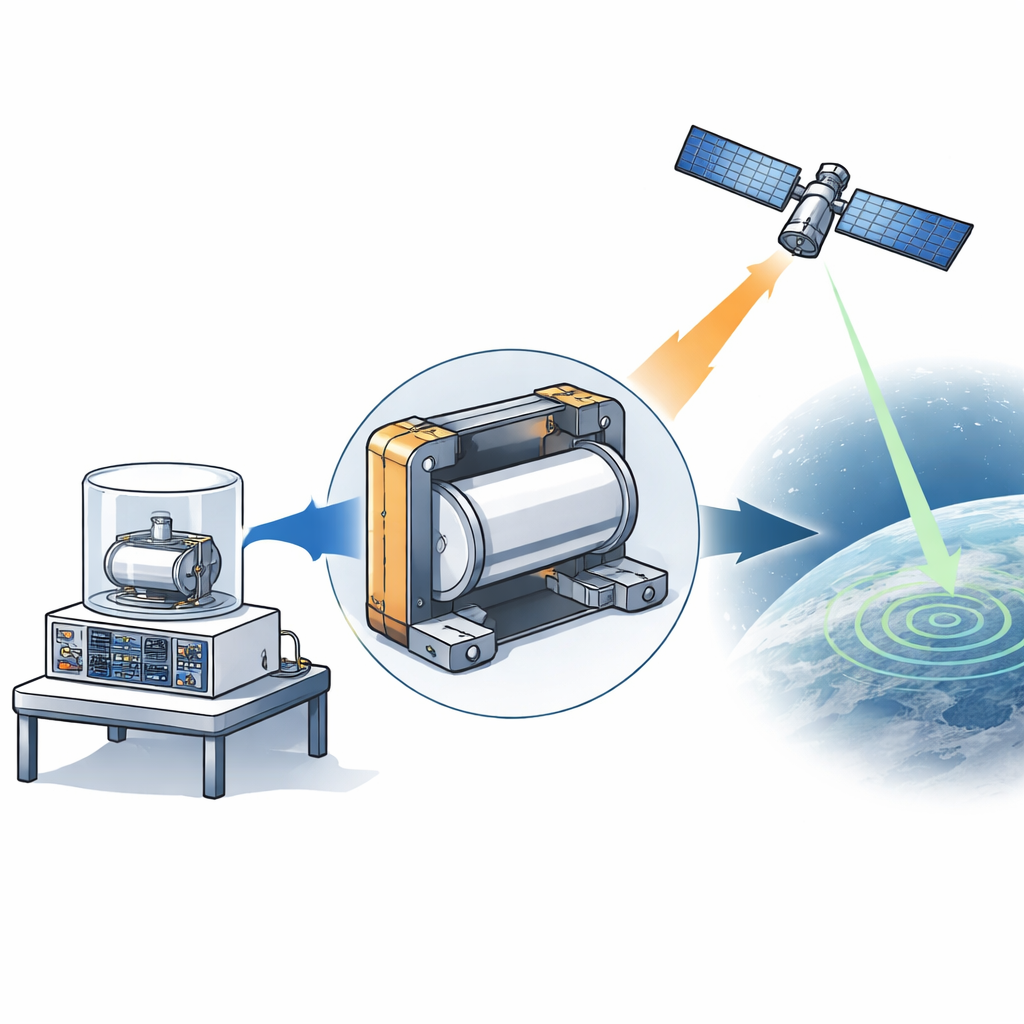
Turning Silicon into a Quiet Measuring Rod
At the heart of an ultra-stable laser is an optical cavity—a pair of mirrors facing each other across a fixed distance. Light bouncing between them locks the laser’s color to that distance, so any tiny change in cavity length shows up as a frequency shift. The authors build their cavity from a single crystal of silicon, engineered so that its length barely changes with temperature at around 124 kelvin (about –150 °C). Compared with more common glass materials, silicon at these cold temperatures has lower internal “jitter,” letting the cavity reach a very low fundamental noise level while still remaining relatively small and light—key advantages for use on a satellite.
Making a Delicate Device Tough Enough to Travel
Designing for space means the cavity cannot just sit gently on a lab table. It must withstand transport, launch-like shaking, and repeated cooling and warming without losing performance. To achieve this, the team uses computer simulations to shape a pumpkin-like silicon spacer and determine where and how to support it. They mount the 112.5-millimeter-long cavity at six carefully chosen points on a rigid metal frame made of Invar, a material that barely expands when cooled. The silicon’s crystal orientation is chosen to be stiffest along the direction of the light path, which reduces how much the cavity length shifts under vibration. Simulations predict that, in both Earth gravity and near-weightlessness, this configuration should respond only very weakly to accelerations.
Cold, Calm, and Well Shielded
To reach the sweet-spot temperature near 124 kelvin, the researchers develop a quiet cooling system inspired by the conditions available on satellites. Instead of using noisy mechanical coolers, they run ordinary nitrogen gas through coils chilled by liquid nitrogen. This cold gas then cools a stack of nested metal shields around the cavity. A sensitive heater and feedback loop keep the innermost shield extremely steady, while insulating supports and vacuum suppress heat leaks and air currents. Machine-learning tools help optimize this arrangement. In testing, the temperature at the control shield is held steady to better than a thousandth of a degree, which means the cavity’s own temperature barely fluctuates—small enough that temperature effects contribute only a tiny fraction of the total frequency noise.
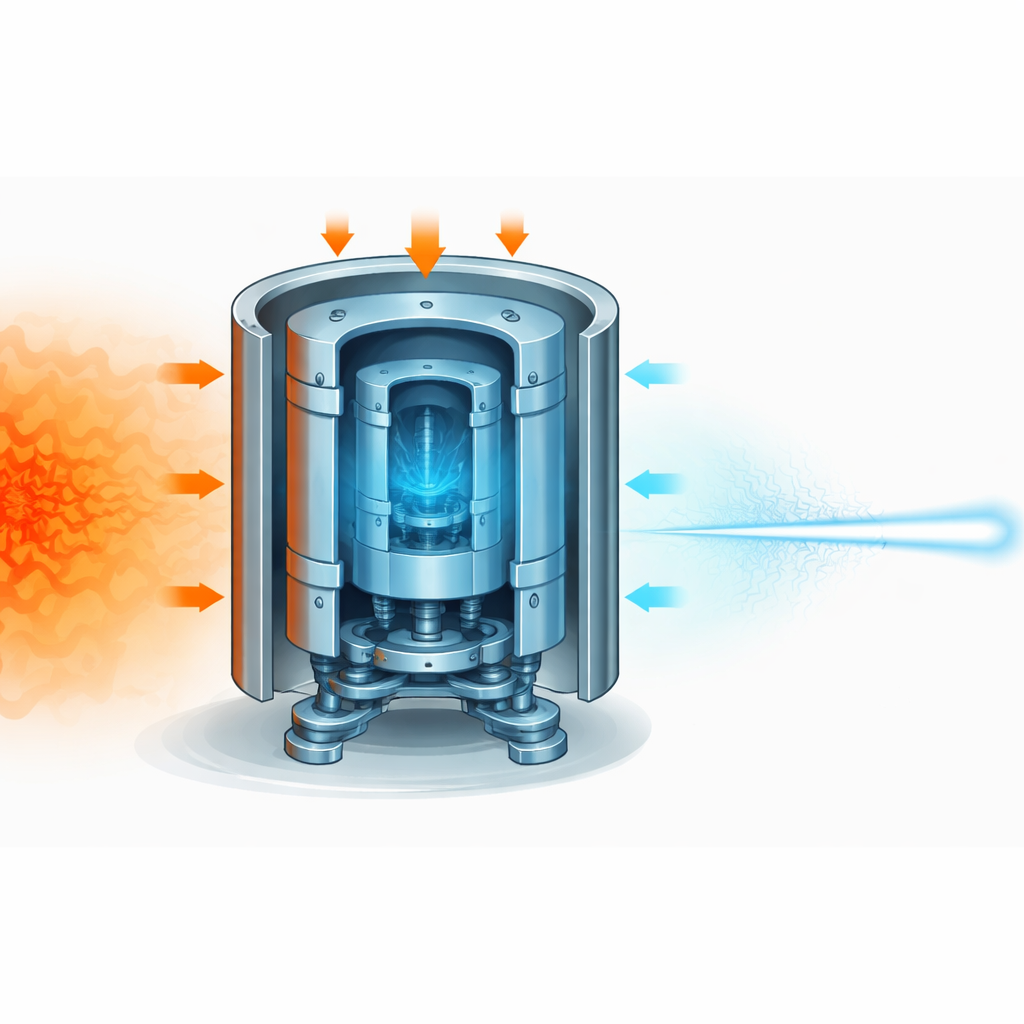
Building and Testing the Ultra-Stable Laser
With the cavity in place and cooled, the team locks a laser to it using a standard optical control technique. They then compare the resulting ultra-stable laser to two independent high-performance lasers based on more conventional glass cavities. By analyzing how the beat notes between the lasers wander over time, they extract the stability of the new silicon system. The device achieves a fractional frequency instability of about four parts in ten quadrillion over times from half a second to one hundred seconds—comparable to the best transportable lasers made so far, but in a shorter, silicon-based package suited to cryogenic operation. The cavity also survives 50 kilometers of car transport and multiple deep-cooling cycles with only minor shifts, confirming its mechanical robustness.
Steps Toward Space-Borne Precision Tools
For a non-specialist, the main takeaway is that the authors have created a compact, cold silicon “ruler of light” that keeps a laser’s color extremely steady while being tough enough to move and cool repeatedly. Though some extra vibration and temperature noise still limit performance above the theoretical minimum, the work shows that single-crystal silicon cavities can be engineered for real-world, transportable use and sets the stage for future versions tailored for satellites. In space, where quiet, cold environments are more readily available, such devices could become the backbone of next-generation clocks, gravitational wave detectors, and other precision instruments that rely on ultra-stable lasers.
Citation: Xian-Qing Zhu, Xiao-Min Zhai, Yong Xie, Yuan Miao, Hai-Wei Yu, De-Quan Kong, Wen-Lan Song, Yi-Wen Zhang, Yi Hu, Xing-Yang Cui, Xiao Jiang, Bao-Yu Yang, Jian-Jun Jia, Juan Yin, Sheng-Kai Liao, Rong Shu, Cheng-Zhi Peng, Ping Xu, Han-Ning Dai, Yu-Ao Chen, and Jian-Wei Pan, "Transportable single-crystal silicon ultra-stable cavity toward space applications," Optica 12, 1342-1349 (2025). https://doi.org/10.1364/OPTICA.568436
Keywords: ultra-stable lasers, single-crystal silicon cavity, space-based metrology, cryogenic optics, precision timekeeping