Clear Sky Science · en
Hidden nonlinear optical susceptibilities in linear polaritonic spectra
Why tiny ripples of light and matter matter
Light trapped between mirrors can mix with clouds of molecules to form new hybrid particles called polaritons. These strange states of light and matter have been hailed as tools to steer chemical reactions, move energy efficiently, and even create lasers that work at room temperature. Yet, when scientists measure how these systems respond to very weak light, the results often look surprisingly ordinary: simple, textbook optics seems to explain everything. This work shows that the story is not so simple—hidden quantum processes quietly leave fingerprints in what appears to be a plain, linear spectrum.
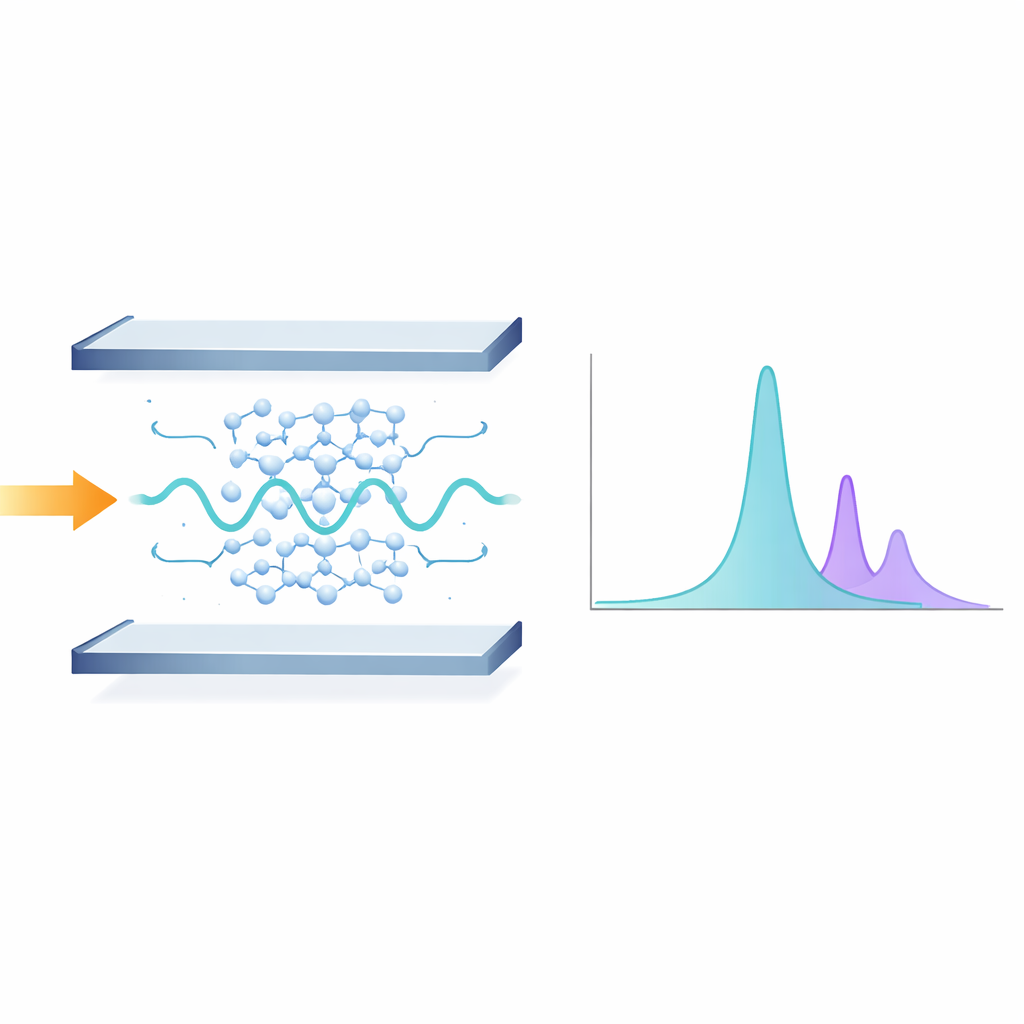
The stage: light in a box full of molecules
The authors study a common experimental setup: a pair of mirrors forming a tiny cavity that traps a single color of light, filled with a large number of identical molecules. When the coupling between the trapped light and the molecules is strong, energy can bounce back and forth many times, mixing light and molecular excitations into polaritons. Experiments typically probe this system with a very weak laser and record three basic signals—how much light is transmitted, absorbed, or reflected. Up to now, these signals have been successfully reproduced by classical optics models that treat the molecules as a simple, linear material with known optical constants, raising an uncomfortable question: where are the genuinely quantum and nonlinear effects one expects from such an exotic light–matter mixture?
Peeling back the layers of a “linear” spectrum
To address this puzzle, the authors derive a general mathematical expression for the cavity’s linear response that keeps track of how the trapped photon couples to the many molecules. By reorganizing the problem into blocks that separate collective motion of all molecules from rare events involving single molecules, they uncover a natural hierarchy controlled by the number of molecules in the cavity. In the ideal limit of infinitely many molecules, only the collective motion survives, and the cavity’s response reduces exactly to what classical linear optics predicts. But for any finite ensemble, there are systematic corrections that scale as powers of 1 divided by the molecule count. These corrections come from processes in which the vacuum field of the cavity briefly nudges individual molecules into vibrational motion, even though the experiment uses only very weak light.
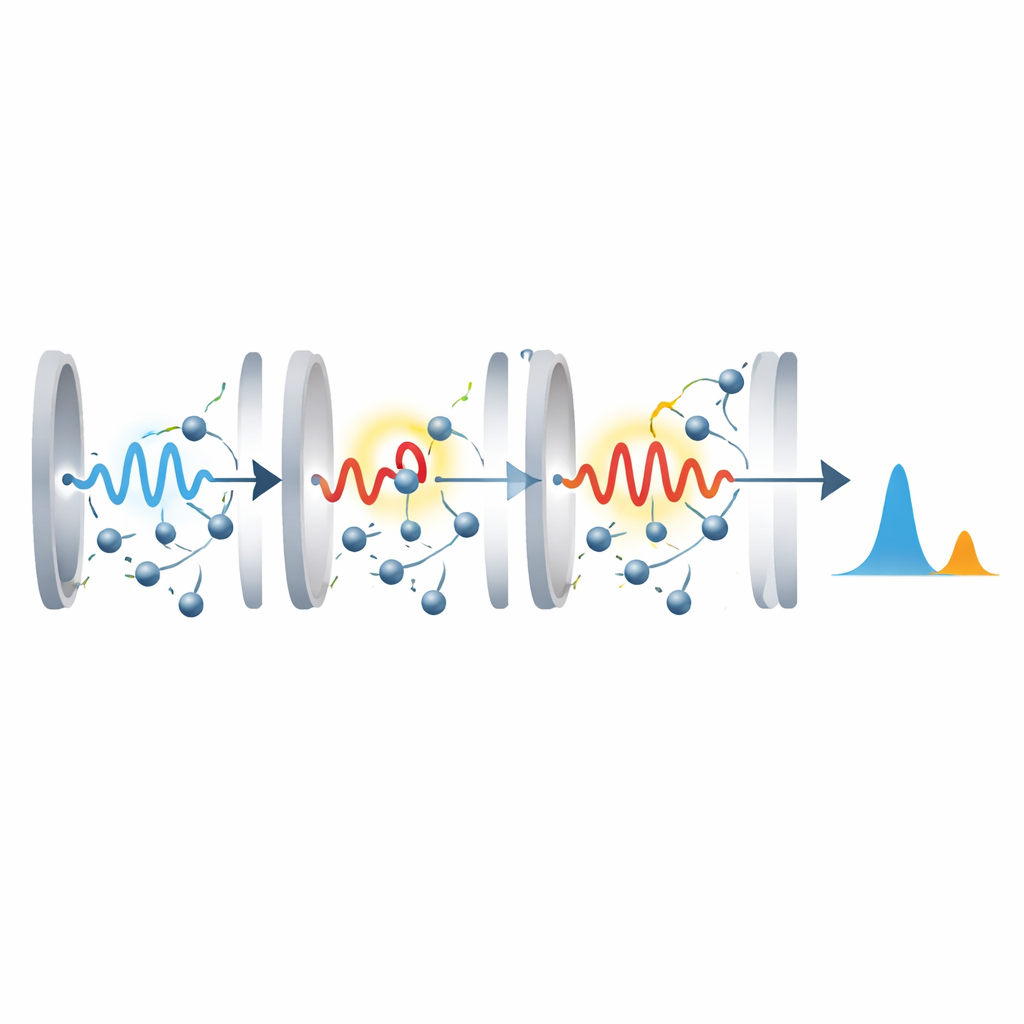
Hidden sidebands from quiet molecular vibrations
The most prominent quantum correction identified in this work looks like a Raman process, in which light loses or gains a small amount of energy by creating or destroying a molecular vibration. Here, however, those vibrations are created and removed through the vacuum field inside the cavity, not by a strong driving laser. The theory predicts that such vacuum-mediated events generate faint side peaks, or sidebands, in the otherwise simple polariton absorption spectrum, shifted by a characteristic vibrational energy from the main polariton peaks. These features are genuinely quantum: they cannot be reproduced by any purely classical model. Higher-order corrections involve two vibrational quanta or even vibrations shared between different molecular species, opening up additional, subtler spectral lines that arise only when several molecules cooperate through the shared cavity field.
Sorting real novelties from repeats
The authors then reinterpret the cavity response in terms of “pathways” familiar from nonlinear spectroscopy, where sequences of light–matter interactions are represented as diagrams. They introduce a useful distinction between irreducible and reducible pathways. Irreducible pathways describe genuinely new processes that cannot be built by stringing together simpler responses, while reducible ones are just cascades of known effects. In the cavity, only the irreducible pathways directly shape the photon’s self-energy and thus the observed linear spectrum. This viewpoint provides a practical recipe for the community: when analyzing spectra from strongly coupled cavities, one should look specifically for the irreducible Raman-like pathways as hallmarks of true cavity-induced quantum behavior, rather than mistaking simple cascades for new physics.
When and where to look for the hidden signals
Finally, the study explains why these quantum fingerprints have been so elusive in typical experiments. The strength of the hidden sidebands depends on how strongly each individual molecule couples to the cavity, while their visibility depends on how long the photon survives between the mirrors. In many common setups, the cavity leaks light too quickly, or supports many different photon colors, so the delicate sidebands blur into the background. The authors show that high-quality, nearly single-color cavities—where the photon lifetime is on the same scale as the single-molecule coupling strength—are required to clearly resolve these features. They suggest that carefully engineered optical cavities or quantum simulators based on trapped ions could reach this regime.
What this means for future light–matter control
In plain terms, this work reveals that “linear” spectra of strongly coupled light–matter systems are not as simple as they seem. Beneath the dominant, classically explained peaks lie a ladder of weaker, quantum-driven features linked to molecular vibrations and vacuum fluctuations. By providing a clear mathematical framework and concrete experimental conditions for seeing these effects, the authors chart a path toward using cavities not just as passive optical filters, but as active platforms for harnessing quantum resources such as entanglement and exotic photon statistics in molecular systems.
Citation: Arghadip Koner and Joel Yuen-Zhou, "Hidden nonlinear optical susceptibilities in linear polaritonic spectra," Optica 12, 1625-1631 (2025). https://doi.org/10.1364/OPTICA.568221
Keywords: molecular polaritons, optical cavities, Raman sidebands, quantum electrodynamics, nonlinear spectroscopy