Clear Sky Science · en
Separable integrated frequency control of a microcomb
Why Tiny Light Combs Matter
Our world quietly depends on exquisitely precise timing and color measurement of light, from the GPS in our phones to the clocks that define the second. Optical frequency combs—light sources made of thousands of evenly spaced colors—are the rulers behind this precision. Shrinking these combs onto a chip promises smaller, cheaper tools for navigation, communications, and spectroscopy, but there has been a stubborn hurdle: it is hard to steer their two main knobs independently. This work shows how to gain separate, fast control over those knobs using a single, simple mechanism built directly into a tiny ring-shaped light circuit.
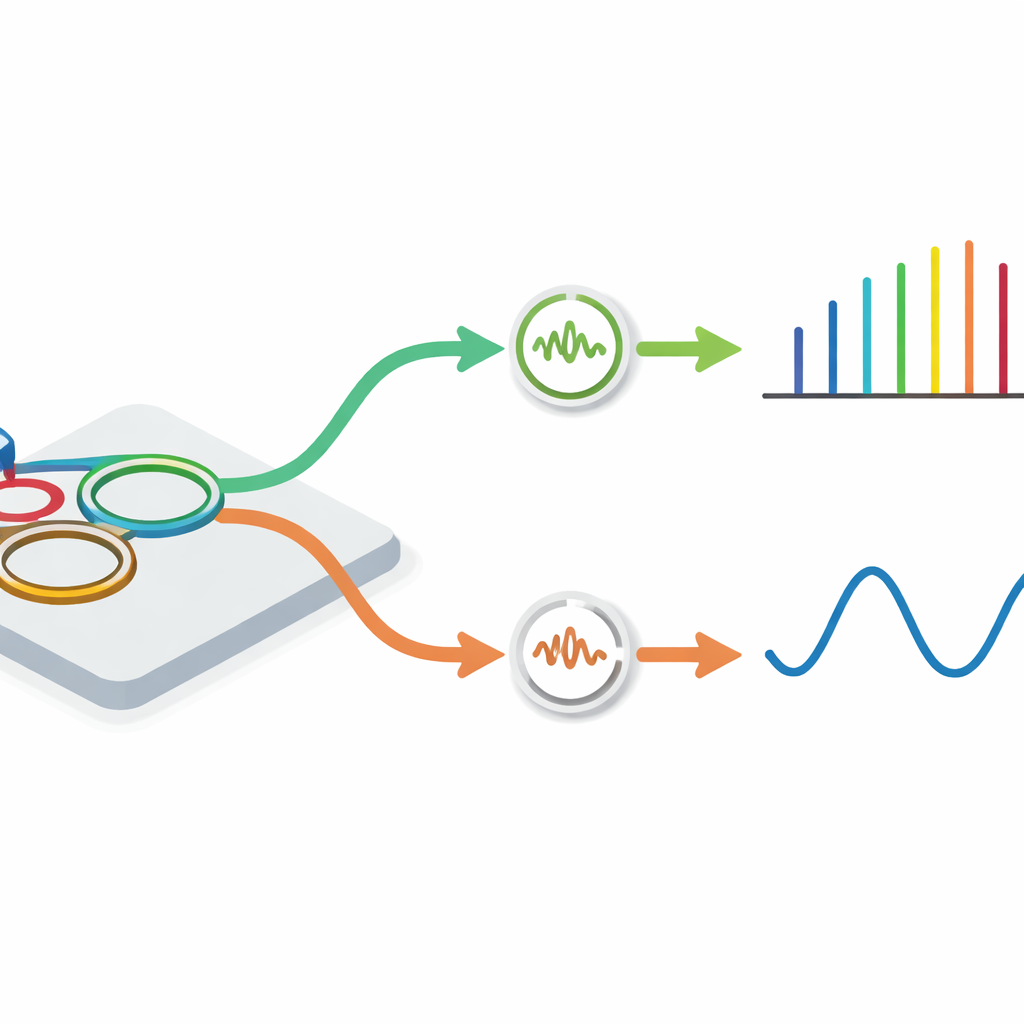
Two Knobs on a Comb of Light
An optical frequency comb looks, in frequency space, like the teeth of a perfectly regular hair comb: evenly spaced sharp lines of color. The position of every tooth is set by two numbers. One is the overall color offset, which says where the first tooth sits. The other is the spacing between neighboring teeth, which also sets the rate at which the comb pulses in time, like the ticking of a clock. In principle these two knobs are independent, but in practice most compact combs, called microcombs, entangle them. Turning one knob—by heating the device, changing the pump laser, or stretching the chip—tends to push both the offset and the spacing at once. That coupling has made it difficult to build fully stabilized, chip-scale combs that can match the performance of bulky lab systems.
A Clever Pair of Rings
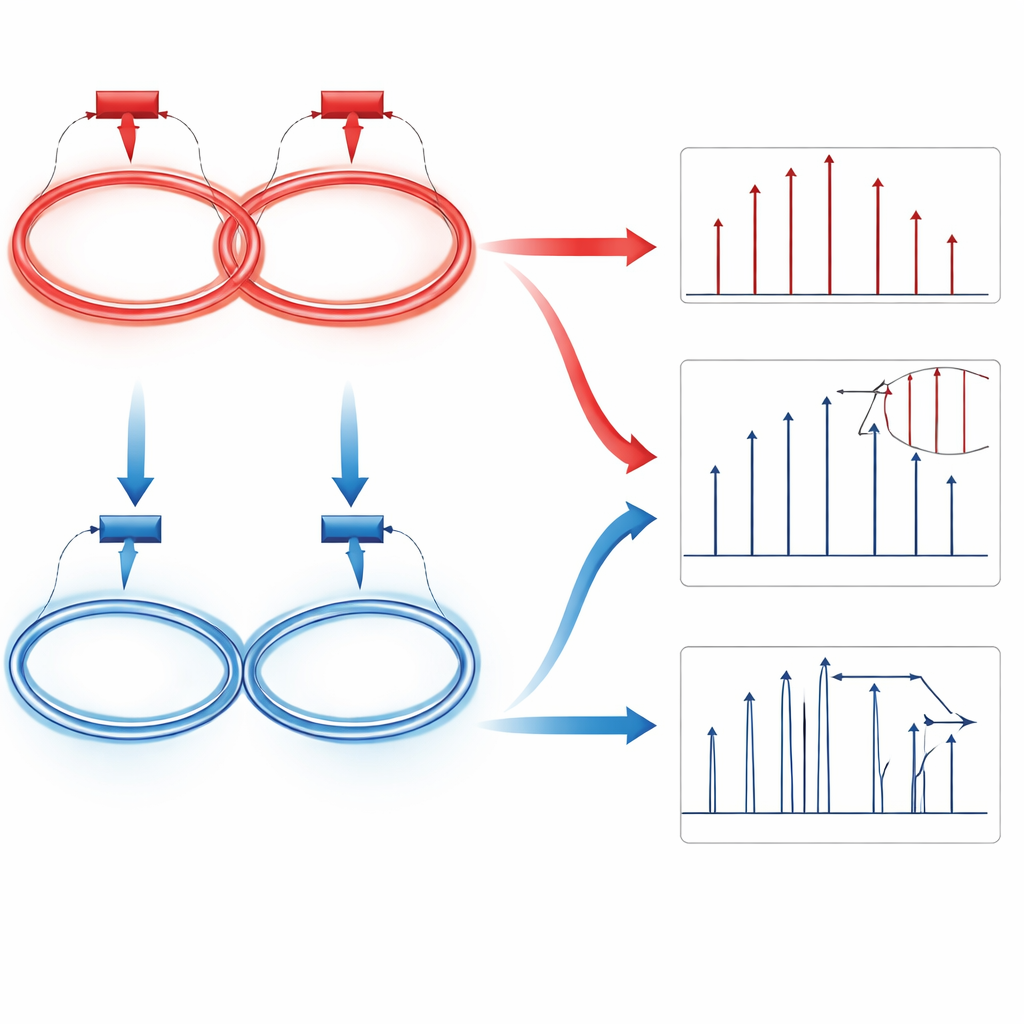
The authors solve this problem by designing a microcomb around two tiny ring resonators on a silicon nitride chip. The rings are almost the same size but not quite, so their natural color spacings differ by a small amount. When light circulates in both rings and they are coupled together, this small mismatch creates a vernier pattern, similar to the way two slightly offset grids form a slowly changing Moiré pattern. By carefully choosing the ring sizes, they make this effect amplify how sensitively the spacing between comb teeth can be tuned. Crucially, they also discover that pushing the two rings in the same way mostly shifts all the teeth up or down together (changing the offset), while pushing the rings in opposite ways mostly changes only the spacing. In other words, they can map two kinds of motion—common and differential—onto the two comb knobs.
Fast On-Chip Control with No Crosstalk
To move the rings, the team integrates thin piezoelectric layers—materials that strain when a voltage is applied—directly on top of the waveguides. When a voltage is applied, the piezoelectric film squeezes the ring slightly, changing the local index of refraction and hence the color of the circulating light. Two separate electrodes on each ring allow them to generate common and differential motions with simple electronic circuits. Measurements show that one electrical signal can tune the overall comb offset while barely affecting the spacing, and another can tune the spacing while leaving the offset nearly untouched. The unwanted leakage between the two controls is suppressed by more than a factor of ten thousand (over 40 decibels) up to audio-rate modulation, and the piezoelectric response itself is fast, with intrinsic bandwidth reaching about ten million cycles per second.
Locking a Tiny Comb to a Stable Yardstick
With this separable control in hand, the researchers go beyond demonstrations of tuning and fully lock the microcomb to a very stable optical cavity that acts as a reference ruler. Two separate lasers are first locked to different resonances of the cavity. Then two different comb teeth are locked to those lasers using the common and differential control channels. This pins down both the comb’s offset and its spacing, transferring the cavity’s stability into the microcomb. The resulting output includes a very low-noise train of light pulses as well as a highly stable microwave signal derived from the tooth spacing. They put this to the test by using an individual comb tooth to scan across a very narrow optical resonance in a second cavity, resolving its line shape cleanly and confirming that the comb’s own noise does not blur the measurement.
What This Means for Future Technologies
In simple terms, this work shows how to give a chip-scale comb of light two independent, precise, and fast steering wheels—one for where the comb sits, and one for how tightly its teeth are packed—using just one integrated actuator design. By exploiting the vernier-like Moiré effect in a pair of coupled rings and driving them with piezoelectric films, the authors achieve finely separated control with minimal crosstalk and high speed. This makes it much easier to build practical, fully stabilized microcombs that can serve as compact optical clocks, ultra-pure microwave sources, and sensitive spectroscopic tools, bringing lab-grade frequency control closer to real-world, mass-producible devices.
Citation: Jin-Yu Liu, Hao Tian, Qing-Xin Ji, Shuman Sun, Wei Zhang, Joel Guo, Warren Jin, John E. Bowers, Andrey B. Matsko, Mohammad Mirhosseini, and Kerry J. Vahala, "Separable integrated frequency control of a microcomb," Optica 12, 1350-1356 (2025). https://doi.org/10.1364/OPTICA.567664
Keywords: optical frequency comb, microcomb, photonic chip, frequency stabilization, piezoelectric tuning