Clear Sky Science · en
Demonstration of a next-generation wavefront actuator for gravitational-wave detection
Listening Deeper into the Universe
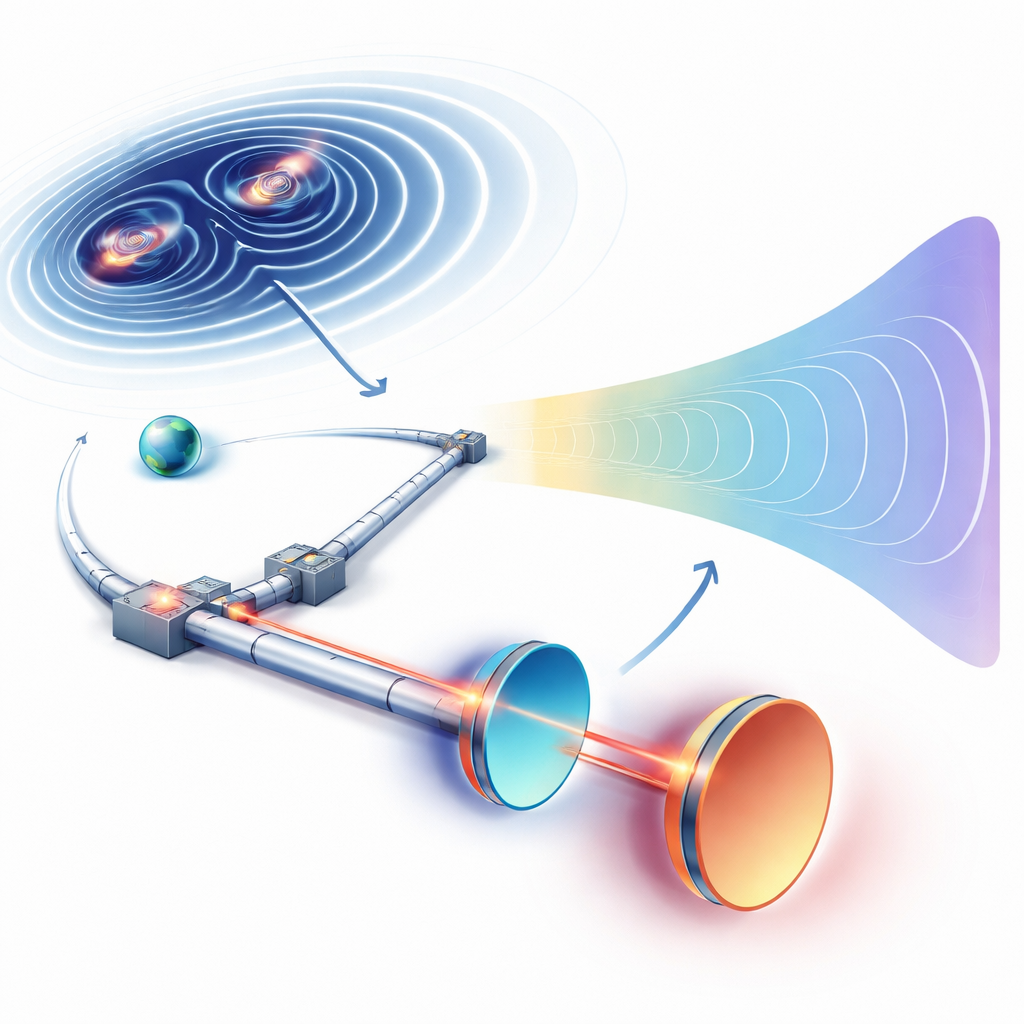
Gravitational-wave observatories like LIGO have already let us “hear” the collisions of distant black holes and neutron stars, but the next generation of detectors aims to listen much farther back in cosmic time—possibly to an era before the first stars formed. To do this, scientists must push huge laser-based instruments to extreme precision without letting the hardware itself blur the signals. This paper presents a new device, tested on a full-scale LIGO mirror, that tackles one of the key obstacles: tiny heat-induced distortions on the mirrors that can drown out the faint ripples of spacetime.
Why Heat Limits Our Cosmic Hearing
LIGO and similar observatories measure gravitational waves by bouncing powerful laser beams between mirrors separated by kilometers. Subtle stretching and squeezing of spacetime slightly change the distance between these mirrors, and the laser light carries that information. To hear fainter events, scientists want to use much stronger laser power and special “squeezed” light that lowers quantum noise. But when megawatts of light circulate in the detector, even parts-per-million absorption of laser power heats the large mirrors—called test masses—unevenly. This heating makes the glass surfaces and their interiors warp by tens of nanometers, enough to scatter light into unwanted patterns and spoil both laser power and quantum-noise reduction.
Limits of Today’s Mirror Tuning Tricks
Current detectors already use a thermal compensation system that gently warms the sides of the mirrors with ring heaters and shines infrared light through an extra glass plate to counteract some of the unwanted “thermal lenses.” These methods work well for broad, smooth distortions, like simple focusing errors. However, as planned upgrades (called A+ and A#) and the envisioned 40-kilometer Cosmic Explorer push to much higher powers, the remaining distortions concentrate near the mirror edges on finer length scales of just a few centimeters. Modeling shows that to keep the detector limited only by fundamental quantum noise, the leftover wavefront errors across the mirror face must be trimmed down to around ten nanometers root-mean-square—far tighter than today’s tools can manage.
A New Gentle Heater Around the Mirror
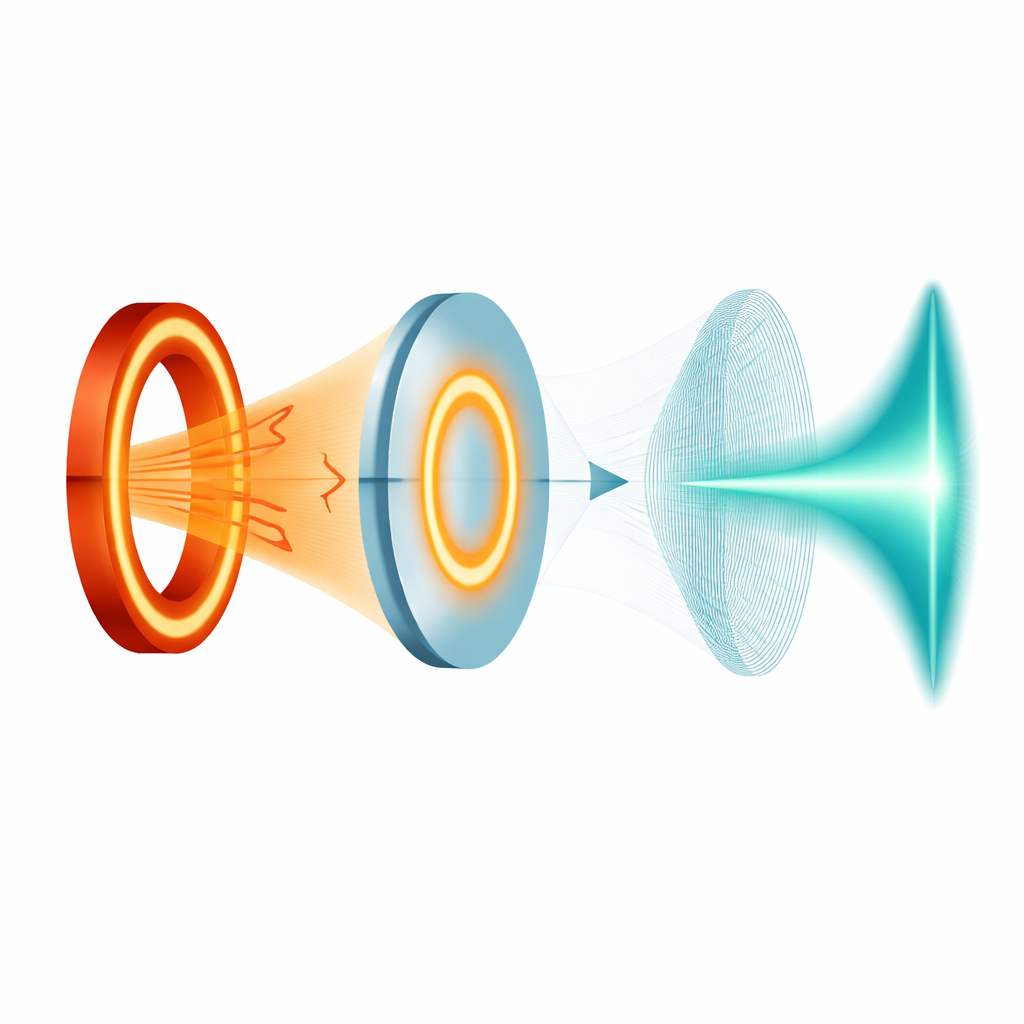
To solve this, the authors introduce a new device called the FROnt Surface Type Irradiator, or FROSTI. Instead of shining a laser, FROSTI uses a ring-shaped “graybody” heater, similar in spirit to a controlled hot plate, that glows in the mid-infrared. This ring sits a few centimeters in front of the mirror, just outside the coated area, inside the same vacuum chamber. Carefully shaped reflective surfaces redirect the thermal radiation into a bright, annular pattern that lands on the front of the mirror. By tuning this pattern, the system can deliberately warm specific regions—especially the outer part of the mirror face—so that the resulting microscopic expansion and refractive changes counteract the unwanted heat distortions created by the main science laser.
Proving It Works Without Adding Noise
The team built a full-scale prototype matched to a 40-kilogram LIGO end mirror and tested it in vacuum. Thermal cameras and a sensitive wavefront sensor measured how the mirror’s surface temperature and optical shape changed when the annular pattern was applied. The results closely matched detailed computer simulations: only about 10 watts of absorbed infrared power produced the desired deformation near the mirror edge, demonstrating that FROSTI can target the problematic regions. Just as important, the researchers checked that this added heating would not shake or contaminate the detector’s measurements. They showed that the thermal source is extremely stable in intensity, so fluctuations in radiation pressure and thermally driven “bending” of the mirror are well below the strict noise limits for future LIGO upgrades. Calculations also indicate that any scattered laser light bouncing off the FROSTI hardware and back into the main beam would be more than a thousand times weaker than the detector’s own design noise. Outgassing tests confirmed that the materials used are safe for ultra-high vacuum and will not coat the pristine mirror surfaces with contaminants.
Building Blocks for Tomorrow’s Gravity Telescopes
Taken together, these tests show that FROSTI delivers finely tailored, low-noise heating patterns on real LIGO-scale mirrors, using a design that can be built from vacuum-compatible materials. The authors outline how more advanced versions, with multiple nested heater rings, could shape even more intricate patterns to support the higher powers and stronger squeezing envisioned for A#, and ultimately for Cosmic Explorer. In practical terms, this technology helps ensure that future gravitational-wave observatories will be limited mainly by the fundamental quantum fuzziness of light and spacetime—not by avoidable optical flaws in their hardware—opening the way to observing vastly more mergers and probing the universe at much earlier times.
Citation: Tyler Rosauer, Huy Tuong Cao, Mohak Bhattacharya, Peter Carney, Luke Johnson, Shane Levin, Cynthia Liang, Xuesi Ma, Luis Martin Gutierrez, Michael Padilla, Liu Tao, Aiden Wilkin, Aidan Brooks, and Jonathan W. Richardson, "Demonstration of a next-generation wavefront actuator for gravitational-wave detection," Optica 12, 1569-1577 (2025). https://doi.org/10.1364/OPTICA.567608
Keywords: gravitational waves, LIGO, thermal wavefront control, precision interferometry, Cosmic Explorer