Clear Sky Science · en
Tailoring ultrahigh index plasmonic combinatorial metamaterials for SEIRA and SERS by tuning the fill fraction
Why Shrinking Light Helps Us See Invisible Molecules
Many important chemical traces in our bodies and the environment hide at vanishingly low concentrations, especially in watery surroundings like blood or river water. Standard infrared “fingerprinting” techniques often miss these faint signals. This study shows how carefully packed layers of metal nanoparticles can trap and concentrate mid‑infrared light so strongly that even large molecules and tiny plastic particles become easier to detect, using a fabrication method that is simple enough to scale for real‑world sensors.
Building a Super‑Dense Highway for Light
The researchers start from gold nanoparticles that naturally assemble into tightly packed sheets only a few particles thick. Each gold sphere is separated from its neighbors by a rigid molecular spacer, creating gaps smaller than a billionth of a meter. When many such sheets are stacked into a “multilayer aggregate,” mid‑infrared light entering this slab experiences an extraordinarily high effective refractive index—more than ten, far higher than most natural materials. In simple terms, the light is forced to slow down and crowd into the tiny gaps, bouncing back and forth between the slab’s surfaces like in a microscopic hall of mirrors. This boosts the interaction between light and any molecule sitting in those gaps, strengthening established techniques such as surface‑enhanced infrared absorption (SEIRA) and surface‑enhanced Raman scattering (SERS). 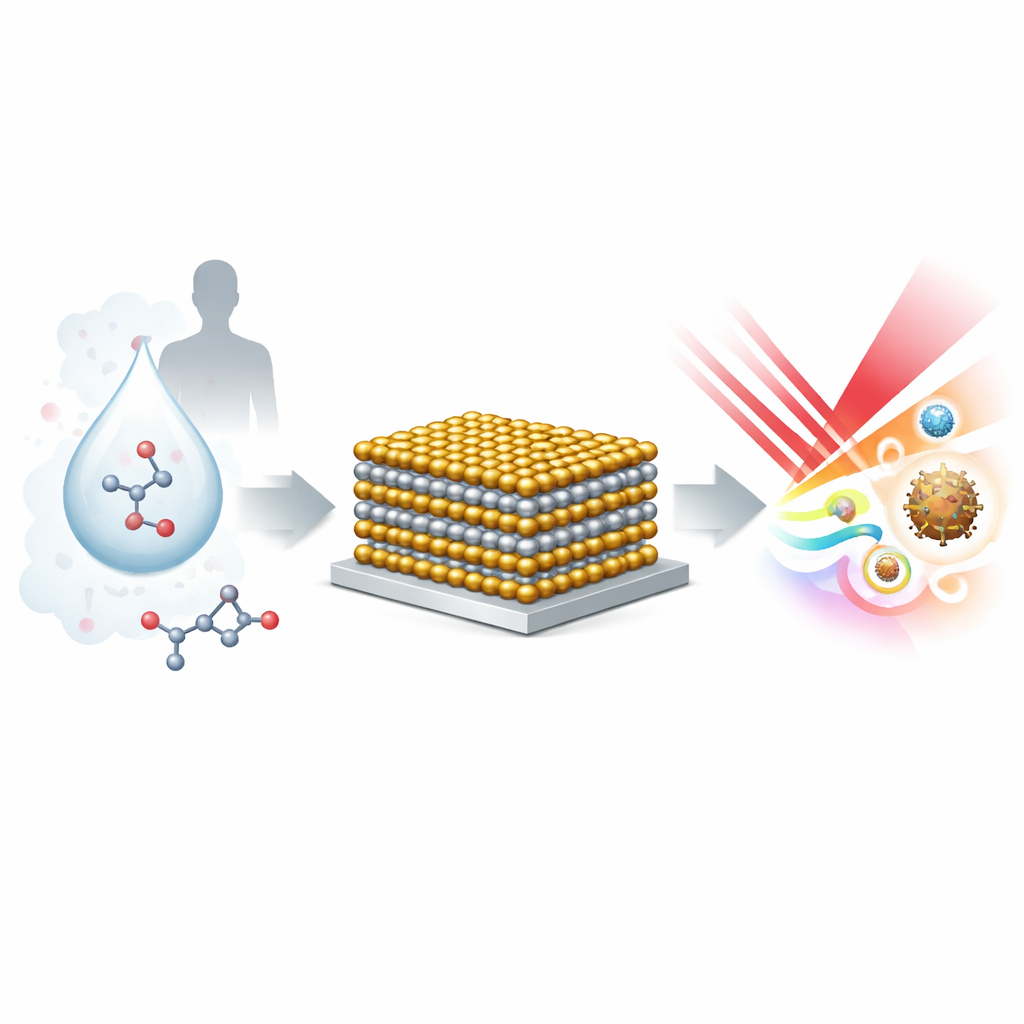
Tuning the Material by Mixing and Removing Metals
To gain fine control over how this light‑trapping slab behaves, the team mixes gold with silver nanoparticles before assembly. The result is a “combinatorial metamaterial,” where the overall optical response depends on the chosen metal mixture rather than on a single fixed recipe. Remarkably, the silver component can later be selectively dissolved away using a gentle chemical treatment that leaves the gold framework and the tiny gaps largely intact. As silver is removed, it creates voids within the structure and reduces the fraction of space filled by metal. This shift in “fill fraction” predictably moves the infrared resonance to new wavelengths and broadens or narrows the peak, matching a simple effective‑medium model the authors develop. That model links how densely the particles are packed to how strongly the slab bends light.
From Solid Wall to Porous Sponge for Big Molecules
Those newly created voids do more than change the color of the resonance—they also change how easily big objects can move inside the material. In the original tightly packed structures, the internal path is tortuous and cramped, so larger analytes, such as proteins or nano‑sized plastic beads, struggle to reach the most intense hotspots where light is confined. After silver dissolution, the aggregate becomes significantly more porous while still maintaining strong light concentration. The team shows that 50‑nanometer polystyrene nanoparticles, used here as stand‑ins for nanoplastics or large biomolecules, can now diffuse in and chemically attach to gold surfaces deep inside the porous slab. Infrared and Raman measurements reveal much stronger vibrational signatures from these beads in the porous structures than in the dense controls or on flat gold, confirming that more particles reach the high‑field regions. 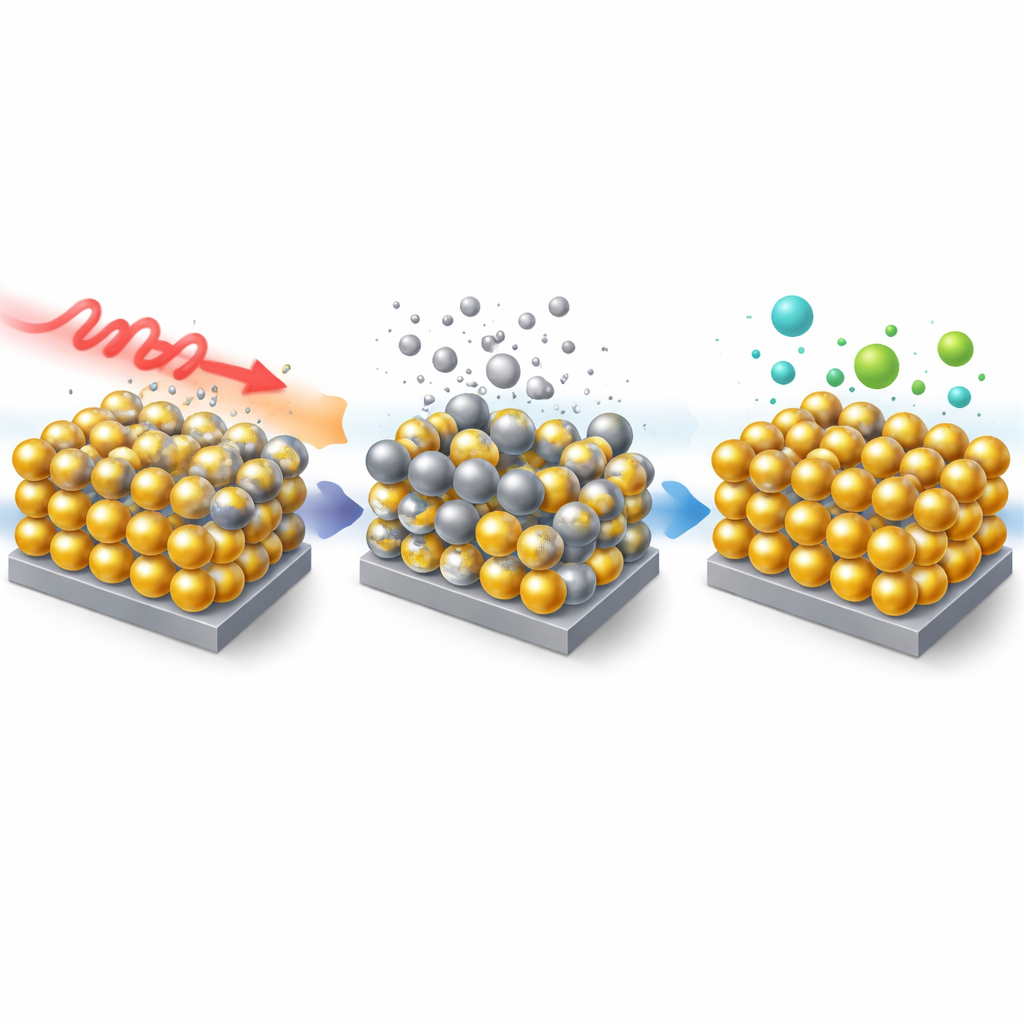
Balancing Light Trapping and Easy Access
There is, however, a trade‑off. Packing nanoparticles more tightly raises the effective index and can, in principle, give extremely sharp resonances that trap light for longer. Making the structure too porous, by contrast, lowers the index and shifts the resonance out of the most useful “molecular fingerprint” band. The authors’ measurements and simulations show how changing gap size, particle faceting, and metal content together determine both the strength and sharpness of the resonance. Silver particles, with their irregular shapes, initially help increase absorption almost to perfection, but their removal reduces loss and opens up pathways for large analytes. This tunability allows designers to find a sweet spot where light is both strongly confined and where molecules can still flow in and bind.
What This Means for Future Sensors
For a non‑specialist, the key result is that a simple, bottom‑up recipe—allowing metal nanoparticles to self‑assemble, mixing in silver that is later washed away, and choosing appropriate surface chemistry—can produce highly sensitive mid‑infrared sensors without the need for expensive nanofabrication. These metamaterial slabs behave like artificial high‑index crystals for infrared light, with their properties set by how tightly the particles are packed and how many voids they contain. Because their porosity and surface coatings can be tailored, they are promising platforms for detecting a wide variety of targets, from biomolecules in medical diagnostics to nanoplastics in environmental samples, by making previously invisible vibrational fingerprints stand out clearly.
Citation: Nicolas Spiesshofer, Elle Wyatt, Zoltan Sztranyovszky, Caleb Todd, Taras V. Mykytiuk, James W. Beattie, Rowena Davies, Rakesh Arul, Viv Lindo, Thomas F. Krauss, Angela Demetriadou, and Jeremy J. Baumberg, "Tailoring ultrahigh index plasmonic combinatorial metamaterials for SEIRA and SERS by tuning the fill fraction," Optica 12, 1357-1366 (2025). https://doi.org/10.1364/OPTICA.567324
Keywords: mid-infrared sensing, plasmonic nanoparticles, metamaterials, surface-enhanced spectroscopy, nanoplastic detection