Clear Sky Science · en
High-rate continuous-variable quantum key distribution over 100 km fiber with composable security
Why faster quantum keys matter
As our digital lives expand, we rely on secret keys to scramble everything from bank transfers to private messages. Today’s key-sharing methods could be cracked in the future by powerful computers, including quantum ones. Quantum key distribution (QKD) offers a way to share keys that is secure by the very laws of physics, not just by clever math. This paper reports a major advance: a quantum system that can generate secret keys at gigabit-per-second speeds across city-scale fiber networks, making physics‑grade security far more practical for real-world communication.
From fragile photons to practical protection
QKD lets two users, often called Alice and Bob, send faint flashes of light whose quantum properties reveal any attempt at eavesdropping. A particular flavor, continuous‑variable QKD, encodes information in the strength and phase of light waves rather than in single particles. This approach meshes well with today’s telecom hardware and promises very high key rates. Until now, however, continuous‑variable systems have faced a trade-off: pushing signals to very high speeds through long stretches of fiber causes extra noise that drowns out the fragile quantum patterns, slashing both distance and speed. Existing record systems typically reached only a few megabits per second or tens of kilometers when strict security rules were enforced.
Splitting one fast river into many calm streams
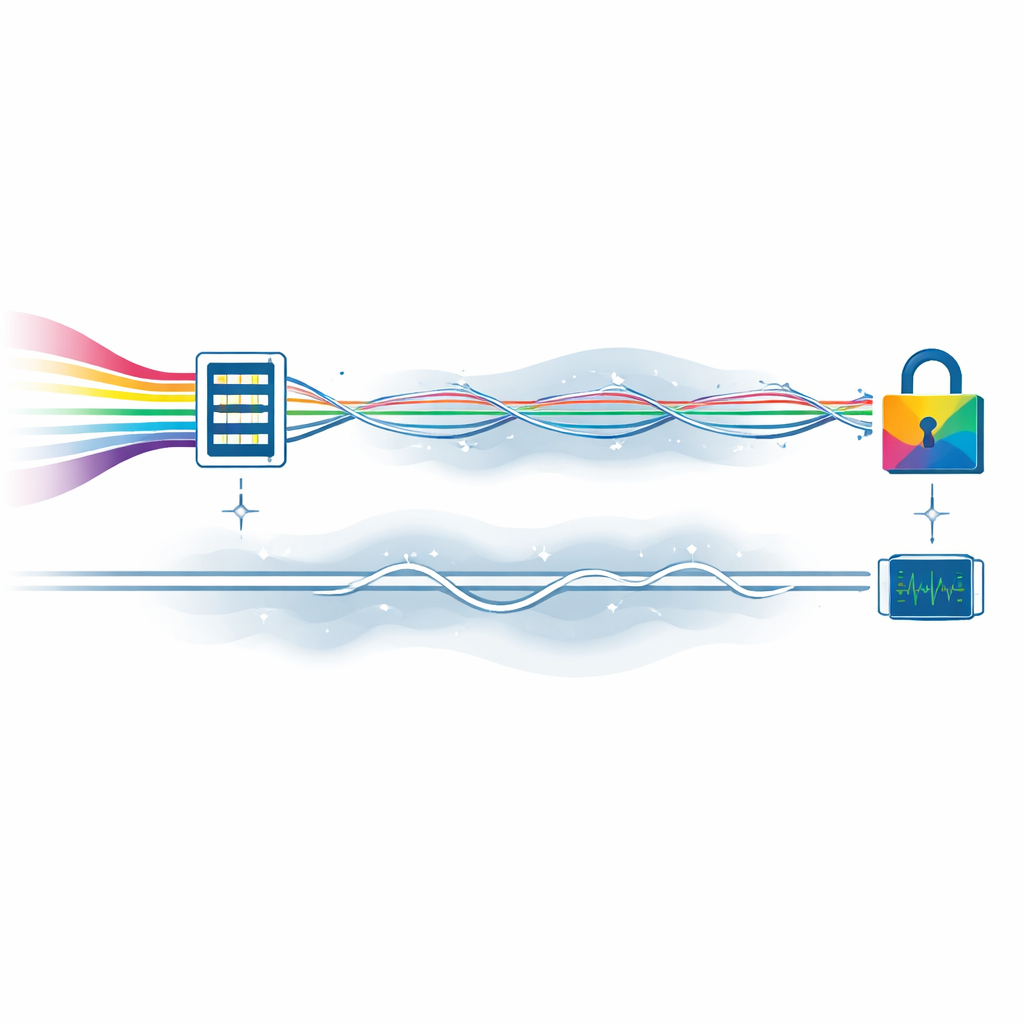
The researchers solve this bottleneck by borrowing a trick from classical high‑speed internet: they divide a single fast data stream into several slower sub‑streams, all riding on different frequency “colors” within the same fiber. This technique, called orthogonal frequency‑division multiplexing, turns a 10‑gigahertz quantum signal into five parallel channels, each running at 2 gigahertz. Because each sub‑channel is slower, it suffers much less distortion from fiber dispersion—the tendency of different frequency components to spread out and blur over long distances. The team carefully models and measures new noise sources created when multiple channels interact, then chooses an optimal number of sub‑channels and fine‑tunes how strongly each is modulated to squeeze out the highest possible secret key rate.
Taming noise and crunching data in real time
To keep the quantum signals clean, the setup sends a strong reference tone alongside the weak quantum pulses and uses it to track rapid phase jitters between two independent lasers and the fiber itself. A second, slower correction step uses specially embedded training patterns to cancel remaining drifts without consuming too much of the data stream. On the receiving end, wide‑band detectors and high‑speed digital processors separate the five sub‑channels and reconstruct their quantum states. Because the system produces enormous volumes of raw measurement data, the team builds a powerful post‑processing engine using several graphics processing units. These chips run advanced error‑correction codes and privacy‑amplification routines fast enough to keep up, turning noisy shared data into identical, provably secret keys at multi‑gigabit speeds.
Record speeds over city‑scale fibers
With this multi‑carrier design, the experiment reaches secret key rates of around 1.8 gigabits per second over 5 kilometers of fiber and just over 1 gigabit per second at 10 kilometers. Even at 50, 75, and 100 kilometers—distances relevant for connecting data centers and city suburbs—the system still produces tens of megabits per second and a few megabits per second, respectively. Crucially, these numbers are not idealized; they account for finite data sizes and use a modern, conservative security framework that ensures the keys remain safe even when combined with other cryptographic tools. Compared with the best previous continuous‑variable systems under similar security assumptions, this work boosts the secure rate by roughly two orders of magnitude and stretches the usable distance by a factor of about five. It also outperforms leading discrete‑variable QKD demonstrations over metropolitan distances by about an order of magnitude in speed.
What this means for future secure networks
In everyday terms, the authors show that you can send extremely fast quantum‑protected keys across 100‑kilometer fiber links using hardware and signal formats closely related to today’s telecom technology. By splitting a very fast quantum signal into multiple gentler streams, and by pairing careful noise control with heavy‑duty parallel computing, they achieve both high speed and strong, composable security guarantees. This brings physics‑based encryption closer to practical deployment in real metropolitan and access networks, where many users, data centers, and services must share vast amounts of confidential information with long‑term protection.
Citation: Heng Wang, Yang Li, Ting Ye, Li Ma, Yan Pan, Mingze Wu, Junhui Li, Yiming Bian, Yun Shao, Yaodi Pi, Jie Yang, Jinlu Liu, Ao Sun, Wei Huang, Stefano Pirandola, Yichen Zhang, and Bingjie Xu, "High-rate continuous-variable quantum key distribution over 100 km fiber with composable security," Optica 12, 1657-1667 (2025). https://doi.org/10.1364/OPTICA.566359
Keywords: quantum key distribution, continuous-variable quantum communication, optical fiber security, high-speed quantum networks, orthogonal frequency-division multiplexing