Clear Sky Science · en
Laser injection locking and nanophotonic spectral translation of electro-optic frequency combs
Sharper Rainbows for Sensing the World
Many of today’s most precise tools for measuring time, distance, and the properties of atoms rely on special “rainbows” of laser light called frequency combs. These combs are made of thousands to millions of evenly spaced colors and act like ultra-fine rulers for light. But getting these rulers bright, clean, and available at many useful colors—from the infrared used in gas sensing to the visible light used with atoms—is surprisingly hard. This article shows a new way to boost very weak combs and shift them to new colors using off-the-shelf laser diodes and tiny light-guiding chips, potentially making advanced optical measurements more practical and widespread.
Why Tiny Laser Rulers Matter
Frequency combs let scientists compare light waves that differ wildly in color, linking optical and microwave signals with exquisite precision. They underpin optical atomic clocks, long-range laser distance systems, and sensitive spectrometers that sniff out gases or probe fragile quantum and biological samples. A popular way to make such combs is to pass a steady laser beam through an electro-optic modulator, which carves the single color into a multitude of evenly spaced teeth. However, to get strong, low-noise combs at the many different colors these applications demand, one needs powerful clean lasers, modulators that can handle a lot of light without damage, and low-noise amplifiers at each wavelength—components that simply do not exist or are immature outside the standard telecom bands.
A New Way to Turn Weak Light into Strong
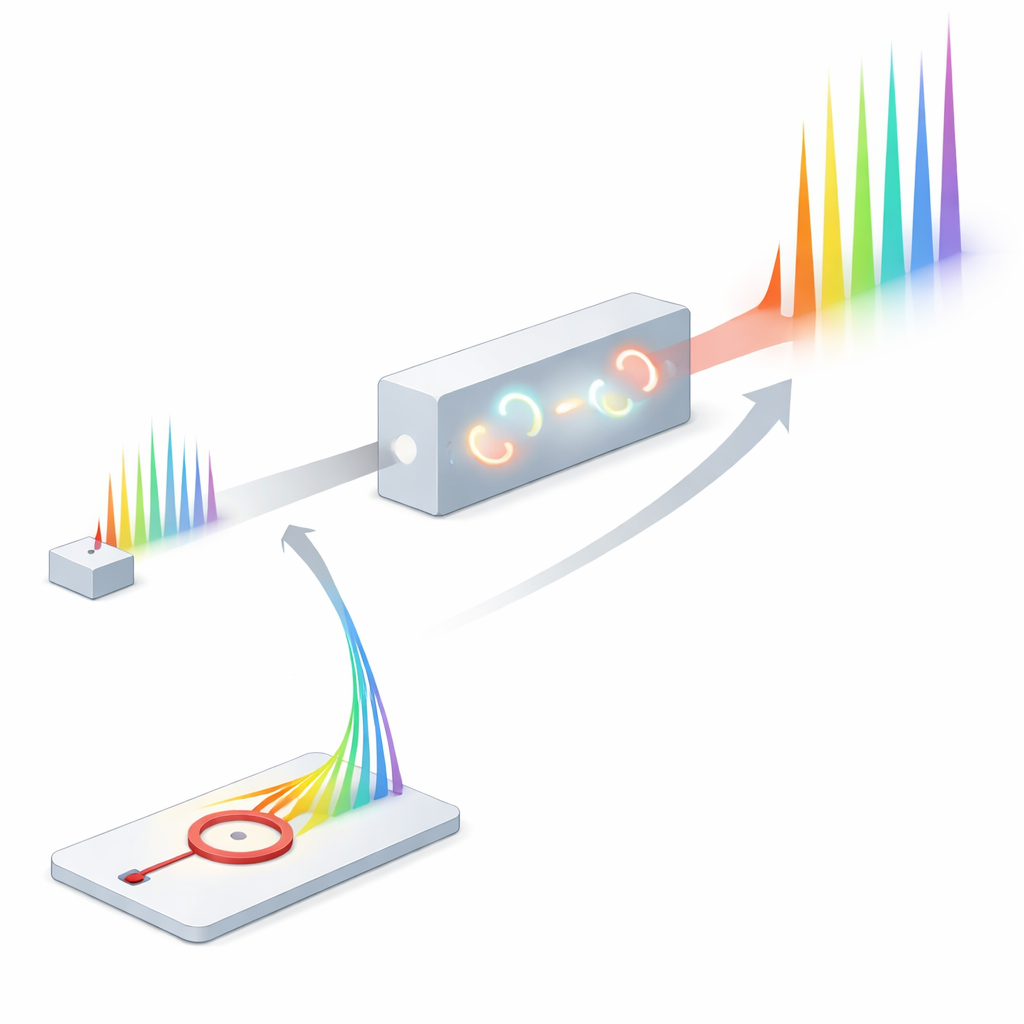
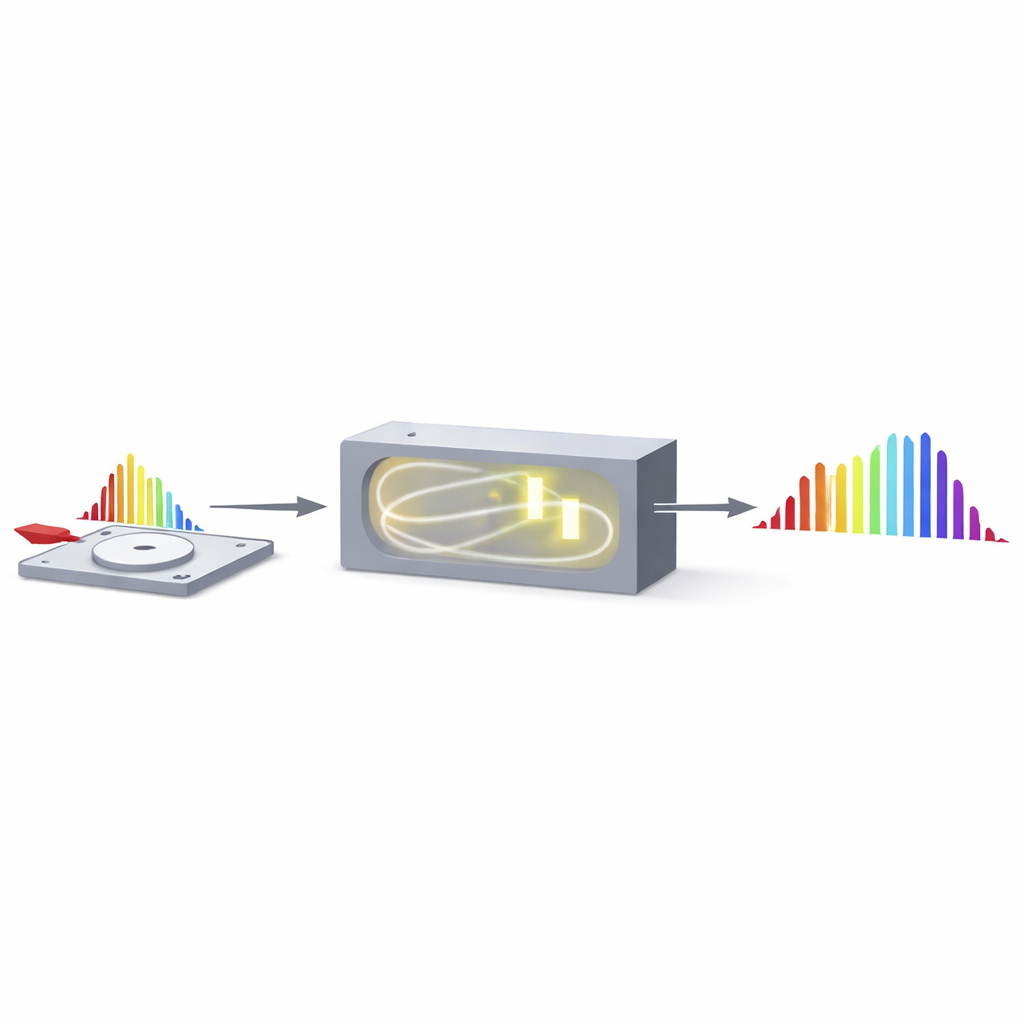
The authors tackle this bottleneck by using a trick called optical injection locking with common Fabry–Perot laser diodes. Instead of feeding a weak comb into a conventional optical amplifier, they “seed” an inexpensive diode laser with the comb itself. The diode then locks its own emission to the incoming pattern and recreates a much brighter version of the comb at its output. In experiments at 780 nanometers (a color useful for atomic physics), a single diode was locked to as many as two million comb teeth spread over 2 gigahertz of bandwidth, even when the total injected comb power was as low as a billionth of a watt. Compared with a commercial semiconductor amplifier, this approach produced over 100 times better signal-to-noise ratio for the same tiny input power and achieved the same quality at more than 35 times lower input power.
Making Broad and Flexible Combs
Beyond simple demonstrations, the team showed that their method works for combs with a wide range of spacings and spans. They tested finely spaced combs suitable for ultra-high-resolution spectroscopy and broader combs created by strongly driving the modulator with a single radio-frequency tone, reaching spans of hundreds of gigahertz. In all these cases, the injection-locked diode reproduced the comb structure while greatly boosting its strength, without noticeably blurring the individual teeth. This means that the method can support both detailed “zoomed-in” measurements and wider “panoramic” scans, using the same basic laser hardware.
Shifting Colors with Tiny Light Circuits
One of the biggest challenges is generating strong combs at colors where lasers and modulators are scarce, such as certain visible wavelengths ideal for atoms or molecules. To address this, the authors combined their locking scheme with nanophotonic spectral translation on a silicon nitride chip. They first created a comb at a telecom wavelength (1560 nanometers), where good components are plentiful, and sent it into a microscopic ring resonator on the chip. Inside the ring, nonlinear optical processes converted the light to its second harmonic around 780 nanometers, creating a new comb at that color—but with very limited power, sometimes only a few billionths or trillionths of a watt. By using this weak translated comb to injection-lock a 780-nanometer diode, they recovered a bright, high-quality comb even when less than a picowatt of power was available per tooth, and in wavelength regions where standard amplifiers failed.
Opening Doors for Practical Light-Based Sensors
In everyday terms, this work shows how a cheap, compact laser diode can be persuaded to copy the fine structure of a delicate optical ruler and amplify it without smearing out its markings. Combined with tiny chips that shift combs from “easy” telecom colors to more specialized hues, this approach offers a flexible route to bright, clean combs across much of the spectrum. That, in turn, can make advanced spectrometers and quantum sensors more robust, smaller, and easier to deploy outside of specialized labs—whether for monitoring greenhouse gases, improving autonomous vehicle ranging, or reading out delicate atomic sensors used to probe the fundamental laws of nature.
Citation: Roy Zektzer, Ashish Chanana, Xiyuan Lu, David A. Long, and Kartik Srinivasan, "Laser injection locking and nanophotonic spectral translation of electro-optic frequency combs," Optica 12, 1597-1605 (2025). https://doi.org/10.1364/OPTICA.566188
Keywords: electro-optic frequency combs, optical injection locking, nanophotonic spectral translation, silicon nitride microring, optical spectroscopy