Clear Sky Science · en
Compact low-noise dual microcombs for high-precision ranging and spectroscopy applications
Sharper Light for Measuring the World
Modern science and technology increasingly rely on exquisitely precise measurements of distance and color (wavelength) of light—from guiding autonomous cars and satellites to detecting faint traces of gases in the air. This paper reports a breakthrough in creating tiny, low-noise “rulers made of light,” called dual microcombs, that fit inside a coin-sized package yet rival the performance of bulky laboratory systems. Such compact, ultra-stable light sources could help move cutting-edge metrology and sensing out of specialized labs and into everyday devices.
Why Light Combs Matter
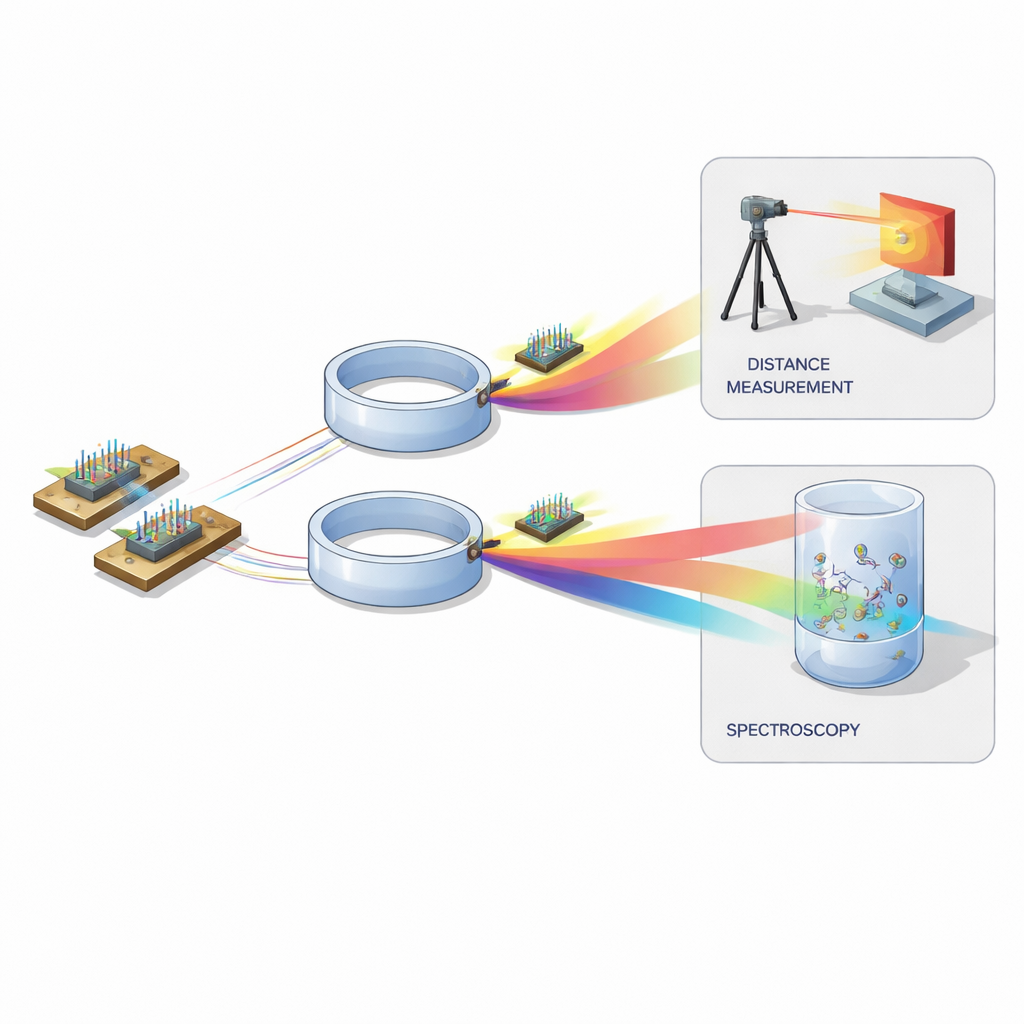
Optical frequency combs are special lasers whose colors are not continuous, but instead form a dense array of evenly spaced “teeth,” like a finely ruled ruler in the spectrum. By comparing unknown light to these teeth, scientists can measure time, distance, and chemical fingerprints with extreme accuracy. Dual-comb systems use two such rulers with slightly different spacings so that, when combined, they beat together and translate optical information down into radio waves that electronics can easily read. The catch is that both combs must stay exquisitely synchronized; any wobble or drift in their frequencies quickly spoils the measurement. Traditional setups keep them under control with complex feedback electronics and large optical benches, limiting their practicality outside the lab.
Building a Tiny, Quiet Light Engine
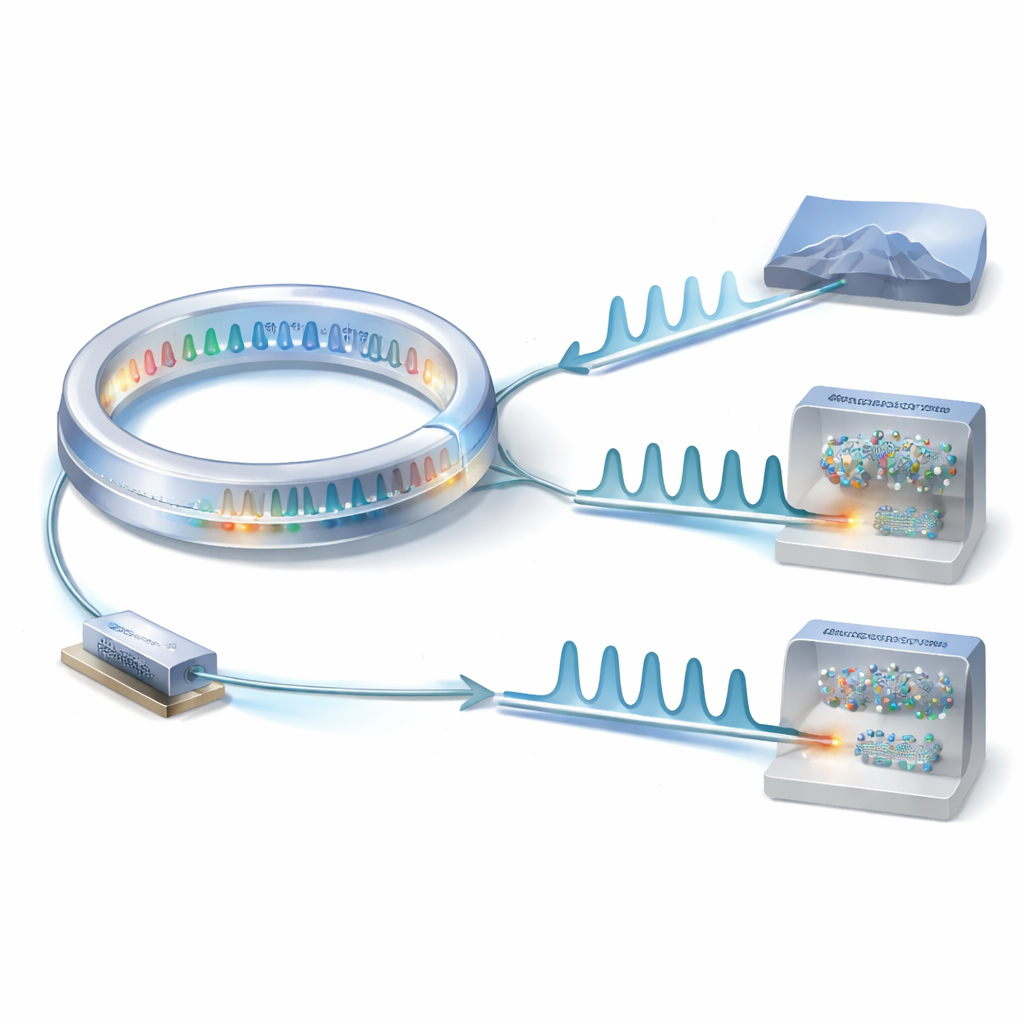
The authors tackle this challenge by redesigning both the hardware and the way the laser is stabilized. They integrate a small semiconductor laser and a short piece of specialized optical fiber—shaped into a Fabry–Perot resonator—inside a butterfly-sized metal housing only a few centimeters across. Light from the chip laser circulates inside the fiber cavity, where the material’s nonlinearity reshapes it into a stable train of extremely short pulses, forming what is known as a Kerr frequency comb. Crucially, a portion of the light that leaves the cavity is sent back into the laser in just the right way to “self-lock” it to the cavity. This self-injection locking automatically narrows the laser’s linewidth and suppresses many sources of technical noise, all without external control loops. Thanks to an unusually large light-guiding volume and an exceptionally high quality factor of the fiber cavity, fundamental quantum and thermal noise are also pushed down toward their physical limits.
How Stable Is This New Comb?
To test their design, the team carefully characterizes the noise and stability of the generated pulses. They show that the phase noise—the jitter in the timing of successive pulses—drops to levels approaching the quantum noise floor over a wide range of frequencies, with the laser linewidth shrunk from tens of kilohertz to below one hertz. The pulse train repeats at about 20 billion times per second and remains remarkably steady: over many hours, both the repetition rate and the overall comb power drift only minutely. Just as important for real-world use, the system behaves in a turnkey fashion: whenever the current to the laser is switched on, a clean, single pulse pattern reappears with near-100% reliability, without requiring delicate manual tuning. These traits make the device well suited as a building block for compact dual-comb instruments.
Measuring Distances and Molecules
With two identical compact comb modules in hand, the researchers construct a free-running dual-comb system and put it through two demanding tests. In time-of-flight ranging, one comb serves as a reference while the other probes a distant target; tiny shifts in the timing of the returning pulses reveal the path length. Despite operating without active stabilization, the system measures distance with errors of only about 1.6 micrometers in a single shot—roughly one hundredth the width of a human hair—and can be averaged down to tens of nanometers over short times. In a second experiment, they send one comb through a gas cell filled with a carbon-containing molecule and use the other comb as a clean reference. By comparing the two, they reconstruct the molecule’s absorption spectrum and find that it matches standard database values to better than 1% across many spectral lines, all without digital phase correction.
Toward Everyday Precision Tools
In summary, this work demonstrates that it is possible to achieve laboratory-grade precision in ranging and spectroscopy using a pair of tiny, self-stabilizing microcomb modules. By combining ultra-low noise, long-term stability, and true plug-and-play operation in a very small package, the platform removes much of the complexity that has kept dual-comb technology confined to specialized facilities. As these compact light rulers are refined and their spectral reach extended, they could underpin future systems for precise navigation, environmental monitoring, high-speed communications, and even quantum technologies, bringing astonishing measurement accuracy into far more common use.
Citation: Chenye Qin, Kunpeng Jia, Zexing Zhao, Yingying Ji, Yongwei Shi, Xiaofan Zhang, Jingru Ji, Xinwei Yi, Haosen Shi, Kai Wang, Xiaoshun Jiang, Biaobing Jin, Shi-ning Zhu, Wei Liang, and Zhenda Xie, "Compact low-noise dual microcombs for high-precision ranging and spectroscopy applications," Optica 12, 1747-1756 (2025). https://doi.org/10.1364/OPTICA.565936
Keywords: optical frequency combs, dual-comb ranging, microresonator Kerr combs, precision spectroscopy, self-injection locking