Clear Sky Science · en
Multiplexed color centers in a silicon photonic cavity array
Light that Talks to Quantum Bits
Building a future “quantum internet” will require devices that can share fragile quantum information over long distances using particles of light. This paper explores a new way to pack many tiny quantum light sources onto a silicon chip—the same material used for everyday computer processors—so that they can all be reached and controlled through a single optical connection.
Tiny Defects that Act Like Artificial Atoms
Inside ultra-pure silicon, certain carefully created defects, called color centers, can trap individual electrons and emit single particles of light. The specific type studied here, known as a T center, shines at telecom wavelengths used in today’s fiber networks and can store quantum information in an electron’s spin for long times. That makes T centers appealing building blocks for quantum repeaters—devices that extend the reach of quantum communication. But each T center is faint and slow to emit light on its own, which makes it hard to build fast, efficient links.
Helping Defects Shine Brighter with Tiny Cavities
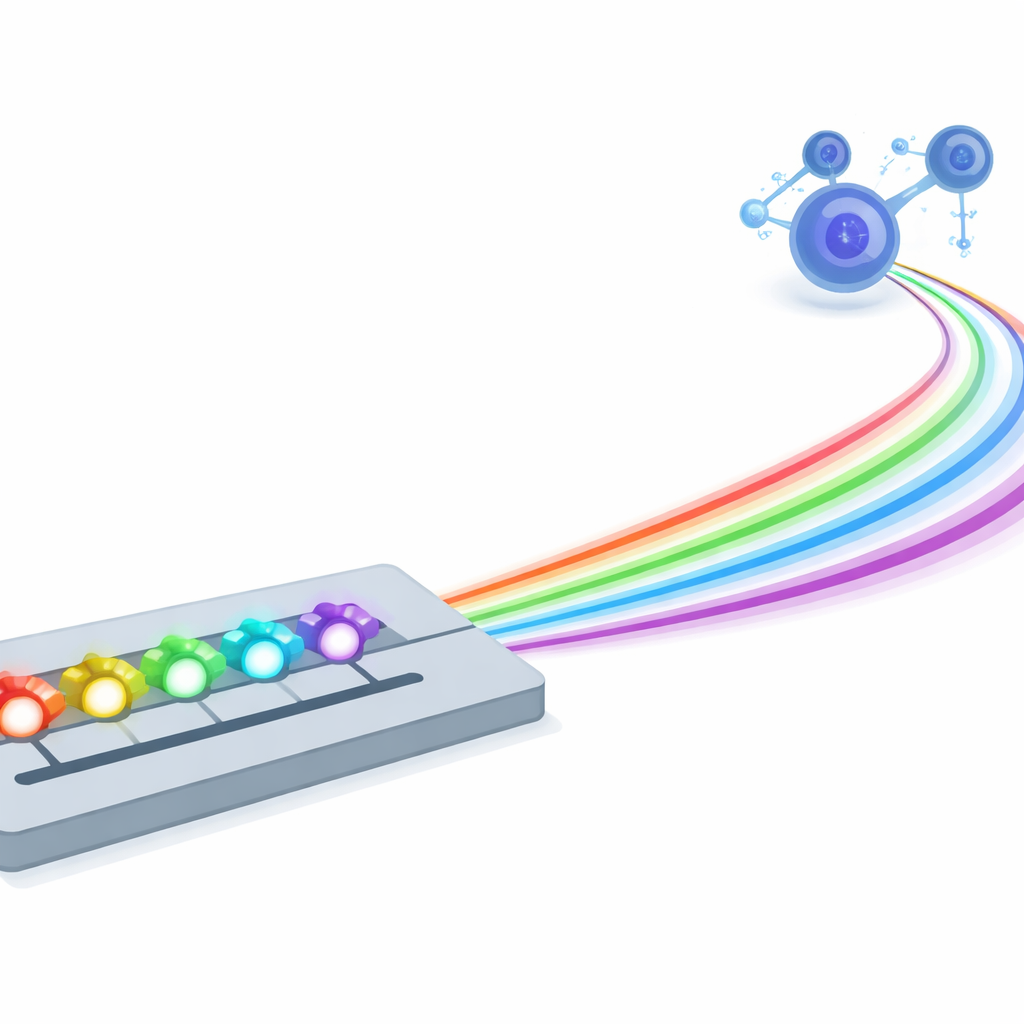
The researchers boost the brightness of T centers by placing them inside microscopic optical cavities—nanostructured regions that trap light and encourage the defect to emit photons more quickly and in a preferred direction. These cavities are arranged in a line next to a single “bus” waveguide, a narrow path that carries light across the chip. Instead of needing a separate connection to each cavity, a single input and output can reach every cavity through this shared bus, making the system much easier to scale up.
Programming Many Light Sources Through One Channel
To turn this structure into a flexible platform, the team develops a method to “tune” each cavity’s color after fabrication. They coat the chip with a thin layer of frozen nitrogen, which shifts all cavity colors to longer wavelengths. Then, by shining laser light into the bus at just the right frequency, they locally heat selected cavities so the nitrogen evaporates only there, nudging those cavities back toward shorter wavelengths. This lets them individually dial in cavity colors across an array. Using this approach, they align multiple cavities to different T centers and demonstrate that two separate defects in different locations can be enhanced and driven in parallel through the same bus. By rapidly switching the drive laser’s color, they time-multiplex single photons from both centers into a single output stream while confirming that each still behaves as a high-quality single-photon source.
Cavities that Cooperate at a Distance
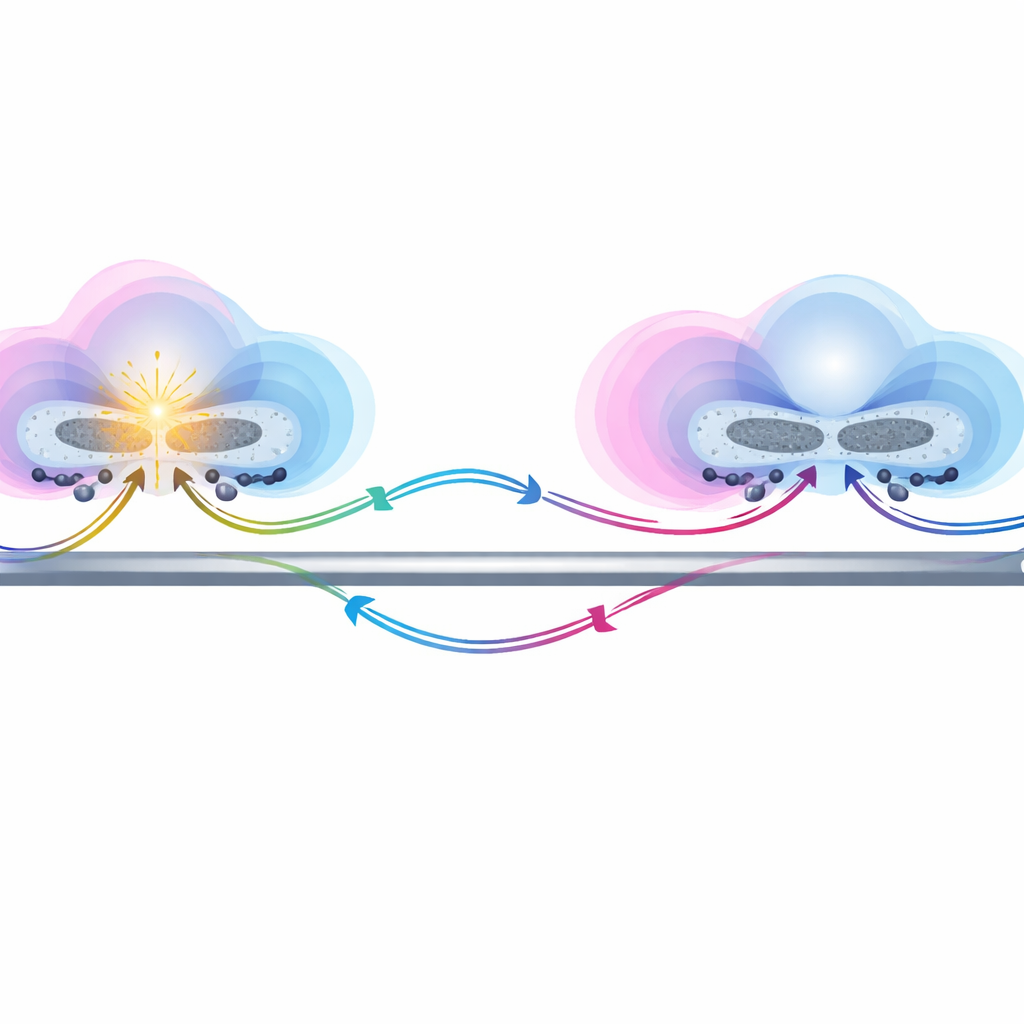
Because all cavities share the same bus, they can also interact with each other through the light that leaks into the waveguide and reflects from a terminating mirror. When two cavities are tuned close to the same color, their resonances hybridize, forming joint “bright” and “dark” modes spread across both locations. The bright mode couples strongly to the bus and loses energy quickly, while the dark mode is more isolated and longer lived. The team measures how these hybrid modes appear in reflection from the chip and uses an analytical model to extract the strengths of the coherent exchange of light between cavities and their shared energy loss into the bus. By placing a single T center in one of the interacting cavities, they show that its emission lifetime changes in a subtle, predictable way as the hybrid modes move past it in color, confirming that a single emitter can be enhanced by a delocalized optical mode spanning two distant cavities.
Path Toward a Scalable Quantum Network
Finally, the authors discuss what is needed to turn this kind of device into a true building block for large quantum networks. Today, the number of T centers that can be operated in parallel is limited by how narrowly each cavity can be defined in color and by the spread of T center frequencies in the material. They outline realistic improvements—sharper cavities, cleaner and more precisely placed emitters, and additional control using strain or electric fields—that could allow tens of T centers per waveguide to function simultaneously. With better light–matter coupling, these arrays could not only send single photons efficiently over long fiber links, but also generate entanglement directly between defects on the same chip, bringing the vision of modular, silicon-based quantum processors and quantum repeaters much closer to reality.
Citation: Lukasz Komza, Xueyue Zhang, Hanbin Song, Yu-Lung Tang, Xin Wei, and Alp Sipahigil, "Multiplexed color centers in a silicon photonic cavity array," Optica 12, 1400-1405 (2025). https://doi.org/10.1364/OPTICA.564691
Keywords: quantum networks, silicon photonics, color centers, single-photon sources, telecom wavelengths