Clear Sky Science · en
Field-resolved measurements of soliton self-compressed single-cycle pulses and their application to water-window high-harmonic generation
Freezing Motion on the Fastest Time Scales
Many of the most important events in chemistry and biology—like electrons jumping between atoms or bonds breaking in DNA—happen unimaginably fast, in billionths of a billionth of a second. To watch these motions directly, scientists need extremely short flashes of X-ray light. This paper shows a simpler and more powerful way to create such flashes, opening the door to tabletop microscopes that can film electrons in action inside molecules, liquids, and materials.
Turning Long Laser Flashes into Ultra-Short Bursts
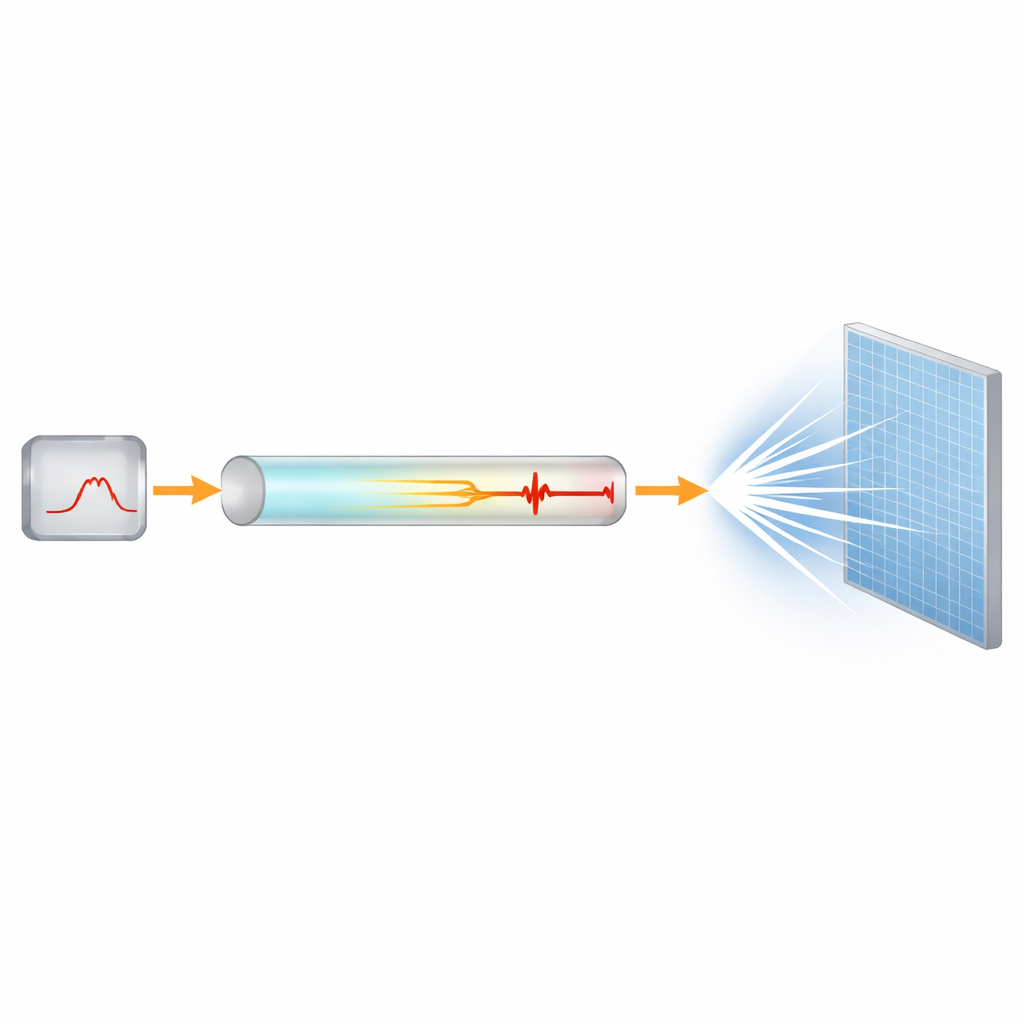
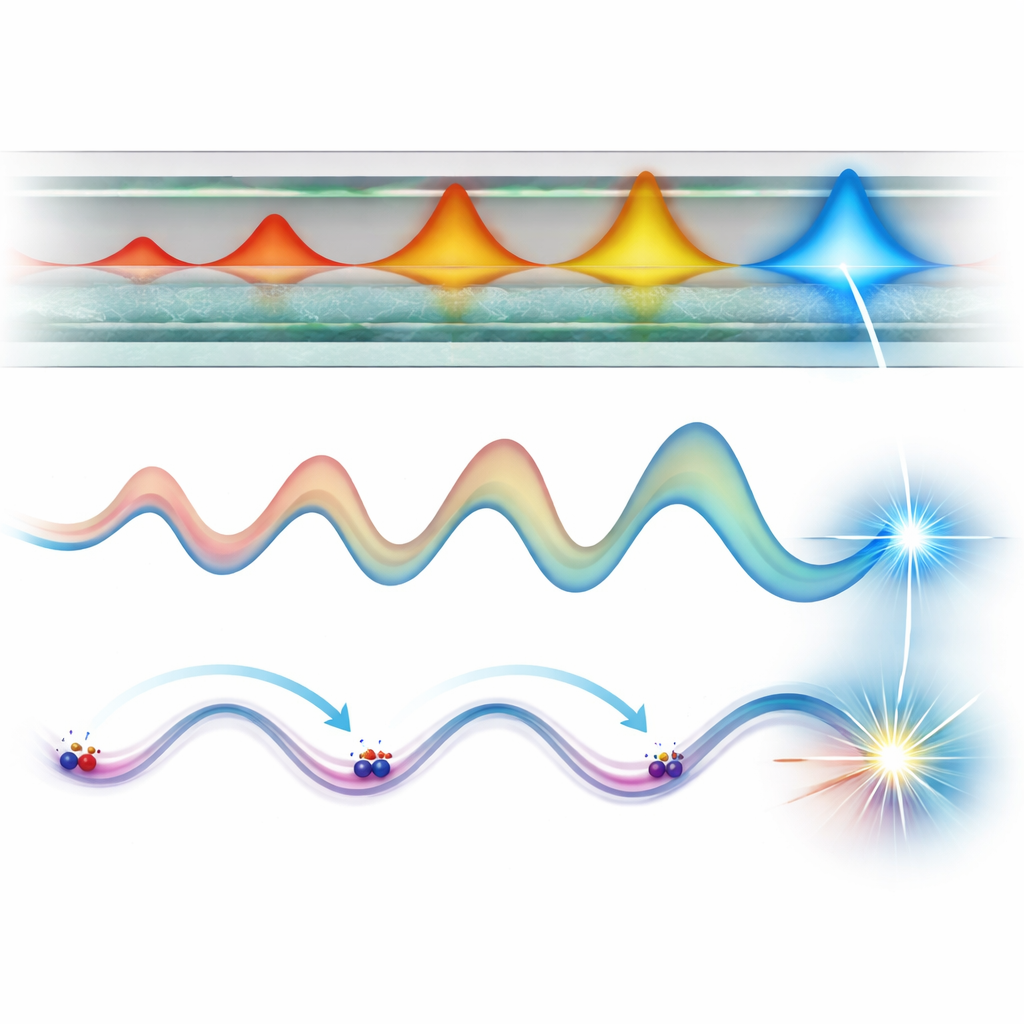
The researchers start from a common type of infrared laser used in many laboratories and send its pulses through a thin, gas-filled glass tube called a hollow-core fiber. As the pulse travels down this fiber, it reshapes itself through a process known as soliton self-compression: the light’s own intensity and the gas it passes through work together so that the pulse gets shorter and more intense all by itself, without the need for complex extra optics. By carefully tuning the gas pressure inside the fiber, the team shrinks the original pulses down to just over a single cycle of light, lasting only about five quadrillionths of a second.
Measuring the Electric Field of Light Directly
To truly control these extreme pulses, it is not enough to know how long they last; one must know the exact shape of the electric field inside them. The team uses a recently developed method that compares how a strong pulse and a much weaker partner pulse ionize a simple gas. By scanning the delay between the two and tracking the pattern of released ions, they can reconstruct the full electric field of the pulse in time, cycle by cycle. This “field-resolved” view lets them see how the pulse changes with gas pressure, how energy shifts from redder to bluer colors inside the pulse, and when it reaches the optimal single-cycle form.
Making Tiny Flashes of Soft X-Rays
With these ultra-short, intense pulses in hand, the researchers send them into a helium gas cell to generate high-order harmonics—many-times-higher-energy copies of the original light. This process converts the infrared pulses into soft X-rays in the so-called water window, an energy range where X-rays pass through water but are strongly absorbed by carbon, nitrogen, and oxygen. That contrast is ideal for imaging and probing complex molecules in their natural, watery surroundings. As the fiber gas pressure increases and the pulses self-compress, both the maximum energy and the total brightness of the generated X-rays rise, reaching all the way to the carbon K-edge, a key energy for following carbon-based chemistry.
Isolated Flashes Without Delicate Fine-Tuning
A long-standing challenge has been to produce not just trains of X-ray bursts, but single, isolated bursts lasting less than a femtosecond—short enough to freeze electron motion. Typically, this has required exquisite control over a subtle property of the laser known as the carrier-envelope phase, which is technically demanding to stabilize. By combining their single-cycle pulses with detailed computer simulations, the authors show that under their conditions, isolated attosecond X-ray pulses appear for almost any value of this phase. In other words, the system naturally produces single X-ray flashes without needing this delicate fine-tuning, greatly simplifying real-world experiments.
A New Route to Attosecond Movies of Matter
In everyday terms, this work shows how to turn a standard, powerful infrared laser into an engine for creating some of the shortest light flashes ever made, using a single gas-filled fiber and a practical measurement method. These compressed pulses are strong, well-characterized, and efficient drivers of bright soft X-rays in the water window, and they reliably produce isolated attosecond bursts without demanding the most fragile forms of laser stabilization. Together, these advances point toward compact laboratory setups that can record “movies” of electrons reshaping molecules, driving chemical reactions, and transforming materials, all with unprecedented clarity in both time and space.
Citation: Tristan Kopp, Leonardo Redaelli, Joss Wiese, Giuseppe Fazio, Valentina Utrio Lanfaloni, Federico Vismarra, Tadas Balčiūnas, and Hans Jakob Wörner, "Field-resolved measurements of soliton self-compressed single-cycle pulses and their application to water-window high-harmonic generation," Optica 12, 1767-1774 (2025). https://doi.org/10.1364/OPTICA.564265
Keywords: attosecond pulses, soft X-ray generation, hollow-core fiber, soliton self-compression, water-window spectroscopy