Clear Sky Science · en
Photonic origami of silica on a silicon chip with microresonators and concave mirrors
Folding Light on a Chip
Imagine building tiny three-dimensional sculptures of glass on a computer chip, not with a 3D printer but by folding them like origami using beams of light. This paper shows how ultra-smooth glass structures, crucial for advanced optics and communications, can be bent and shaped in midair on a silicon chip in less than a thousandth of a second. The result is a new way to make delicate, high-performance optical parts that could one day power better sensors, navigation systems, and even tests of gravity itself.
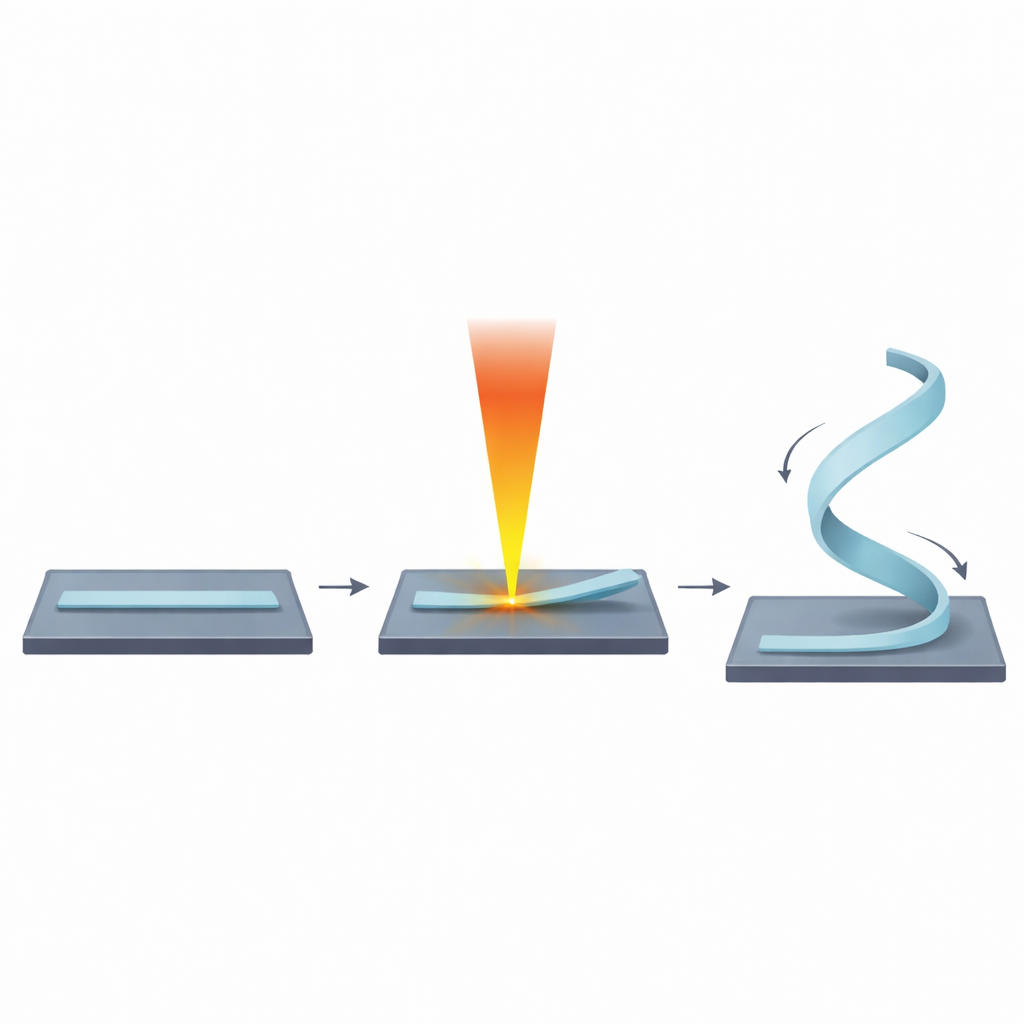
From Flat Glass to Folded Shapes
The work begins with a familiar material: silica, the same ultra-pure glass that carries light through fiber-optic cables around the world. For decades, engineers have perfected ways to make silica surfaces astonishingly smooth—down to fractions of a nanometer—so that light can glide along without being scattered. Until now, most of these devices have been flat, etched into the surface of a chip like miniature highways for light. Moving from flat (2D) to fully 3D structures usually means turning to 3D printing, but glass printed layer by layer tends to be bumpy at microscopic scales, which ruins optical quality. The authors tackle this problem by starting with flat, prefabricated, atomically smooth silica patterns on a silicon chip and then folding them into 3D shapes, preserving their mirror-like finish.
Using Light and Liquid-Like Forces
To fold the glass, the team suspends long, ultraslender silica bars above the chip, a bit like tiny diving boards. These bars are extraordinary in their proportions: 3 millimeters long but only about half a micrometer thick, giving them a record-high length-to-thickness ratio. A special infrared laser is then focused onto a chosen point on a bar. The laser briefly heats just the top side of the silica until it softens and behaves like a very viscous liquid while the rest remains solid. At this tiny molten region, surface tension—the same force that pulls water droplets into spheres—takes over. By trying to minimize surface area, it pulls the softened section into a smooth curve, rapidly snapping the entire bar into a new position, even lifting it against gravity. Because the molten region cools and solidifies in tens of microseconds once the laser turns off, the glass freezes almost instantly into its new shape.
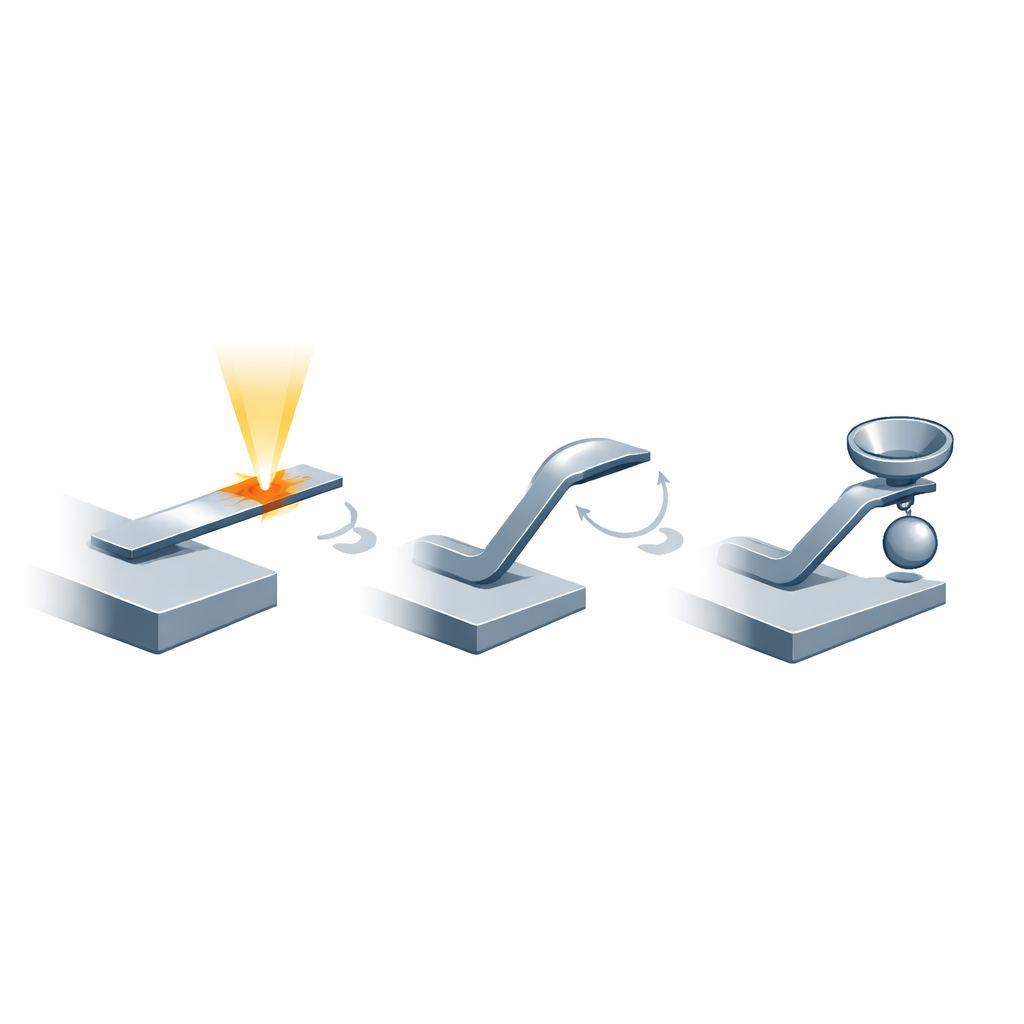
Drawing in Air with Precision
The researchers show that this snap motion can turn a flat bar into a vertical beam in less than a millisecond, with accelerations thousands of times stronger than Earth’s gravity. By reducing the laser power and sending a carefully timed train of pulses, they can nudge the bar a tiny bit with each pulse and stop at almost any angle they like. Their control is so fine that they can adjust the direction of a typical arm with position steps of about 20 nanometers—smaller than many viruses. By choosing where along the bar to heat, they can create a chain of bends forming a polyline, or they can move the sample under the laser as it heats to wind the structure into a helix. This turns once-flat patterns into complex 3D paths, all while staying attached to the silicon base and preserving extremely smooth surfaces.
Building Tiny Mirrors and Resonators
Beyond simple beams and spirals, the team integrates advanced optical components directly into these folded structures. In one case, they use the laser not just to bend but also to gently evaporate glass from a small region, carving out a smooth parabolic pit that acts as a concave mirror with a relatively high numerical aperture—meaning it can focus light tightly. In another, they reflow a folded segment so that surface tension pulls material into a near-perfect sphere, forming a “whispering-gallery” resonator where light circulates many millions of times before leaking out. These tiny components reach quality levels comparable to the best chip-based resonators, confirming that the fast folding process does not compromise optical performance.
Why This New Glass Origami Matters
By combining the precision of traditional chip manufacturing with the flexibility of folding, this work sidesteps the roughness and contamination that limit many 3D-printing methods. The authors demonstrate that they can reliably bend from flat to steep angles, create helices, and add both concave and convex optical elements—all while keeping surfaces so smooth that light barely loses energy. To a non-specialist, the key message is that we can now “origami” ultraclean glass on a chip into intricate 3D shapes, with nanometer-scale accuracy and built-in optical devices. This opens the door to compact, three-dimensional light-based circuits, sensitive instruments to probe fundamental physics, and perhaps even ultra-light structures for future light-driven spacecraft, all fabricated using tools that are compatible with today’s chip-making factories.
Citation: Manya Malhotra, Ronen Ben-Daniel, Fan Cheng, and Tal Carmon, "Photonic origami of silica on a silicon chip with microresonators and concave mirrors," Optica 12, 1338-1341 (2025). https://doi.org/10.1364/OPTICA.560597
Keywords: photonic origami, silica microstructures, laser folding, microresonators, 3D photonics