Clear Sky Science · en
Extreme ultraviolet high-harmonic interferometry of excitation-induced bandgap dynamics in solids
Watching Electrons Move at Incredible Speeds
Electronics in our phones and computers already switch billions of times per second, but the motion of electrons inside solids is even faster—unfolding in quadrillionths of a second. This study shows how scientists can "film" those ultrafast motions using extreme ultraviolet light and interference patterns, revealing how the energy gap that governs a material’s electronic behavior briefly changes when it is hit by an intense laser pulse.
Light Waves That Measure Other Light
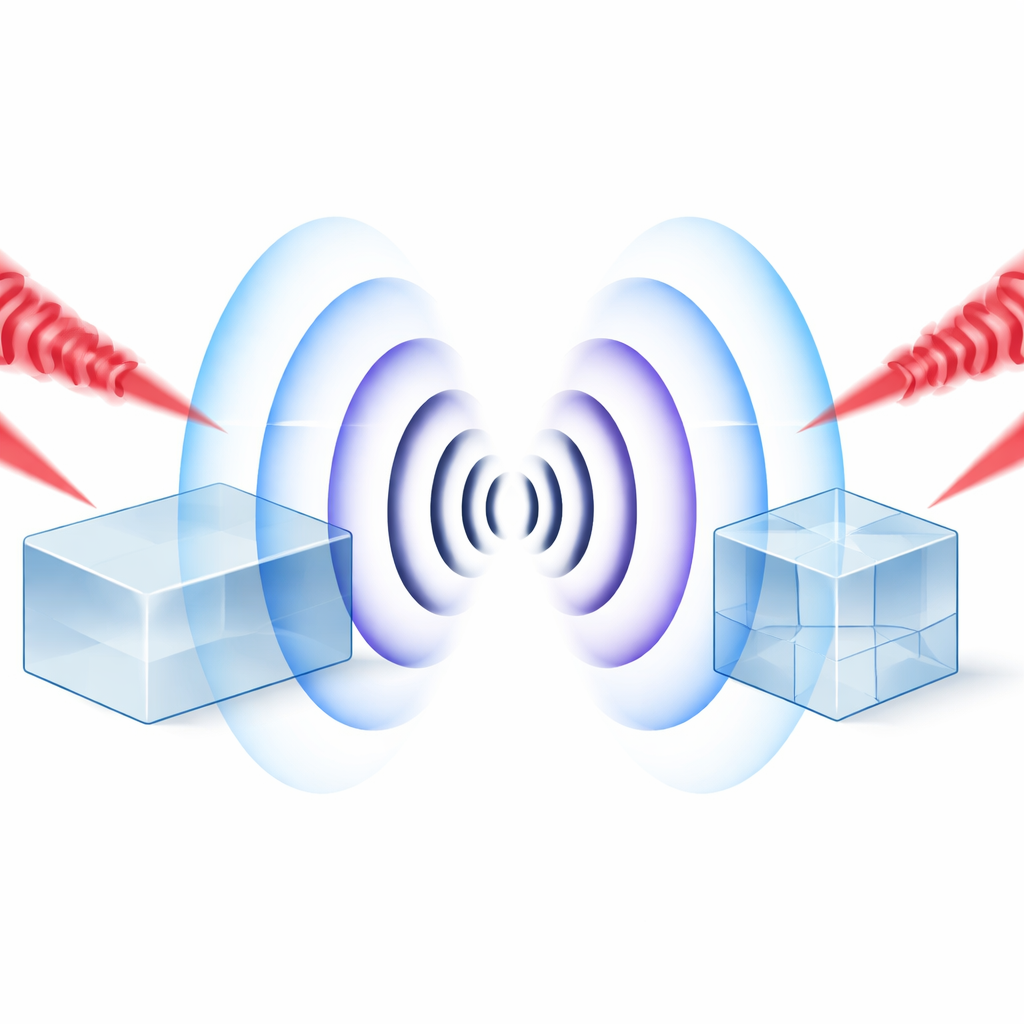
Interferometry is a classic trick of physics: let two waves overlap and read tiny differences from the resulting pattern of bright and dark fringes. Here, the authors apply this idea to extreme ultraviolet light generated inside solids. They start with a near-infrared laser pulse only a few femtoseconds long and split it into two identical copies that follow the same path but arrive at slightly different times. When these twin pulses strike a solid sample, each one drives the material to emit flashes of extreme ultraviolet light made of high-order harmonics of the original laser. Because the two driving pulses are locked in phase, the two resulting extreme ultraviolet bursts are also locked together and create a precise interference pattern in an XUV spectrometer.
Probing Two Very Different Kinds of Solids
The team tested this method on two transparent materials that share a large energy gap but differ strongly in structure: amorphous silicon dioxide (a glass-like form of SiO2) and crystalline magnesium oxide (MgO). In both, the intense laser pulses shake electrons so hard that they briefly leap from the valence band, where they normally reside, into the conduction band, where they can move freely. This process, known as high-harmonic generation, produces odd-numbered harmonics of the driving light up to photon energies around 16 electron volts. By carefully increasing the laser intensity while keeping the two pulses balanced, the researchers watched how the positions of the interference fringes in each harmonic shifted, which directly reflects how the phase of the emitted extreme ultraviolet light changes.
Reading Bandgap Changes from Fringe Shifts
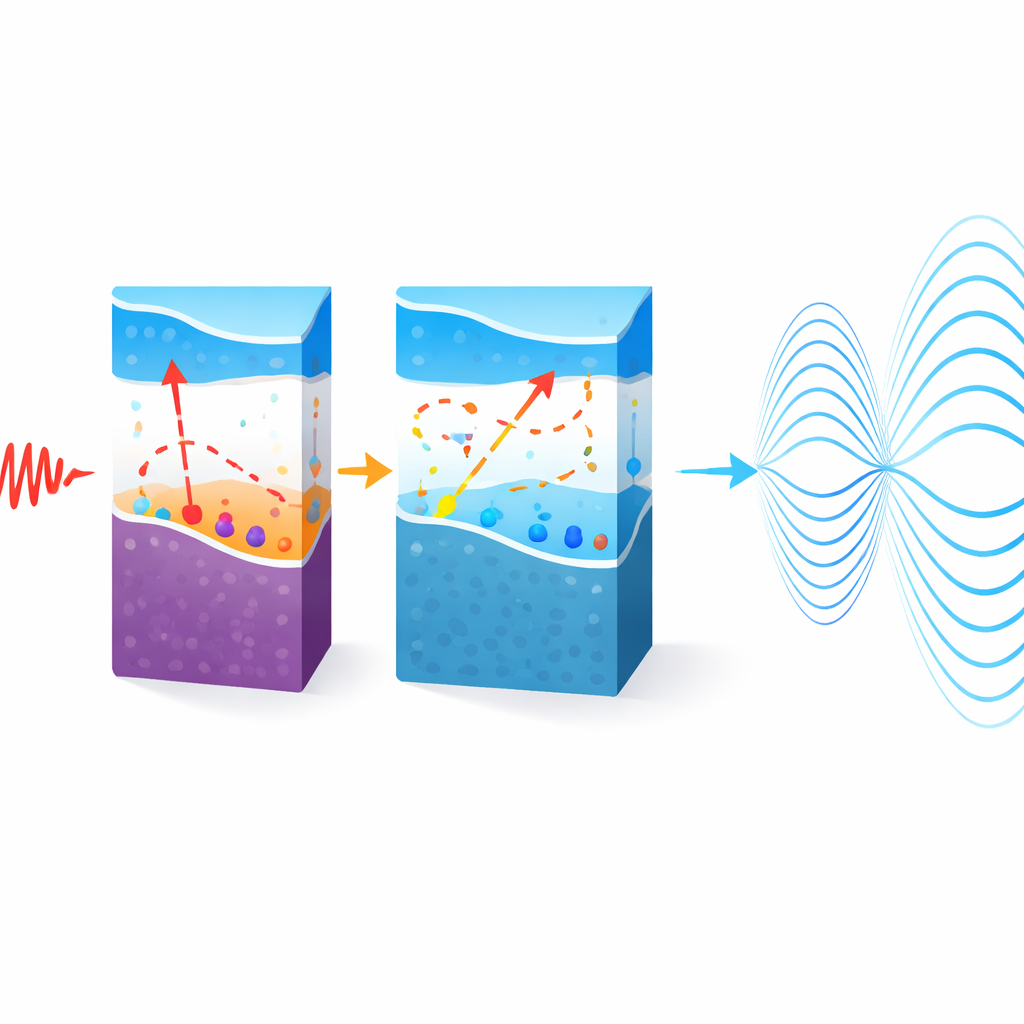
Crucially, the method separates two possible sources of phase shifts. One possibility is that the fundamental near-infrared light itself picks up extra delay as it travels through a laser-modified region of the material. To test this, the authors repeated the same interferometry in the near-infrared range and found almost no intensity-dependent phase change there. That means the striking phase shifts they observed in the high harmonics must come from how the electrons are driven and recombine, not from simple propagation effects. In amorphous SiO2, the harmonic phase shifts grow in one direction as the laser intensity rises, while in crystalline MgO they grow in the opposite direction. Combined with earlier studies, this pattern points to the underlying energy gap between filled and empty states shrinking in the glass-like solid but widening in the crystal when large numbers of electrons are excited.
Simulations That Tie the Picture Together
To test this interpretation, the authors used advanced calculations at two levels. Density-functional theory shows that when many electrons are promoted in MgO, some available states are blocked, effectively pushing the conduction band edge upward and widening the gap. Then, semiconductor Bloch equation simulations and a simpler semi-classical model track how this changing gap would alter the timing and phase of the high-harmonic emission. Both approaches predict that a widening gap should drive the interference fringes to higher energies, just as measured in MgO. Using an approximate relation between gap size and harmonic phase, the team estimates that the gap can change by nearly one electron volt within just a few femtoseconds, with opposite signs for the two materials.
Why This Matters for Future Electronics
Together, these experiments and simulations demonstrate a new way to watch how a solid’s electronic landscape rearranges itself on the fastest timescales nature allows. By using all-optical, extreme ultraviolet interferometry, the technique can resolve transient bandgap changes and carrier dynamics with subcycle precision, without the need for electrical contacts or slower probes. This capability is relevant for future petahertz electronics, where light fields rather than wires would control currents, and for studying thin films, semiconductors, and two-dimensional materials under extreme conditions. In essence, the work turns interference fringes into a sensitive ruler for measuring how the energy barriers that define a material’s behavior breathe in and out under intense illumination.
Citation: Lisa-Marie Koll, Simon Vendelbo Bylling Jensen, Pieter J. van Essen, Brian de Keijzer, Emilia Olsson, Jon Cottom, Tobias Witting, Anton Husakou, Marc J. J. Vrakking, Lars Bojer Madsen, Peter M. Kraus, and Peter Jürgens, "Extreme ultraviolet high-harmonic interferometry of excitation-induced bandgap dynamics in solids," Optica 12, 1606-1614 (2025). https://doi.org/10.1364/OPTICA.559022
Keywords: high-harmonic generation, ultrafast spectroscopy, bandgap dynamics, extreme ultraviolet interferometry, strong-field solids