Clear Sky Science · en
Integrated photonic platform with high-speed entanglement generation and witnessing
Light Chips and Quantum Links
Today’s data networks and future quantum computers both need tiny, fast, and reliable devices to handle light. This paper shows how a silicon chip—made with technology similar to that in everyday electronics—can not only generate delicate quantum links between particles of light, known as entanglement, but also check that those links are really there, all at very high speeds and at room temperature. That combination could make it much easier to build practical quantum devices for communication, sensing, and randomness generation.
Why Quantum Links Matter
Entanglement is a strange connection between particles that underpins many proposed quantum technologies. It lets distant devices share correlations that cannot be explained by ordinary physics and can be used to secure messages, speed up certain kinds of computing, and improve measurements. Doing all of this on an integrated chip is attractive because it promises smaller size, lower cost, and easier scaling, but it is technically difficult. Different materials are good at different jobs—some are better for creating entangled light, others for detecting it—and bringing them all together on one platform without sacrificing performance is a major engineering challenge.
Putting Quantum Optics on Silicon
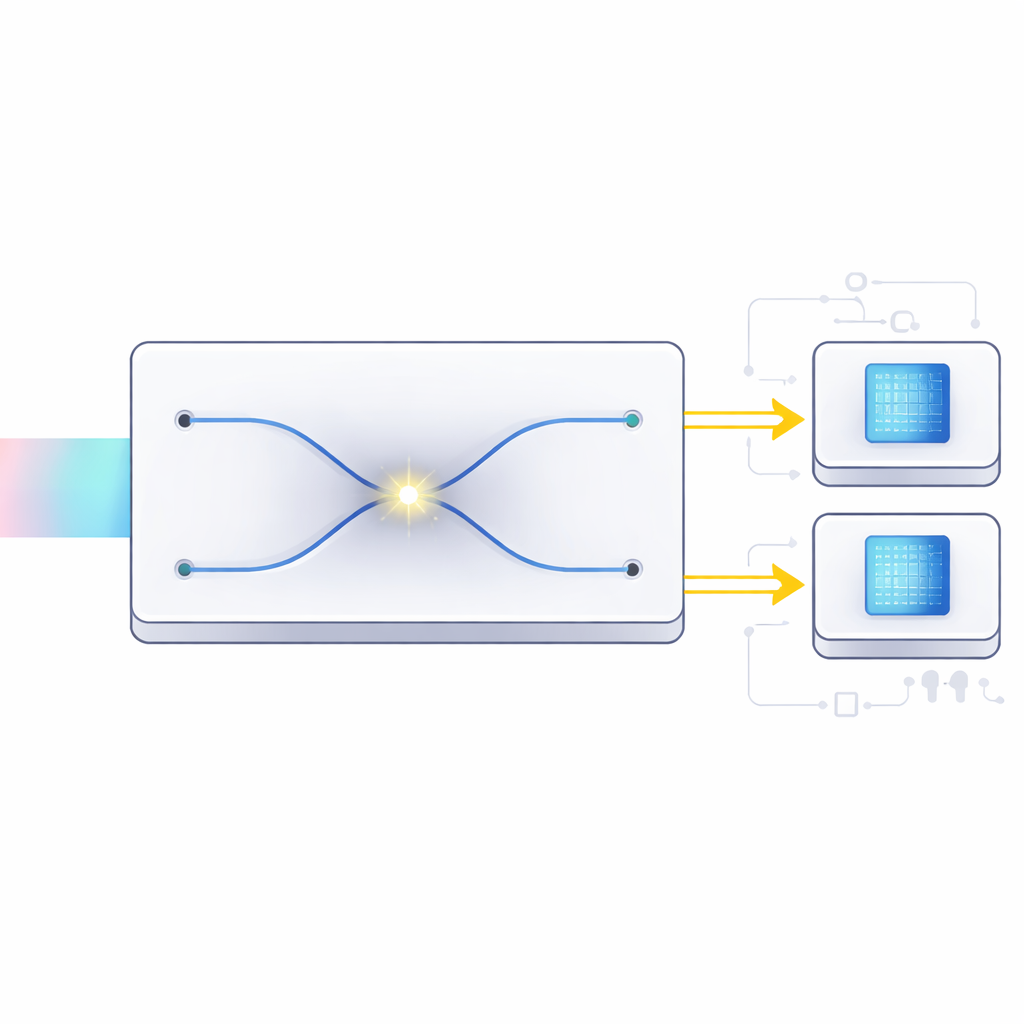
The authors build their entire experiment around a silicon photonic chip fabricated in a commercial foundry process. A conventional laser sends light into the chip, where on-chip modulators first carve it into pulses and then dim it down to the single-photon level. These almost single-photon pulses are sent into a tiny on-chip beam splitter, which directs each photon into two paths at once, creating a “shared” photon between two outputs. To make this work with easily available laser light instead of ideal single-photon sources, the team borrows a strategy from quantum cryptography called the decoy-state method: they mix pulses of several carefully chosen brightness levels so that, in post-processing, they can reliably extract the behavior of the true single-photon component.
Listening to Quantum Signals in a Noisy World
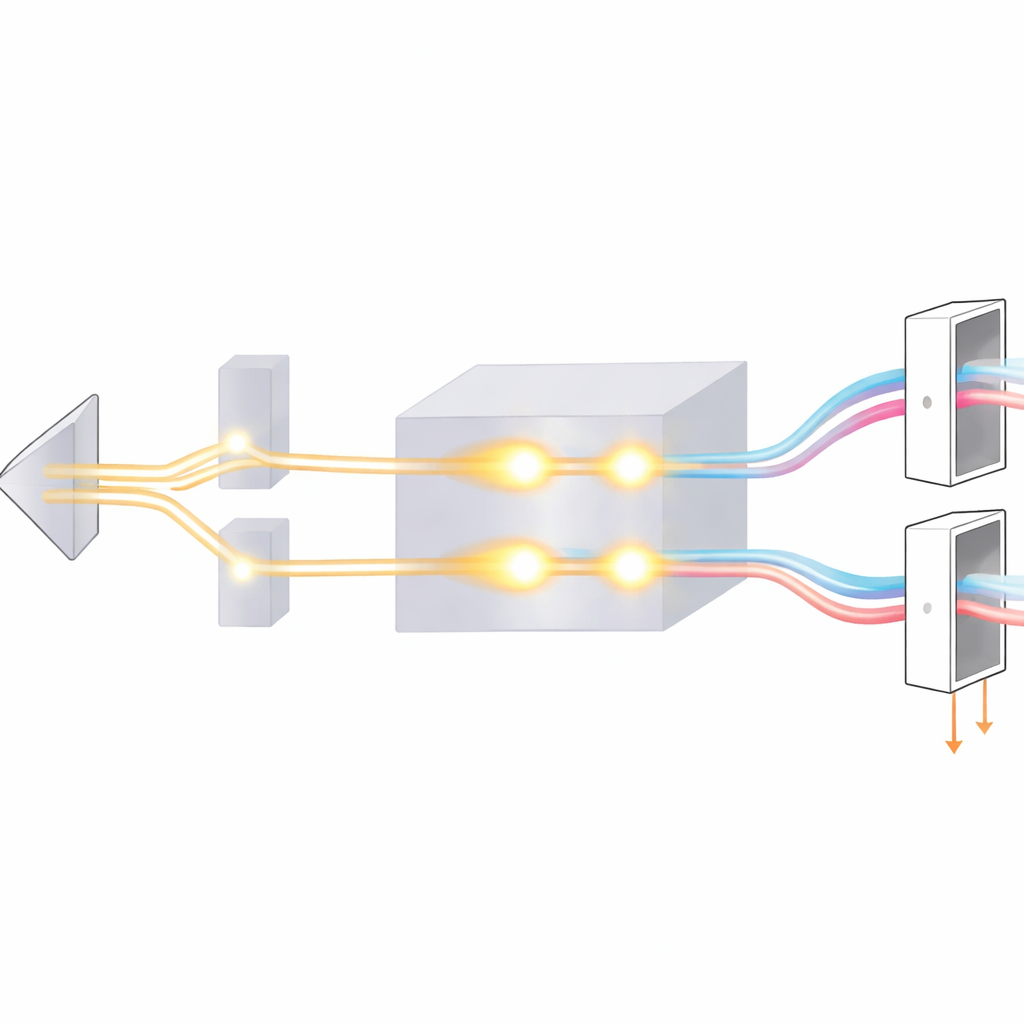
Detecting such fragile quantum links is just as hard as creating them. Instead of using specialized single-photon counters that often need cryogenic cooling, the chip uses a more conventional style of measurement called balanced homodyne detection, which relies on fast photodiodes and electronic amplifiers that work at room temperature. Each output path from the beam splitter meets a strong reference beam on the chip, and the tiny differences between the two beams carry the quantum information. However, real detectors lose some light and add electronic noise. The authors introduce a clever “loss-equivalent” analysis: they mathematically treat all imperfections as if they were extra dimming in the source, and then conceptually raise the input brightness to compensate. With this recalibration, the quantum state can be analyzed as though the detectors were ideal, even though the hardware is not.
Testing the Quantum Connection
To show that genuine entanglement is present, the researchers reconstruct the quantum state and perform a well-known test of nonclassical behavior called a Bell test. By adjusting the phases of the reference beams and looking at how the measured signals vary together, they build up a detailed picture of the shared state of the two light paths. Their analysis reveals that the produced state matches an ideal single-photon entangled state with about 92% fidelity. When they apply the Bell test, they obtain a value that clearly exceeds the maximum allowed by any classical theory based on local hidden variables, even after accounting for the use of practical light sources and noisy, high-speed detectors on the same chip.
What This Means for Future Devices
The work demonstrates that a silicon photonic chip can generate, manipulate, and verify quantum entanglement at multi-gigahertz sample rates while operating at room temperature, all using components that are compatible with standard semiconductor manufacturing. Although the scheme relies on certain reasonable modeling assumptions and is not yet suited for long-distance secure communication, it points to a path where complex quantum optical systems—such as on-chip quantum random number generators or testbeds for quantum information processing—could be built as compact, scalable, and relatively low-cost devices. As on-chip lasers and other missing pieces are added, such platforms may become core building blocks for practical quantum technologies.
Citation: Gong Zhang, Chao Wang, Koon Tong Goh, Si Qi Ng, Raymond Ho, Henry Semenenko, Srinivasan Ashwyn Srinivasan, Haibo Wang, Yue Chen, Jing Yan Haw, Xiao Gong, Joris Van Campenhout, and Charles Lim, "Integrated photonic platform with high-speed entanglement generation and witnessing," Optica 12, 1737-1746 (2025). https://doi.org/10.1364/OPTICA.557199
Keywords: silicon photonics, quantum entanglement, integrated quantum optics, homodyne detection, quantum random number generation