Clear Sky Science · en
Beam combining of high-power terahertz lasers with semiconductor metasurface gratings
Sharper Light for Seeing the Invisible
Terahertz waves sit between microwaves and infrared light, and they can peer through clothing, plastics, and even paint layers without the harmful effects of X-rays. Scientists want bright, tunable terahertz lasers to scan chemicals, drugs, and biomolecules with great precision, but today’s compact sources either do not shine brightly enough or are hard to tune. This paper shows how to blend the beams from several powerful terahertz lasers on a single chip into one well-behaved, steerable beam, using tiny patterned structures called metasurfaces.
Why Many Beams Are Better Than One
A single terahertz quantum-cascade laser can already deliver impressive power, but it typically operates at only one color, or frequency, at a time. For applications like spectroscopy—identifying substances by how they absorb light—it is far more useful to have a set of closely spaced colors that can be selected electronically. One strategy is to build an array of many single-color lasers and then merge their outputs so that, to the outside world, they look like a single bright, tunable source. The challenge is that terahertz beams tend to be messy and spread out quickly, and the bulky lenses and gratings normally used to steer and combine them do not sit well inside the cramped, cold environment these lasers require.
Tiny Grooves that Steer Light
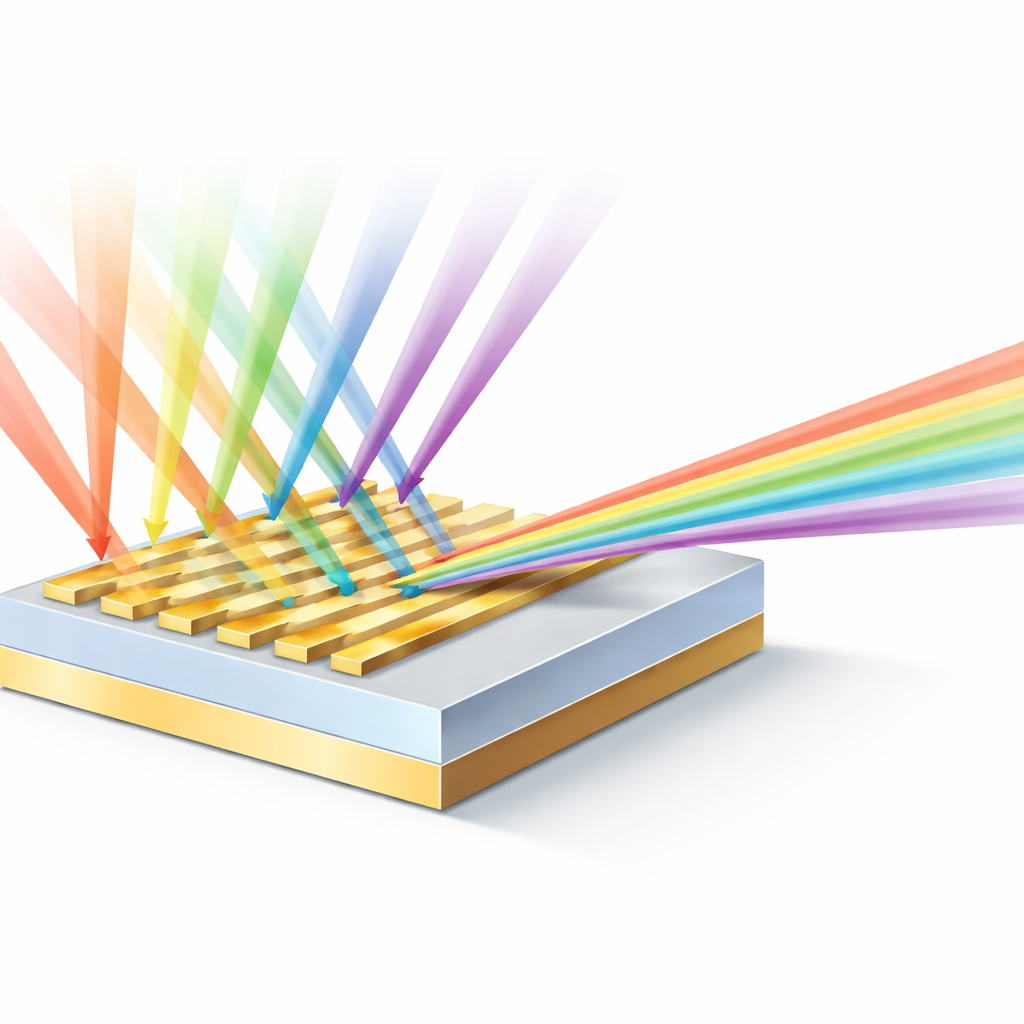
The authors tackle this problem with custom-made diffraction gratings—optical elements that redirect light based on its color—built directly on semiconductor chips. Instead of the classic sawtooth grooves carved into a bulky piece of metal, they use a "metasurface": an ultra-thin sandwich of metal, gallium arsenide, and patterned metal stripes that are smaller than the terahertz wavelength. By carefully choosing the thickness of the layers and the spacing and width of the stripes, they create a resonant structure that pushes most of the incoming energy into a single desired direction while strongly suppressing simple mirror-like reflection. Simulations predicted that these gratings could redirect up to about 80 percent of the incoming light over a fairly broad frequency band centered around 3.2 terahertz, and experiments confirmed efficiencies as high as 70 percent for a single device.
Building a Compact Laser Orchestra
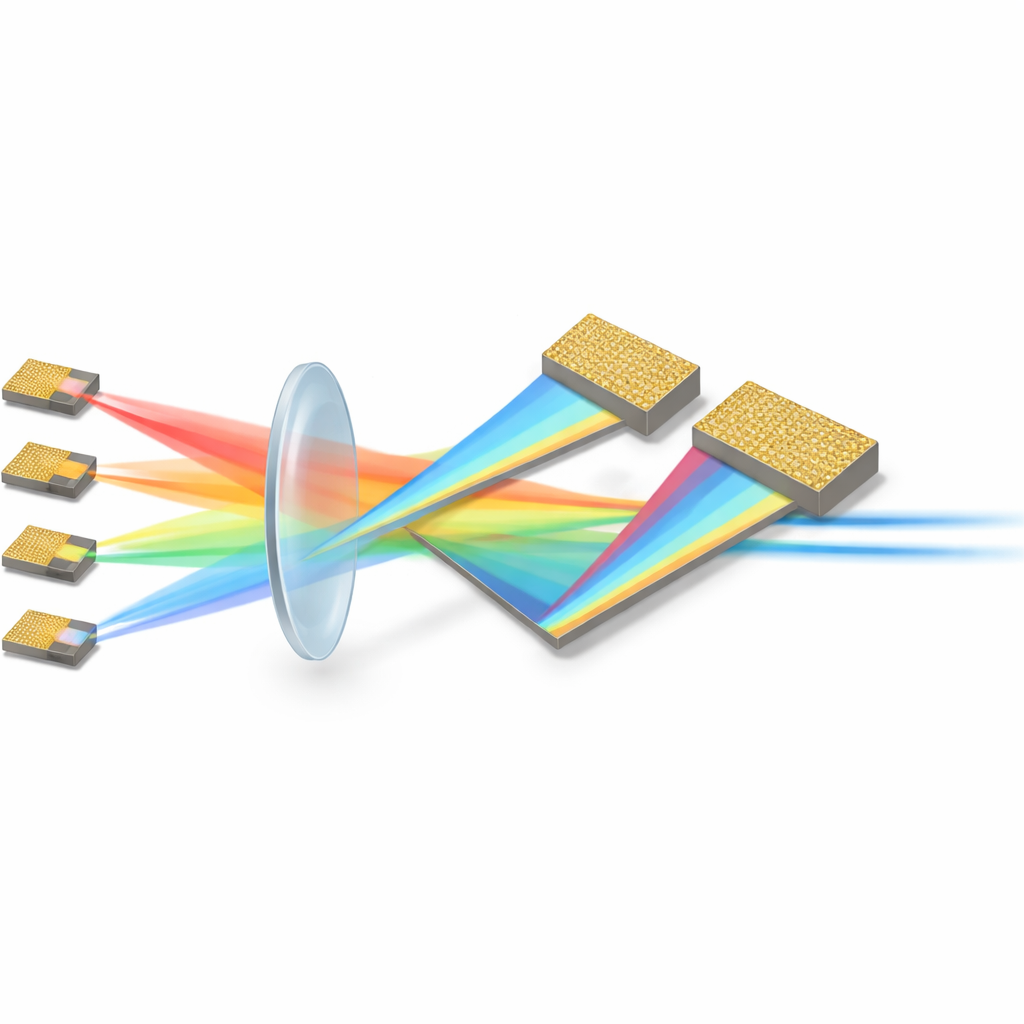
On a separate chip, the team fabricated four surface-emitting terahertz quantum-cascade lasers based on an earlier design that uses a row of tightly coupled microcavities to produce a single, clean mode. By slightly varying the spacing between these microcavities from one laser to the next, they set each device to lase at its own color, with frequency steps of roughly 14 gigahertz—small enough that, in principle, dozens of such lasers could fit within the natural bandwidth of the active material. Each laser produced a single-lobed beam with peak powers of hundreds of milliwatts before any combining optics, but the beams left the chip at different angles and would normally diverge away from one another.
Guiding Many Colors into One Path
To bring the beams together, the researchers installed a compact plastic lens and two identical metasurface gratings side by side on a copper plate inside a cryogenic vacuum chamber. The lens first collimates the beams but does not make them parallel; their directions still differ slightly because the lasers sit at different positions. The first metasurface grating bends each color-dependent beam in a carefully chosen way, and the second grating completes the correction so that, after the pair, all four beams overlap in space and propagate almost perfectly along the same line. Far-field measurements show that, 35 centimeters away, the spots from all four lasers lie within about a tenth of a degree of one another and are separated by less than a millimeter, forming a tightly collimated, elliptical beam with a modest divergence.
What This Means for Future Terahertz Tools
Although the overall power that reaches the detector—about 11 to 16 percent of what the lasers produce directly—is lower than the theoretical maximum, the authors identify clear paths to improvement, mainly by widening the gratings so that they capture the full beam. Even in its current form, the system delivers 50 to 100 milliwatts from each laser after combining, within a compact, fully integrated cryogenic package. For non-specialists, the key message is that this work shows how to merge several bright terahertz "notes" into a tunable "instrument" using chip-scale structures instead of bulky optics. With more lasers in the array and refined gratings, this approach could lead to practical, hand-sized terahertz spectrometers capable of rapidly identifying chemicals, inspecting materials, or probing biological samples with high sensitivity and without physical contact.
Citation: Fei Jia, Sadhvikas J. Addamane, and Sushil Kumar, "Beam combining of high-power terahertz lasers with semiconductor metasurface gratings," Optica 12, 1640-1646 (2025). https://doi.org/10.1364/OPTICA.553819
Keywords: terahertz lasers, metasurface gratings, beam combining, quantum cascade lasers, spectroscopy