Clear Sky Science · en
Does ETS reshape corporate green strategic behaviors? Evidence from innovation and merger & acquisition
Why climate rules matter for everyday business
As the world races to slow climate change, governments are experimenting with new ways to nudge companies toward cleaner growth. China, the largest carbon emitter and a manufacturing powerhouse, has rolled out a carbon Emissions Trading System (ETS) that puts a price on pollution and lets firms trade emission permits. This study looks under the hood of that system to see how it changes the way Chinese companies plan for a low‑carbon future—whether they choose to invent cleaner technologies themselves or buy their way into greener operations through mergers and acquisitions.

Putting a price on pollution
Traditional environmental rules tend to be blunt: regulators set limits and punish companies that step over the line. An ETS works differently. Authorities cap the total amount of carbon that can be released and distribute or sell permits to emit within that cap. Companies that emit less than their permits allow can sell the surplus; heavy emitters must buy extra permits or cut their pollution. China launched pilot carbon markets in seven regions starting in 2013, each with slightly different rules on enforcement, penalties, use of offset credits and pricing. These pilots created a natural testbed to see whether market‑based climate policy can push firms in an emerging economy to rethink their long‑term strategies rather than simply doing the minimum to comply.
Tracking how firms respond
The authors assembled data on Chinese A‑share listed firms in industries covered by the regional pilots from 2009 to 2018, giving a window of several years before and after the carbon markets began. They compared companies included in the ETS with similar firms outside the system using a "difference‑in‑differences" approach, a standard tool for teasing out cause and effect from policy changes. To capture in‑house innovation, they combed through patent records, flagging those specifically aimed at cutting emissions, such as technologies for cleaner fuels, waste‑heat recovery and more efficient equipment. To capture outward‑looking strategies, they coded mergers and acquisitions as "green" when the deal descriptions and business activities centered on environmental protection, low‑carbon energy or other sustainability themes.
Two green paths: invent or acquire
The analysis shows that China’s carbon markets do more than shave off emissions at the margin—they push firms to change course. Companies covered by the ETS became more likely to file patents directly related to cutting emissions, especially higher‑quality invention patents rather than minor design tweaks. At the same time, they were more inclined to buy greener capabilities through mergers and acquisitions, such as acquiring firms with mature pollution‑control technologies, renewable‑energy projects or surplus emission permits. These shifts held up under a battery of robustness checks, including alternative statistical models, different ways of defining policy start dates and placebo tests using fake policy timings.
Rules, leaders and industries shape choices
The study also finds that not all carbon markets—and not all firms—are equal. Regions with stricter monitoring, tougher penalties, higher carbon prices or more generous rules for using offset credits saw stronger changes in corporate behavior. Inside firms, the people in charge mattered: companies whose top executives had environmental expertise, whose directors held green‑focused positions at other firms, or whose major investors ran environmentally themed funds were more inclined to deepen their own low‑carbon research. Heavy‑polluting sectors such as power, steel and cement were particularly driven to innovate, because relying only on permit purchases or acquisitions would leave them exposed to rising long‑term carbon costs.
Working together instead of choosing only one way
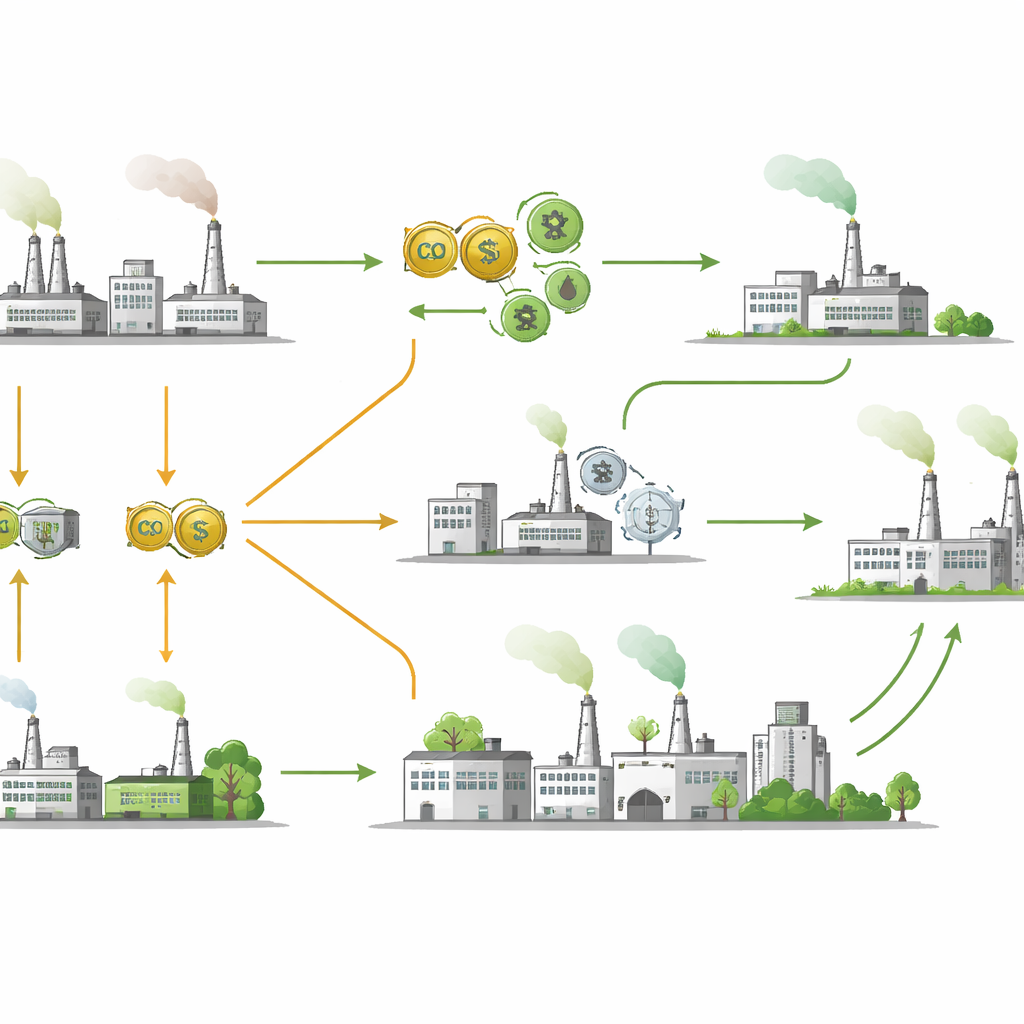
Importantly, the paper shows that internal innovation and green mergers and acquisitions are not either‑or options. Many firms use both: they buy cleaner assets or technologies to relieve short‑term pressure to meet emission caps, while also investing in their own research to build a lasting edge in a low‑carbon economy. Statistical tests suggest these two strategies complement each other rather than compete. In regions with pilot carbon markets, overall emissions fell, indicating that the policy did not just move pollution around but actually reduced it.
What this means for climate policy and business
For a non‑specialist reader, the takeaway is that smart carbon markets can do more than punish polluters—they can reshape corporate strategy. By putting a real price on emissions and backing it with credible rules, China’s ETS has nudged companies to both invent cleaner technologies and actively seek greener acquisitions. The study suggests that tailoring market design to local conditions, while empowering environmentally minded leaders and investors inside firms, can amplify these effects. In other words, when climate policy is well crafted, it can turn the challenge of cutting carbon into a driver of innovation, investment and, ultimately, more sustainable growth.
Citation: Shen, L., Chen, S. Does ETS reshape corporate green strategic behaviors? Evidence from innovation and merger & acquisition. Humanit Soc Sci Commun 13, 353 (2026). https://doi.org/10.1057/s41599-026-06854-4
Keywords: emissions trading, carbon markets, green innovation, corporate strategy, China climate policy