Clear Sky Science · en
Community of practice: how bilingual Chinese Americans use backchannels to negotiate identity
Why the Smallest Sounds Matter
When we talk with friends or family, we constantly murmur little sounds like “mm-hmm” or “oh” to show we’re listening. These tiny responses, called backchannels, are so automatic that we hardly notice them. Yet for bilingual Chinese Americans who move between Mandarin and English every day, these small noises become powerful tools for expressing who they are and where they belong. This study looks closely at how a handful of young bilingual Chinese Americans subtly change their listening behavior in different settings—and what that reveals about identity in a multicultural world. 
Two Worlds of Everyday Talk
The people in this study grew up with both Mandarin and English, using Chinese mostly with family and English in school, work, or with friends. Rather than treating them as representatives of fixed “Chinese” or “American” cultures, the researcher follows a newer idea: we build our identities through the habits we share with particular groups, known as communities of practice. A community of practice might be a family dinner table, a college study group, or a circle of coworkers. Each group quietly teaches its own expectations for how to listen, when to speak, and how much to react. For these bilingual speakers, that means learning one style of listening in Mandarin circles and another in English ones.
Measuring the Quiet Signals
To uncover these patterns, the researcher recorded about ten hours of casual, face-to-face conversations—half in Mandarin and half in American English—among five bilingual Chinese Americans in North America. Every clear backchannel was identified and coded: tiny verbal sounds (like “yeah,” “mm,” or their Mandarin equivalents), as well as nods and subtle facial expressions. The study did not just count how often backchannels appeared. It also examined how they sounded (their pitch, loudness, and length), what kinds of words were used, how much speakers relied on body movement, and exactly where in the flow of conversation these signals occurred.
Different Listening Styles in Each Setting
The numbers and close-up examples tell a clear story. All five speakers used more backchannels in English conversations than in Mandarin ones, even though they were highly fluent in both languages. In Mandarin contexts, their responses tended to be softer, shorter, and more restrained. Listeners often waited for a clear pause or completed thought before offering a quiet “hm” or a brief agreement, sometimes replacing words with a small smile or minimal movement so as not to disturb the speaker’s flow. In English settings, by contrast, backchannels were more frequent, longer, and louder, and they often overlapped with the speaker’s words. Nods and other gestures became more energetic, and listeners chimed in mid-sentence to show enthusiasm and shared understanding. 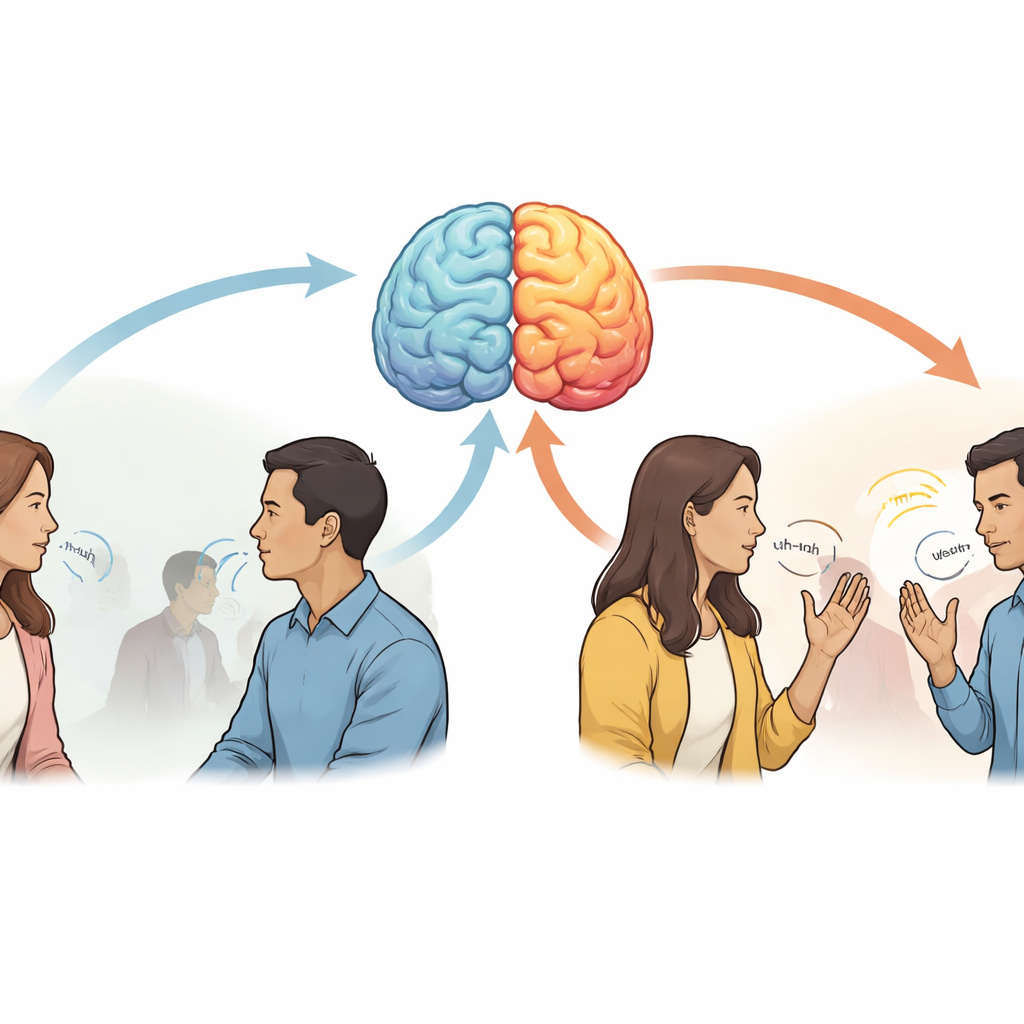
Shaping Identity Through Everyday Habits
These shifts were not simply by-products of grammar or accent; they reflected choices about how to “fit” into each local group. The study shows that the same person can listen in one style with Chinese-speaking relatives and another with English-speaking friends, subtly matching the norms favored in each circle. Some participants, shaped by early immersion in Chinese settings, maintained relatively low backchannel rates even in English; others, steeped in English-dominant environments, were consistently more reactive in both languages. These personal differences suggest that what matters most is not just which languages people know, but which communities they have invested in over time and which interactional styles those communities reward.
What This Means for Who We Are
Overall, the paper argues that identity is not a fixed label like “Chinese” or “American,” but something we continually craft through small, everyday practices—right down to when we nod or murmur “mm-hmm.” Bilingual Chinese Americans in this study use backchannels as flexible tools to navigate between family, school, and social worlds, signaling belonging to each through their listening style. For lay readers, the takeaway is that the tiniest sounds in conversation can reveal how people manage life between cultures and how they actively build a sense of self within the groups that matter most to them.
Citation: Liu, Q. Community of practice: how bilingual Chinese Americans use backchannels to negotiate identity. Humanit Soc Sci Commun 13, 337 (2026). https://doi.org/10.1057/s41599-026-06693-3
Keywords: bilingual communication, Chinese American, conversation style, identity negotiation, backchannels