Clear Sky Science · en
Transforming the Northwest frontier: development discourse in Republican China through computational analysis of the historical press
Why this frontier story still matters today
In the first half of the twentieth century, what is now Northwest China—places like Gansu, Shaanxi, Qinghai and Xinjiang—shifted in the national imagination from a distant backwater to the heart of plans for the country’s survival and future. This article shows how that transformation unfolded not through battlefields alone, but in the pages of newspapers and magazines. By reading thousands of historical articles with modern computational tools, the study uncovers how journalists, officials and intellectuals talked about the Northwest, what they hoped to build there, and how foreign invasions and civil wars reshaped those dreams.
From far edge to strategic heartland
For centuries, China’s rulers viewed the Northwest as a protective rim—home to diverse peoples and harsh landscapes that buffered the agricultural heartland. During the Republican era (1911–1949), this frontier took on new meaning. As modern print media boomed, the slogan of “developing the Northwest” spread through journals and newspapers. Writers portrayed the region as both treasure house and shield: rich in land, minerals and rivers, yet also a bulwark against threats from Japan in the east and Russia and the Soviet Union in the north and west. After Japan seized Manchuria in 1931 and pushed deeper into China, talk about the Northwest became more urgent, casting it as a fallback base for the nation’s defence and reconstruction.
How a massive press archive was decoded
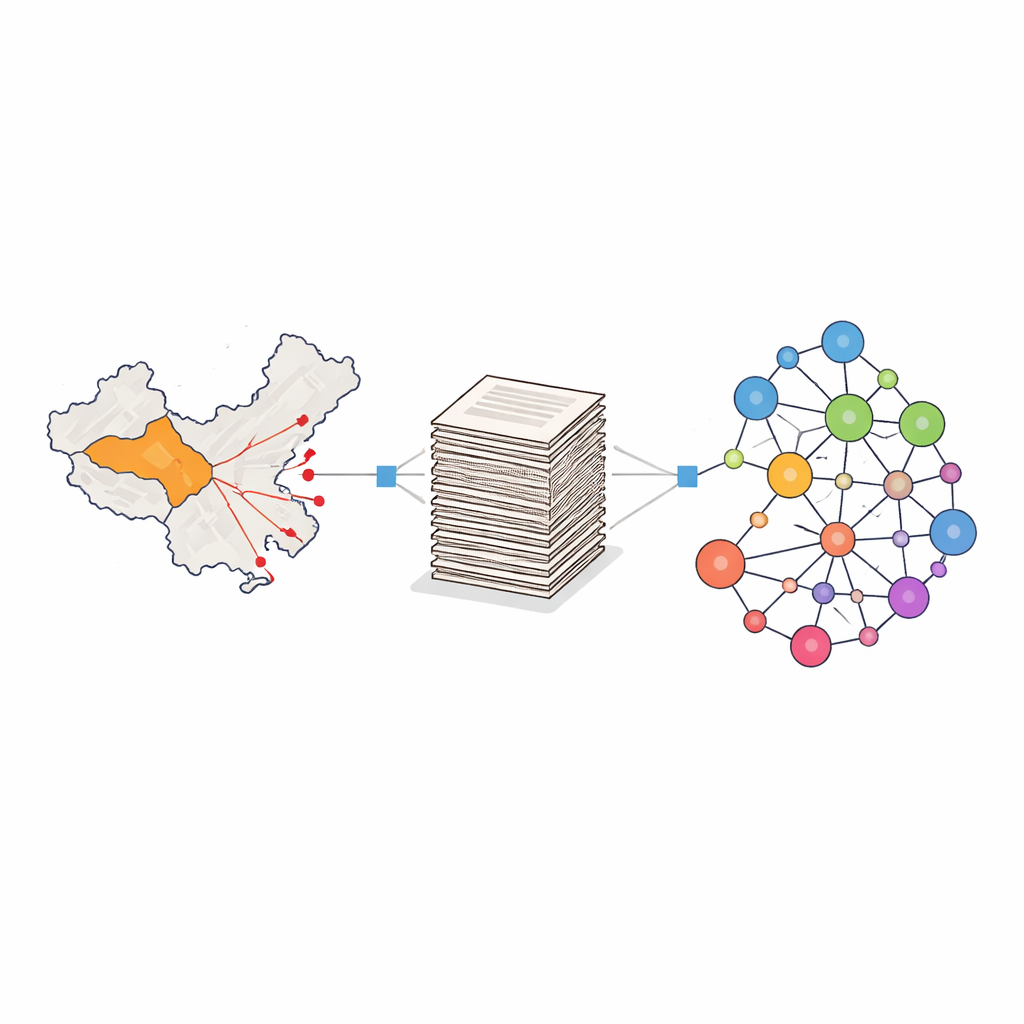
To move beyond scattered anecdotes, the author assembled more than 5,000 items about the Northwest from two large databases of historical Chinese newspapers and periodicals. Many of these sources survive only as low-quality scanned pages with dense vertical type. The study therefore built a multi-stage pipeline to turn these images into usable text: cutting multi-column pages into segments, using an advanced image–language model to read the characters, and in especially faded cases having assistants read the pages aloud and transcribe the recordings. Historical character forms were converted into modern simplified script, and the resulting text was carefully cleaned so that computer algorithms could reliably detect patterns in it.
Letting themes emerge from the words
With this cleaned corpus, the study applied a method called structural topic modelling. Instead of starting with a fixed list of themes, the algorithm scans which words tend to appear together and groups them into “topics,” each representing a recurring bundle of ideas. It also allows the researcher to link topic strength to extra information such as publication date or place. After testing different model settings, the author settled on 26 topics capturing conversations about railways and roads, irrigation, mines, cities, education, ethnic groups, national defence, heavy industry and more. The method also reveals which topics tend to co-occur in the same articles, producing a kind of map that shows how different strands of discussion are woven together.
What the newspapers revealed about nation-building
The resulting picture is not of a single development plan but of two tightly linked clusters of concern. One cluster centers on governance and industry: national planning agencies, administrative control over frontier provinces, and efforts to build factories and modern farming. The other focuses on infrastructure and natural resources: transport routes, water projects and extraction of minerals and energy. Security worries—about foreign empires and later Japan’s invasion—tie these clusters together, pushing writers to frame almost every road, canal or factory as part of a larger struggle for national survival. Cultural and educational efforts, as well as travel writing and survey reports, orbit at the edges of this network, helping to fold local populations and landscapes into a shared national story but rarely driving the agenda on their own.
How crisis reshaped hopes for the Northwest
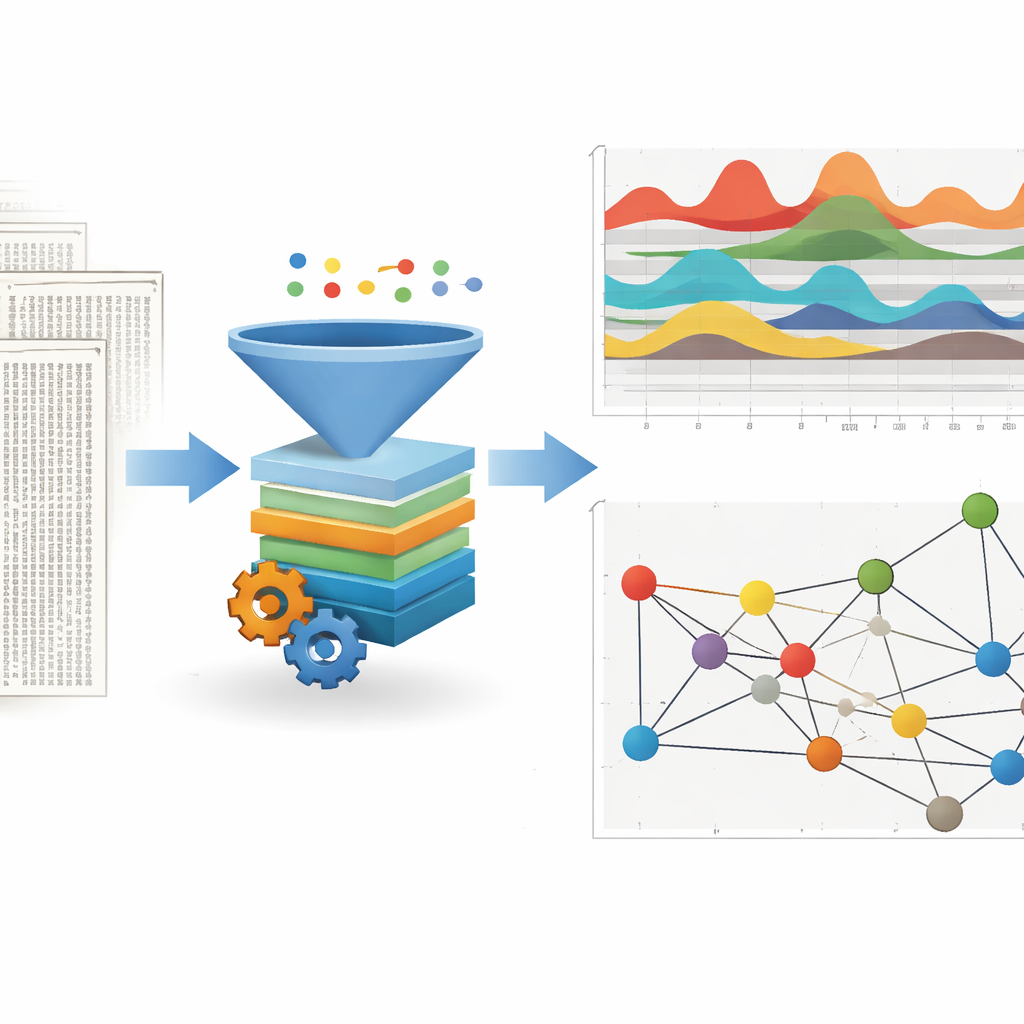
Because publication dates were built into the analysis, the study can trace how attention to each topic rose and fell between 1911 and 1949. In the 1920s, when powerful warlords dominated the region, newspapers highlighted land reclamation, local administration and experimental building schemes meant to secure their rule. After 1931, as Japan advanced and the Soviet Union loomed on the northern frontier, articles increasingly stressed strategic surveys, defence routes and the Northwest’s place in global geopolitics. With the full-scale war against Japan from 1937, the tone hardened further. The region was now portrayed as an emergency rear base where universities, factories and key industries must be moved, and where irrigation, heavy industry and transport projects could directly feed the war effort. After Japan’s defeat in 1945, this intense focus quickly ebbed, as the country slid toward civil war and other crises claimed the headlines.
What this frontier story tells us about modern China
In plain terms, the study shows that the Northwest became important not just because of what lay in its deserts and mountains, but because newspapers and journals learned to talk about it as central to China’s fate. Over three turbulent decades, they recast it from remote margin to strategic core, tying dams, roads, schools and resettlement schemes into a single narrative of national strength and unity. By marrying digital tools with close historical reading, the article offers both a new, large-scale view of how media helped imagine and justify frontier development, and a case study of how crisis can turn distant regions into symbols and testing grounds for state power.
Citation: Ren, T. Transforming the Northwest frontier: development discourse in Republican China through computational analysis of the historical press. Humanit Soc Sci Commun 13, 334 (2026). https://doi.org/10.1057/s41599-026-06682-6
Keywords: Republican China, Northwest frontier, newspaper discourse, computational history, state-led development