Clear Sky Science · en
Divergent reference frames in Chinese and Japanese spatiotemporal metaphors: a cross-cultural study of multidimensional mapping in Qian/Hou and Mae/Ato
How We Imagine Time in Front of Us
When people say they are “looking forward” to a holiday or that a bad year is “behind” them, they are quietly turning time into space. This article explores how Chinese and Japanese speakers use the ideas of “front” and “back” to talk about time, and shows that, beneath shared characters on the page, the two languages picture time in strikingly different ways. These differences hint at how culture, history, and religion shape something as basic as our sense of past, present, and future.
Turning Space into Time
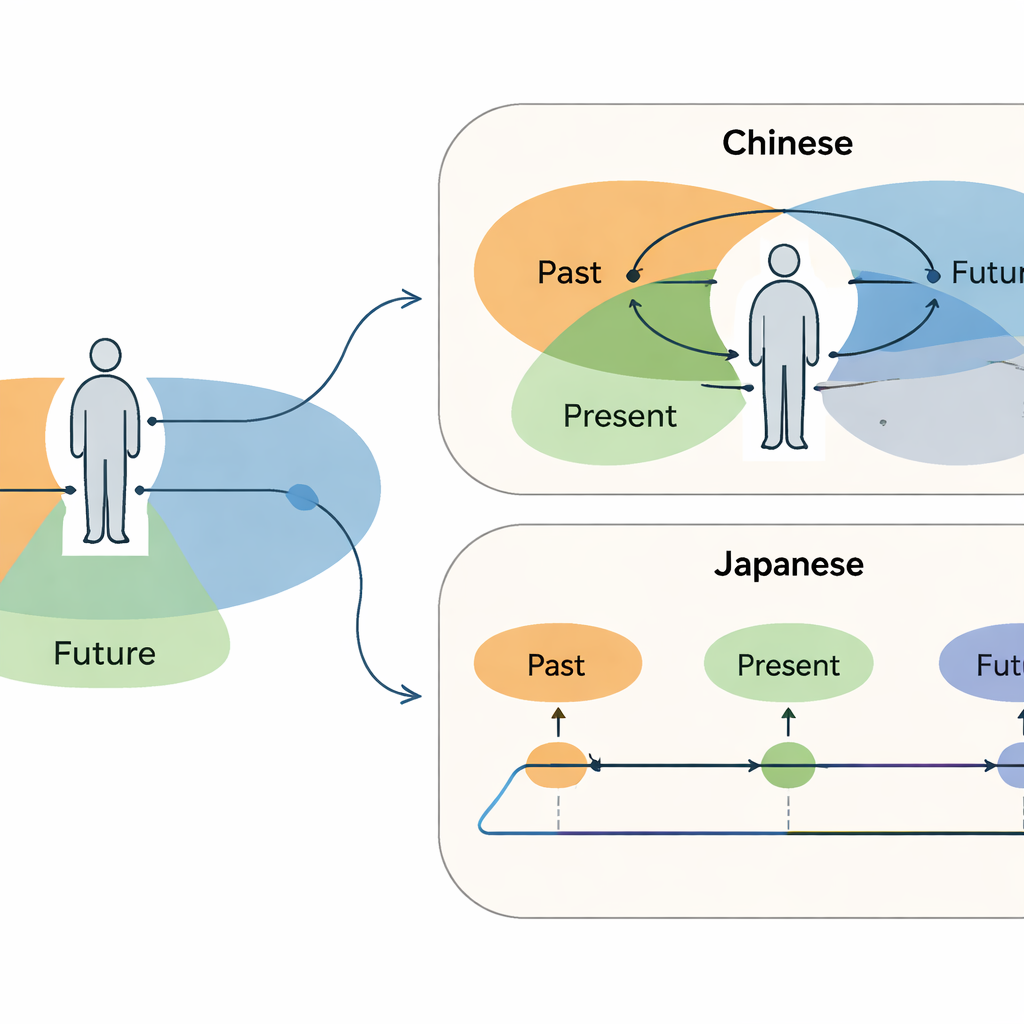
Across many languages, time is imagined using movement in space. One common pattern treats the self as a traveler moving along a path: the past is the road already walked, the present is where we stand, and the future lies ahead. Another pattern freezes the self and lets time move instead, like a river flowing from the future toward us and then away into the past. A third pattern compares time points only to each other, as if they were objects lined up in a row, with some “in front” (earlier) and others “behind” (later). The paper calls these the Ego-Perspective (self-based) and Sequence-as-Position (line-based) frames, and uses them to compare Chinese words qian/hou (front/back) with Japanese mae/ato and their Sino-Japanese cousins zen/go.
Digging into Real-Life Language Use
Instead of relying on a few eye-catching examples, the study mines two massive text collections: a major corpus of modern Chinese and the Balanced Corpus of Contemporary Written Japanese. From thousands of instances of qian, hou, mae, ato, zen, and go, the author filters out purely spatial uses (like “front seats” or “behind the station”) and keeps only those that refer to time. Each remaining sentence is then hand-tagged: does “front/back” mark the speaker’s standpoint in time (Ego-Perspective), or does it simply indicate that one event happens earlier or later than another (Sequence-as-Position)? This careful coding allows the researcher to count how often each language leans on each way of mapping time onto space.
Chinese Flexibility with Front and Back
The corpus reveals that Chinese qian and hou are semantically very flexible. They frequently participate in Ego-Perspective metaphors where the future is ahead and the past is behind. Phrases like “qiancheng” (future prospects), “xiang qian zou” (move forward), and “xiang hou kan” (look back) turn individuals, cities, or even generations into travelers on a temporal road. At the same time, qian and hou serve as neutral sequence markers in compounds like “qiantian/houtian” (the day before yesterday / the day after tomorrow) or “qianren/houren” (earlier and later generations). Qian can even point to the present when combined with words like “eye” or “face” in expressions such as “muqian” (at present), picturing the current moment as “right before one’s eyes.” This multidirectional use is especially common in public and official writing, where personified collectives are urged to “look back” at history in order to “move forward” into a bright future.
Japanese Preference for Ordered Sequences
Japanese tells a different story. While speakers clearly understand the same “future in front, past behind” idea, the everyday words mae and ato rarely carry that embodied viewpoint in the corpus. Instead, they, along with zen and go, mostly mark simple temporal order: earlier versus later. Examples like “futsukamae/futsugo” (two days ago / two days later), “zenkai” (last time), and “kouhai” (junior colleague) arrange times, events, and generations along a line, without invoking a moving self. When Japanese does portray time as moving, it more often relies on verbs such as “kuru” (come), “chikazuku” (approach), or “sugisaru” (pass), which let deadlines, seasons, and life stages flow toward or away from the person. In other words, Japanese tends to keep “front/back” tied to neutral sequencing while pushing the more vivid journey metaphors into the verb system and sentence structure.
Cultures, Beliefs, and the Shape of Time
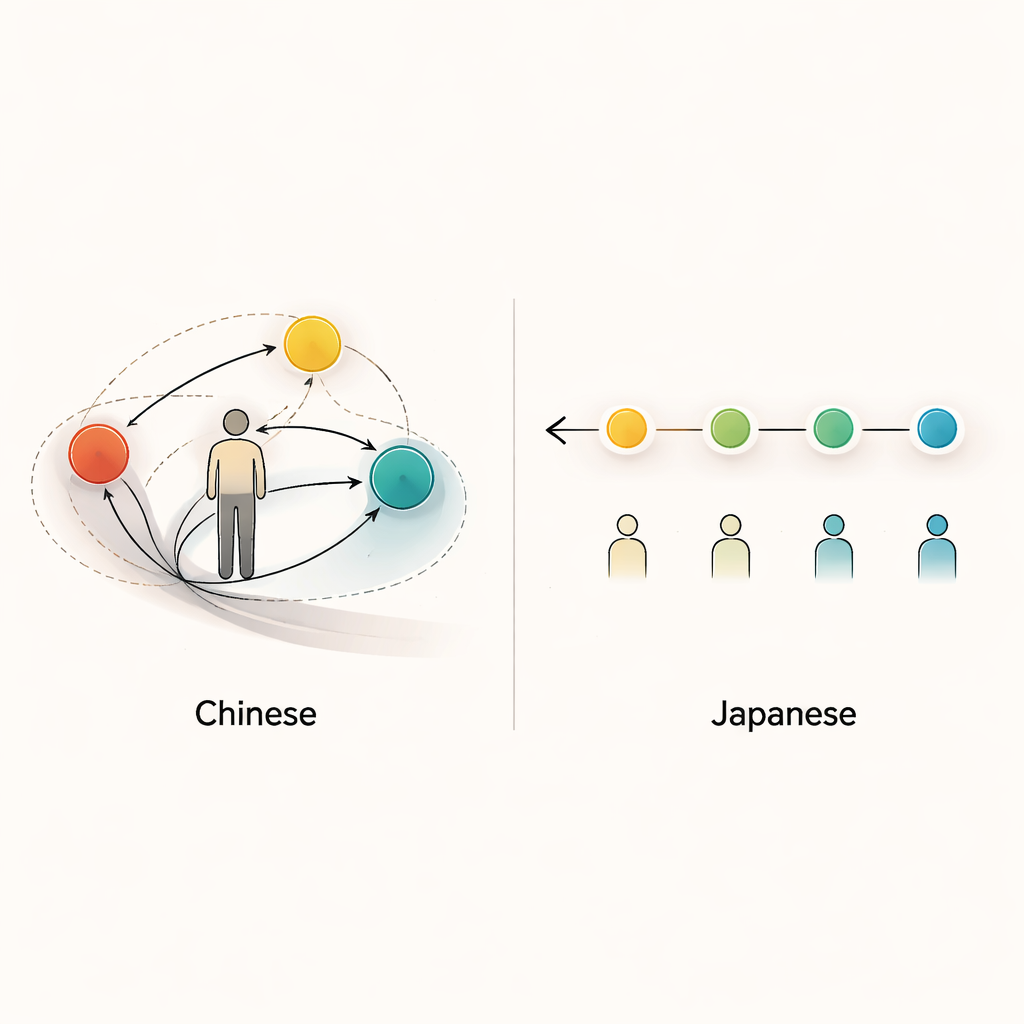
Why would two neighboring languages that share writing systems treat the same characters so differently? The article argues that the answer lies in deeper cultural patterns. In China, long-standing blends of Confucian, Daoist, and Buddhist thought encourage a flexible, layered view of time that ties moral duty, ancestry, and future planning together. This flexibility shows up linguistically as qian and hou freely stretching across past, present, and future in many registers. In Japan, imported Confucian ideas of hierarchy merged with industrial-era emphasis on punctuality and scheduling. This favors strict, sequence-based expressions, making mae/ato and zen/go behave more like precise ticks on a timeline. Thus, similar-looking characters end up encoding different balances between personal viewpoint and objective order.
What This Means for Understanding Time
For a lay reader, the key message is that language does not just label time; it helps build how people feel and think about it. Chinese allows speakers to slide easily between “I am moving through time” and “events are lined up before and after me,” using the same front/back words for history, the present moment, and imagined futures. Japanese, in contrast, mostly reserves front/back for cleanly ordering events while using other tools to express how time feels as it approaches or recedes. These contrasts, grounded in large-scale data, show that even small, everyday words like “before” and “after” quietly carry the imprint of whole cultural histories and ways of living in time.
Citation: Jin, T. Divergent reference frames in Chinese and Japanese spatiotemporal metaphors: a cross-cultural study of multidimensional mapping in Qian/Hou and Mae/Ato. Humanit Soc Sci Commun 13, 323 (2026). https://doi.org/10.1057/s41599-026-06664-8
Keywords: time metaphors, Chinese language, Japanese language, spatial cognition, cross-cultural linguistics