Clear Sky Science · en
Public management in the COVID-19 pandemic: safeguarding the rights and well-being of vulnerable groups
Why this matters for everyday life
The COVID-19 pandemic did more than spread a dangerous virus—it exposed how unevenly risk and hardship are shared in our societies. This article looks across hundreds of studies from around the world to ask a simple but urgent question: how did the crisis affect people who were already struggling, and what did governments actually do to help them? By following the evidence, it shows how health, money, schooling, and social life are tightly linked, and what that means for making future crises fairer as well as safer.
Who is most at risk when crisis hits
The authors focus on “vulnerable groups” such as women, low‑income workers, children, older adults, people with disabilities, migrants, and racial or ethnic minorities. Drawing on 429 studies published between 2020 and 2025, they map how research on these groups evolved through three stages. Early work simply identified who was being hit hardest and where the biggest inequalities lay. Later studies dug into why these gaps existed, pointing to long‑standing problems in housing, jobs, health care, and social support. The most recent work shifts toward what comes next: rebuilding economies and services in ways that do not repeat the same patterns of neglect.
Four kinds of hardship, all tangled together
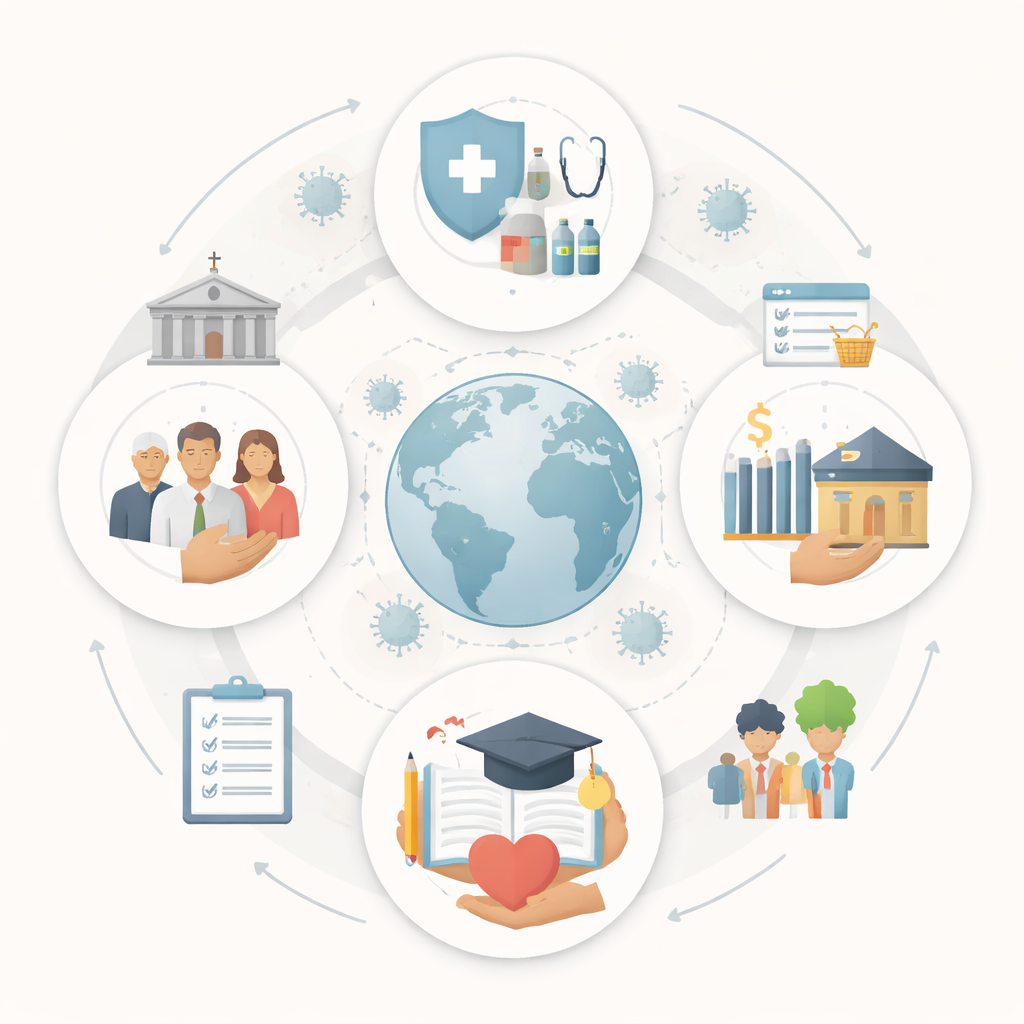
The review shows that vulnerable groups rarely face just one problem at a time. Health risks were higher in crowded housing, low‑paid frontline jobs, and communities with more chronic illness and weaker health systems. Economic shocks were sharper for women, informal workers, and those who could not work from home, often pushing families into poverty and food insecurity. School closures hit children from poorer households hardest because they lacked quiet space, reliable internet, and devices, and some—especially girls—never returned to class. Social life also frayed: older people and those with disabilities became isolated, while migrants and racialized communities faced a surge in stigma and discrimination. These four areas—health, income, learning, and social connection—reinforced one another, creating “piles” of disadvantage rather than isolated setbacks.
How governments tried to help
Using a public management lens, the article compares how different countries responded. Many removed or reduced the cost of COVID‑19 care, expanded vaccination, and used mobile clinics or “firewall” rules so migrants could seek treatment without fearing immigration checks. Economic measures ranged from wage subsidies and job‑protection schemes to large cash transfers and emergency aid apps. To keep learning going, authorities distributed laptops and data, trained teachers for online classes, and offered special support for children with disabilities, migrant pupils, and those experiencing homelessness. Efforts to promote social inclusion included stronger rules for accessible public and digital spaces, campaigns against racism, and safer ways for older and disabled people to receive care and stay connected. Yet these steps were often temporary, unevenly applied, and weakest where needs were greatest.
Unequal knowledge and blind spots
The review also uncovers an imbalance in who studies these issues. Most research on vulnerable groups in low‑ and middle‑income countries is written by scholars based in wealthier nations, and leading institutions are concentrated in the United States and a few other high‑income countries. This “about but not with” pattern risks missing local priorities and lived experience. Policy responses, likewise, mostly target single categories such as age or income, overlooking people who sit at the crossroads of many disadvantages—for example, a low‑income migrant woman with a disability. The authors argue that truly effective protection must recognize these overlapping identities and give affected communities real influence over decisions, not just token consultation.
What this means for fairer crisis response
For a lay reader, the core message is straightforward: COVID‑19 did not create social inequalities, it magnified ones that were already there—and quick fixes cannot replace strong everyday systems. The article calls for building permanent safety nets in health care, income support, education, and inclusion that treat protection as a basic right, not a charitable extra. It recommends better tools to spot people facing multiple risks at once, digital policies that go beyond handing out devices to building real skills, and crisis plans that embed the needs of vulnerable groups from the start. In essence, if societies want to weather the next big shock more fairly, they must invest now in public institutions that work for those who are usually left at the edge.
Citation: Lyu, D., Wang, J. & Lang, Y. Public management in the COVID-19 pandemic: safeguarding the rights and well-being of vulnerable groups. Humanit Soc Sci Commun 13, 259 (2026). https://doi.org/10.1057/s41599-026-06635-z
Keywords: COVID-19 vulnerability, social inequality, public management, social protection, vulnerable groups