Clear Sky Science · en
The impact of nuclear energy on social welfare and the future of renewable energy: episode from South Korea
Why this energy story matters for everyday life
South Korea’s struggle over whether to lean on nuclear power or race toward renewables is not just a technical argument among experts. It shapes electricity bills, job prospects, and even how stable the wider economy feels. This paper asks a simple but vital question with global echoes: when a country has strong nuclear know‑how but shifting politics, what mix of nuclear, renewable, gas, and coal power really leaves people better off, and how much does policy zig‑zagging itself hurt prosperity?
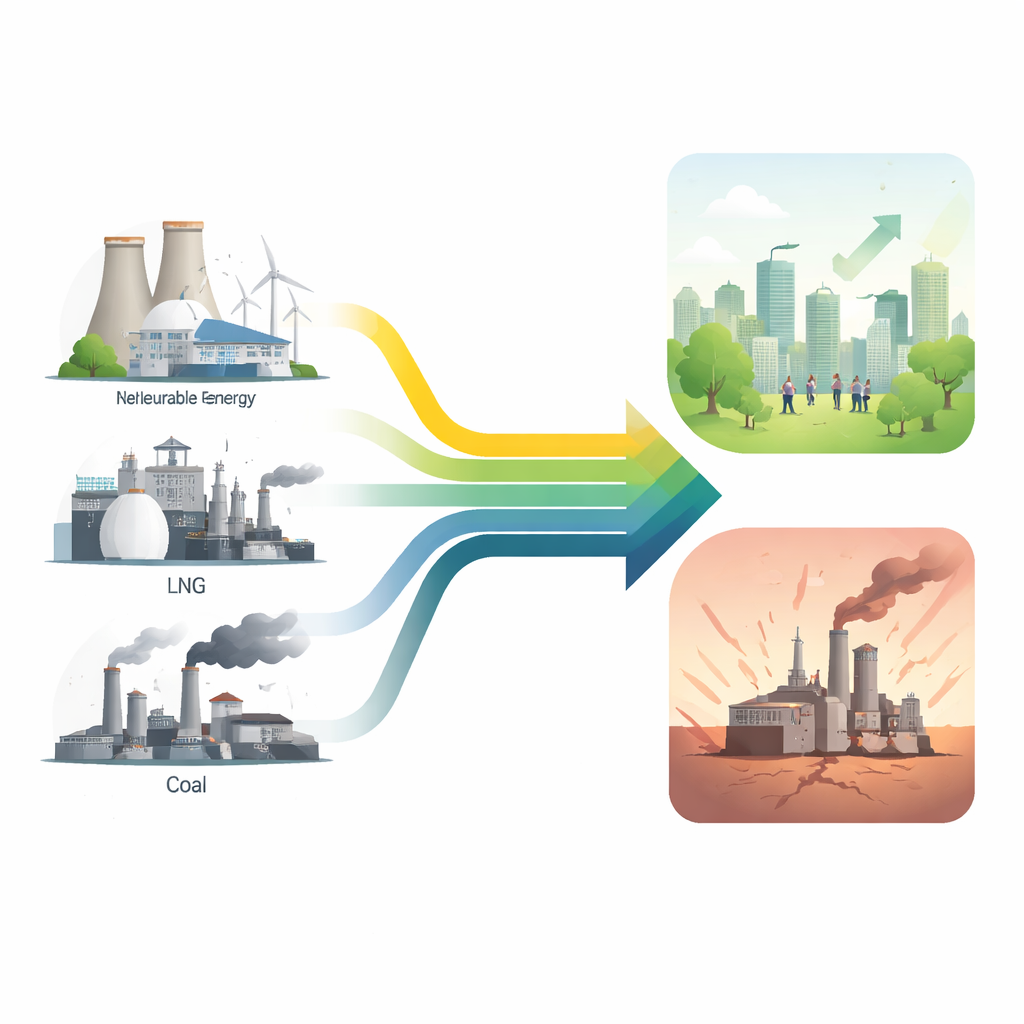
Two very different paths for the power mix
The authors focus on South Korea’s recent “whiplash” in energy plans. One conservative government sought to expand nuclear power sharply, betting on its low cost and reliability. The next, more progressive administration reversed course, cancelling new reactors and pledging a rapid build‑out of renewable energy instead. Similar debates play out in countries like Germany, Japan, China, and the United States, but South Korea is unusual: it exports nuclear technology abroad while repeatedly re‑opening the domestic argument at home. This back‑and‑forth offered a natural experiment for asking how different power mixes ripple through the entire economy.
A whole‑economy model of electricity choices
To study these ripples, the researchers built a macroeconomic model that treats energy as a core ingredient in both household life and business production. Electricity can come from four sources—nuclear, renewables, liquefied natural gas (LNG), and coal—each with its own cost of generating power. In the model, governments set targets for how much each source should contribute, but they cannot finely tune prices or fully control outcomes, reflecting real‑world political limits. The model also includes the chance of rare nuclear accidents, which can temporarily damage factories, power plants, and productivity, as well as an extra layer of uncertainty when future policy directions are unclear.
What more nuclear or more renewables means for welfare
Using detailed Korean data on electricity generation, generation costs, and past policy plans, the authors compare two stylized futures: one with a higher share of nuclear power, the other with a higher share of renewables. In the nuclear‑heavy case, the overall cost of generating electricity falls, leading firms to invest more and households to consume more, raising long‑term social welfare. Crucially, when realistic probabilities and damages from nuclear accidents are included, the economic benefits from lower power costs still outweigh the expected losses from possible disasters. In the renewable‑heavy case, current technologies and local conditions make renewable electricity substantially more expensive, so the model predicts slightly lower long‑run welfare, even though renewables carry much lower disaster risk.
Falling renewable costs and the burden of uncertainty
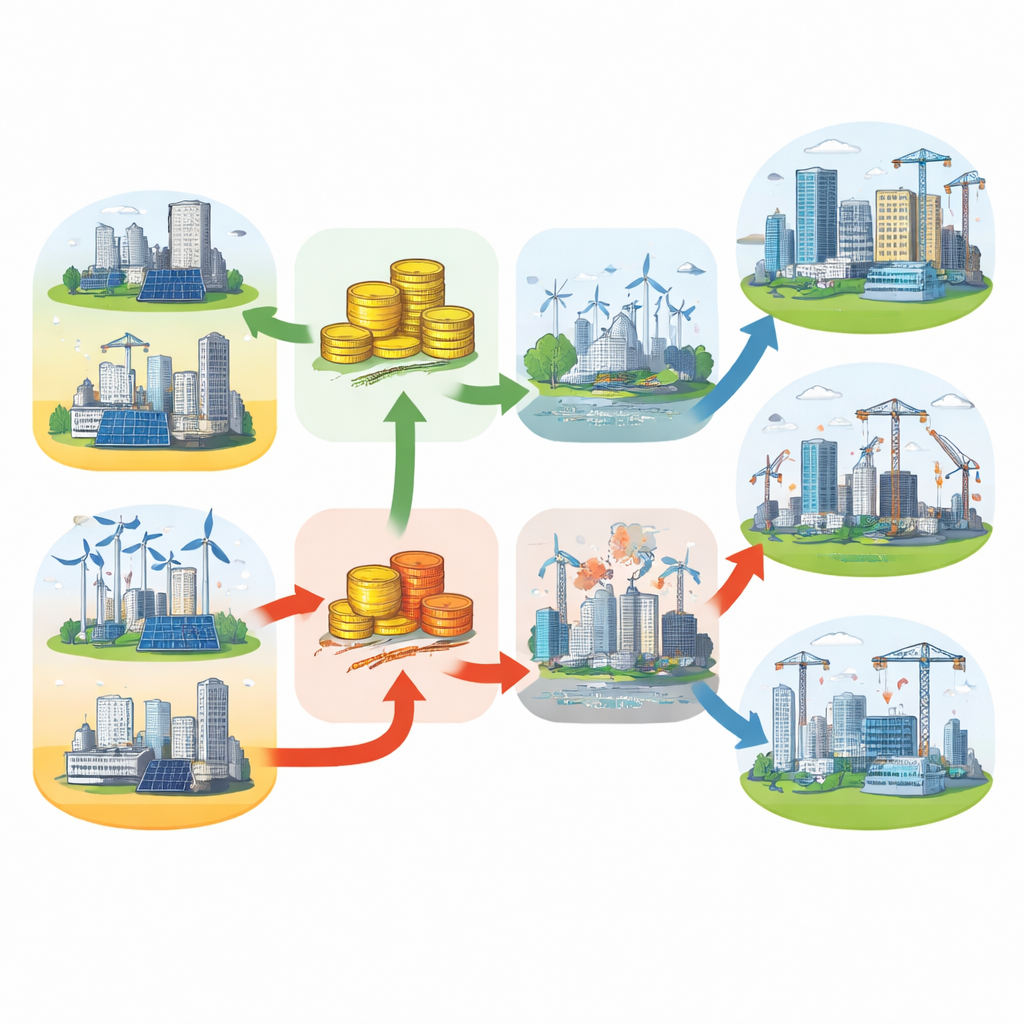
The story changes as renewable technology gets cheaper. The authors show that if the cost of renewable electricity falls by roughly one‑fifth from recent levels—a trend already underway in Korea’s market—then the welfare loss from a renewable‑heavy plan essentially disappears. In other words, renewables are on track to become an economically neutral or even attractive choice, once their price advantage catches up to their safety and environmental strengths. At the same time, the model highlights a different, less visible threat: uncertainty itself. When companies cannot trust that today’s energy plan will survive the next election, they postpone long‑lived investments. In the simulations, spikes in policy uncertainty reduce output and consumption, not because any single mix is disastrous, but because the rules of the game keep changing.
What this means for people and policymakers
For a lay reader, the central message is that both nuclear and renewables can support a prosperous, low‑carbon future, but they do so through different trade‑offs. Today, nuclear power in South Korea delivers clear economic gains thanks to its low running costs, and the expected cost of rare disasters is not large enough to overturn that benefit under realistic assumptions. Renewables still look expensive in the short run, yet rapidly falling prices mean that handicap is likely to fade. The factor that reliably harms social welfare is not choosing one clean technology over the other, but allowing energy policy to swing unpredictably. Stable, transparent, and science‑based decisions about the pace and direction of the energy transition, the authors argue, will do more for everyday well‑being than any single dramatic move either for or against nuclear power.
Citation: Jeong, M., Chu, Z. & Ahn, K. The impact of nuclear energy on social welfare and the future of renewable energy: episode from South Korea. Humanit Soc Sci Commun 13, 302 (2026). https://doi.org/10.1057/s41599-026-06632-2
Keywords: nuclear energy policy, renewable energy transition, South Korea electricity mix, energy policy uncertainty, social welfare impacts