Clear Sky Science · en
Digital infrastructure construction and urban inflow of high-skilled talents: evidence from China
Why Better Digital Connections Shape Where People Live and Work
As our phones, laptops, and online services become central to daily life, the invisible networks behind them quietly reshape cities. This study asks a simple but important question: can stronger mobile networks help cities attract highly educated workers—the engineers, researchers, and professionals who power innovation? Focusing on hundreds of Chinese cities and their 4G base stations, the authors show that digital infrastructure is not just about faster downloads. It changes where skilled people choose to move, how cities grow, and who benefits most from the digital age.

How the Study Measured the Pull of Connected Cities
To find out whether digital networks draw in high-skilled workers, the researchers built a detailed dataset for 269 Chinese cities from 2011 to 2018. They counted each city’s 4G mobile base stations as a concrete sign of its digital infrastructure. Then they used a large national survey of migrants to estimate how many highly educated people—those with at least an associate degree—moved into each city every year. They combined this with information on wages, housing prices, hospitals, universities, public spending, and economic output, allowing them to separate the effect of digital networks from other factors that might lure people in.
Digital Signals and the Movement of Talent
The analysis shows a clear pattern: cities with more 4G base stations attract more high-skilled migrants. After carefully controlling for other city traits and using advanced statistical tools to handle cause-and-effect issues, the authors find that adding more base stations per thousand residents leads to noticeable growth in the inflow of skilled workers. This result holds even when they test alternative measures of digital infrastructure, change the statistical model, account for national broadband policies, or redefine what counts as “high-skilled.” In short, the pull of digital connectivity is real, not a statistical mirage.
Why Strong Networks Make Cities More Appealing
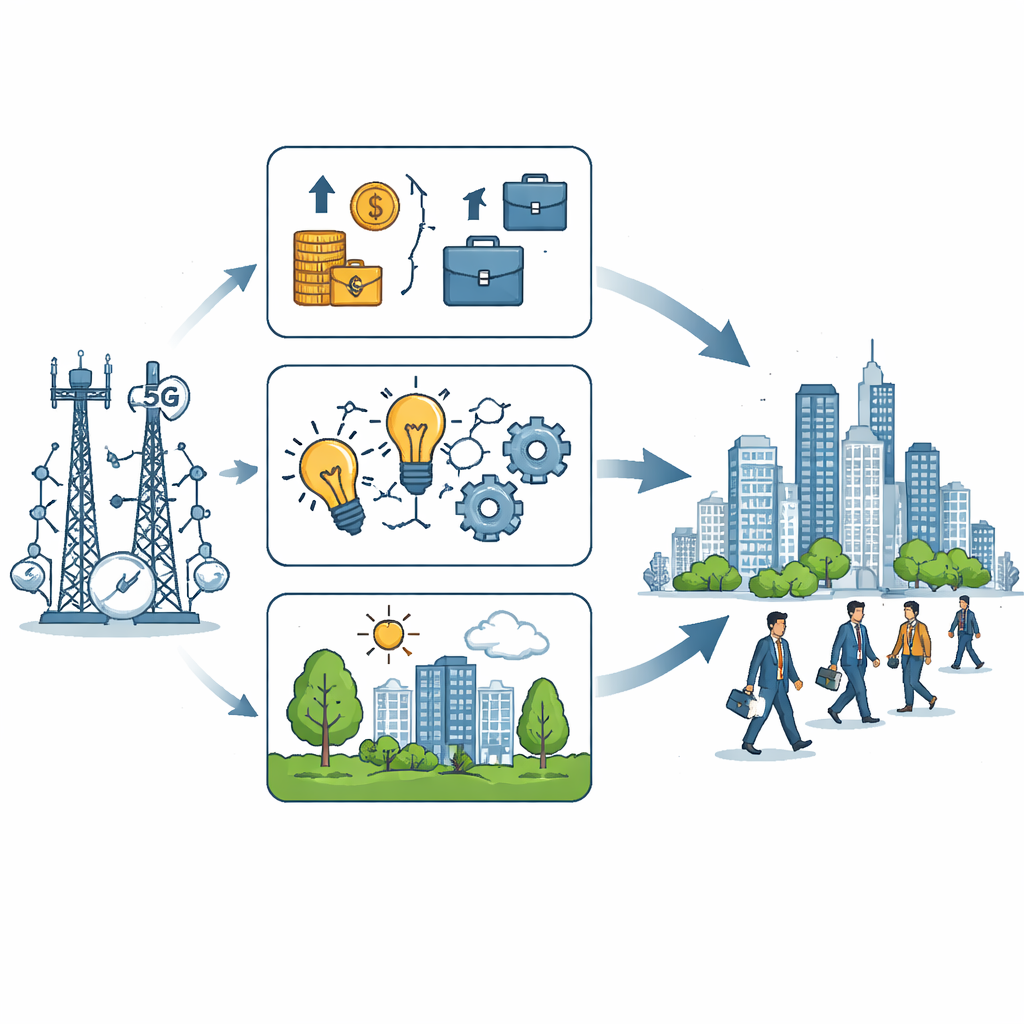
The study then looks inside the black box to see how digital infrastructure changes life in cities. One route is money: better networks improve access to information and online platforms, raising productivity and bargaining power for educated workers, while also fueling new digital industries and start-ups. This creates more high-end jobs and higher incomes, especially for people already near the top of the pay scale. A second route is innovation: fast, reliable networks make it easier for firms, universities, and labs to share data, collaborate across regions, and turn ideas into patents and new products. Cities with stronger digital foundations tend to invest more in research, generate more invention patents, and make better use of their innovation resources.
Digital Life, Daily Comfort, and Uneven Benefits
A third route is quality of life. Digital tools help cities monitor and manage pollution, and the study finds that better-connected cities often have cleaner air. Online services—from mobile payments to telemedicine and smart transport—also make daily life smoother. Survey data show that skilled residents in better-connected cities report higher life satisfaction and greater financial surpluses even after covering moving costs. But these benefits are not spread evenly. Digital infrastructure has the strongest pull in cities with open business environments, strong innovation systems, and dense populations. In these places, new networks reinforce existing strengths. By contrast, less developed or lower-density cities often lack the economic and institutional foundations needed to turn digital signals into real opportunities, so the effect on talent inflows and long-term human capital is much weaker.
What This Means for the Future of Cities
For a general reader, the takeaway is straightforward: fast, reliable digital connections are becoming as important to city growth as roads, railways, and power lines. They help top up paychecks, support new ideas, and make everyday life more livable, all of which matter greatly to highly skilled people deciding where to move. In China’s biggest and most advanced cities, stronger networks both attract and churn talent, but on balance raise the overall level of education and skill. In less developed places, digital upgrades alone are not enough; they need to be paired with better business conditions, innovation support, and traditional infrastructure. As countries grapple with aging populations and slower labor-force growth, this study suggests that building smart, inclusive digital foundations could be one of the most effective ways for cities to compete for the people who drive innovation and long-term prosperity.
Citation: Zou, X., Meng, S. & Liu, C. Digital infrastructure construction and urban inflow of high-skilled talents: evidence from China. Humanit Soc Sci Commun 13, 272 (2026). https://doi.org/10.1057/s41599-026-06590-9
Keywords: digital infrastructure, high-skilled migration, urban development, innovation and talent, China cities